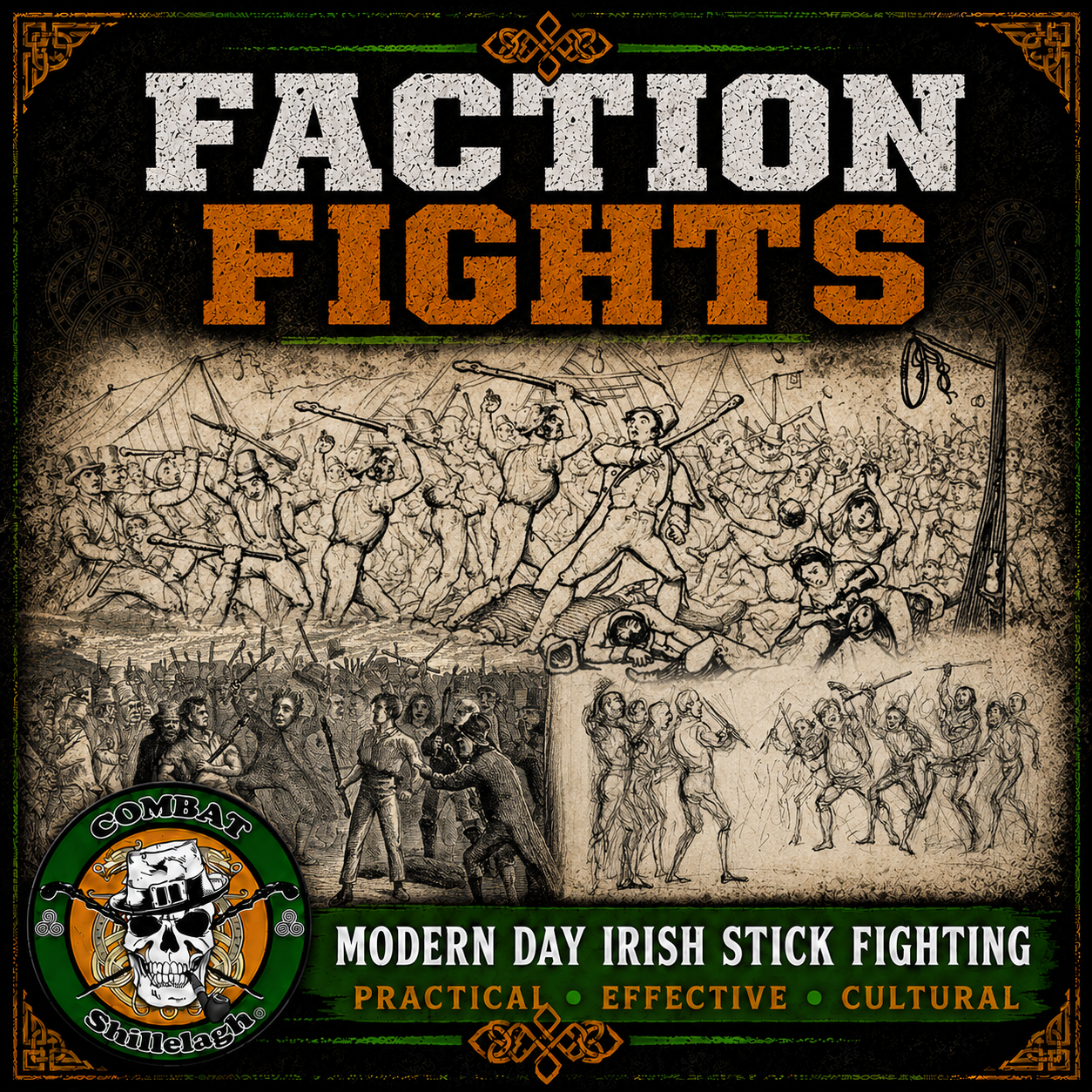
Yes, faction fights in rural Ireland were absolutely connected to Irish Stick Fighting.
In fact, when people start looking into the history of bataireacht, this is one of the first topics that usually comes up. The old stories of Irish faction fights, fairs, market days, family rivalries, village conflicts, and men carrying shillelaghs are all part of the larger cultural picture.
Now, before we go any further, it is important to say something clearly.
We are not trying to bring faction fighting back.
Those days are long gone, and that is a good thing.
Faction fights were often violent, chaotic, and dangerous. They could involve large groups of people, family alliances, local grudges, old rivalries, political tensions, community disputes, and sometimes just too much alcohol mixed with too much pride. These were not friendly martial arts matches. They were not organized sporting contests. They were social conflicts that could turn ugly very quickly.
But if we are going to understand Irish Stick Fighting, we have to understand the world it came from.
In rural Ireland, the shillelagh was more than a walking aid. It was part of daily life. People walked long distances. Roads were rough. Travel could be dangerous. A sturdy walking stick made sense. It helped you move across uneven ground, but it could also help protect you if trouble showed up.
Because of that, the shillelagh was both practical and cultural.
It was something a man might carry without looking out of place. It was useful, common, and socially acceptable. At the same time, in the hands of someone who knew how to use it, it could become a serious defensive tool.
That is where bataireacht enters the conversation.
Bataireacht is the Irish martial tradition connected to the use of the bata, or fighting stick. Different families, regions, and groups had their own methods, preferences, grips, guards, and ways of moving. Like many traditional martial arts, it was not always taught in the same way everywhere. Some of it was formal. Some of it was informal. Some of it was passed down through families, communities, or local fighting culture.
Faction fights created an environment where stick fighting skills mattered.
If your family, townland, or local group had a reputation for fighting, then knowing how to use the shillelagh was not just a hobby. It could be part of how people protected themselves, defended their side, or survived a violent crowd situation.
These fights often took place around public gatherings. Fairs, festivals, markets, weddings, funerals, and political events could all become flashpoints. Large numbers of people were already gathered together. Old disputes could resurface. Rival groups could cross paths. When that happened, the bata could quickly come into play.
Again, this was not pretty or romantic.
It is easy today to look back and turn these stories into folklore or entertainment. But real violence is messy. People got hurt. Families carried grudges. Communities could be divided. The historical connection between faction fighting and Irish Stick Fighting is interesting, but we should not sanitize it or pretend it was some charming old-time Irish pastime.
At the same time, we should not ignore the martial knowledge that came out of that environment.
When people had to deal with real pressure, real distance, real impact, and real consequences, certain lessons became very clear. Footwork mattered. Timing mattered. Knowing when to strike mattered. Knowing how to protect your head mattered. Knowing how to create space mattered. Knowing how to use the bata with one hand or two hands mattered. Knowing how to manage chaos mattered.
Those lessons still matter today.
The faction fights have long since died out, but the practical study of the shillelagh does not have to die with them.
That is one of the reasons I believe Irish Stick Fighting is still relevant. Not because we are preparing for a 19th century rural brawl, but because the core principles of the bata still make sense when viewed through a modern self defense lens.
Distance is still distance.
Timing is still timing.
Footwork is still footwork.
A strong grip, a good guard, the ability to strike with structure, the ability to defend under pressure, and the ability to move with purpose are still valuable skills.
In the Combat Shillelagh system, we look at Irish Stick Fighting as a modern day self defense and combatives method. We respect the cultural roots of bataireacht. We study the history. We appreciate where the art came from. But we are not trying to recreate faction fights, village feuds, or old social violence.
Our focus is practical application for modern students.
That means we train the shillelagh as a defensive tool. We look at how it can be used to create distance, protect yourself, control space, manage pressure, and deal with aggressive movement. We train striking, blocking, footwork, checking, weapon retention, close range control, and the transition between weapon based and empty hand combatives.
We also understand that modern self defense is not about ego.
It is not about proving how tough you are. It is not about looking for trouble. It is not about glorifying violence. It is about being prepared, aware, capable, and responsible.
For me, that is one of the most important differences between studying the history of faction fighting and training Combat Shillelagh today.
The old faction fights were about group conflict, rivalry, and violence between communities.
Modern Irish Stick Fighting should be about personal development, cultural connection, practical skill, and responsible self protection.
The shillelagh still has a place in that conversation.
It is a simple tool. It is deeply connected to Irish identity. It is practical, portable, and historically meaningful. In trained hands, it can teach powerful lessons about movement, structure, distance, timing, and self defense.
So yes, faction fights in rural Ireland were connected to Irish Stick Fighting.
They were part of the environment that shaped the use of the bata and helped keep those skills alive in Irish culture. But those days are over, and they should stay over.
What remains valuable is the art itself.
The history gives us context. The culture gives us connection. The training gives us skill.
And in the Combat Shillelagh system, our goal is to take those lessons and apply them in a way that is practical, responsible, and relevant for the modern world.