Irish Stick Fighting is a practical, weapon-based martial art, so safety has to be taken seriously from the very beginning.
Whether you are training with a traditional shillelagh, a walking stick, a cudgel-length stick, or a homemade training tool, you are still working with an impact weapon. Even light contact can hurt if training is careless. Hard contact without the right controls can cause real injury.
The good news is that Irish Stick Fighting can be trained safely when students use good judgment, proper equipment, controlled speed, and progressive training methods.
In the Combat Shillelagh system, safety is not treated as an afterthought. It is part of the training process. Students are encouraged to develop skill, control, awareness, and responsibility while learning how to use the shillelagh effectively.
Start With the Right Mindset
The first piece of safety equipment is not something you wear. It is your mindset.
Irish Stick Fighting should never be trained with ego. If two students are trying to “win” every drill, prove toughness, or hit harder than necessary, someone is going to get hurt.
A serious martial artist trains with control.
The goal of training is to improve skill, not injure your training partner. That means learning how to move, strike, guard, defend, and respond at a level where both people can continue training over time.
In Combat Shillelagh, the shillelagh is treated as a serious defensive tool. Because of that, students should train with discipline, respect, and awareness of what the weapon can do.
Use Speed as a Safety Valve
One of the best ways to train Irish Stick Fighting safely is to use speed as a safety valve.
This means controlling the speed of the drill based on the purpose of the training and the experience level of the students.
Not every drill needs to be fast. In fact, many drills should begin slowly.
Slow training allows students to understand body mechanics, footwork, angles, distance, timing, grip, recovery, and defensive structure. It gives the brain time to process what is happening. It also reduces the chance that someone will panic, flinch, overreact, or accidentally strike too hard.
As skill improves, speed can gradually increase.
A good rule is simple:
If control breaks down, slow down.
Speed should never be used to cover up poor technique. Speed should be added only after the student can move with proper structure and control.
In practical terms, this means students can train at different speeds depending on the drill:
- Very slow for learning new material
- Moderate speed for partner drills
- Faster speed for controlled pressure testing
- Higher intensity only with proper equipment, rules, and supervision
Speed is one of the most important safety tools in martial arts. You can make a drill safer or more dangerous simply by changing how fast it is performed.
Protective Equipment for Sparring
When students move into sparring or higher-contact training, protective equipment becomes important.
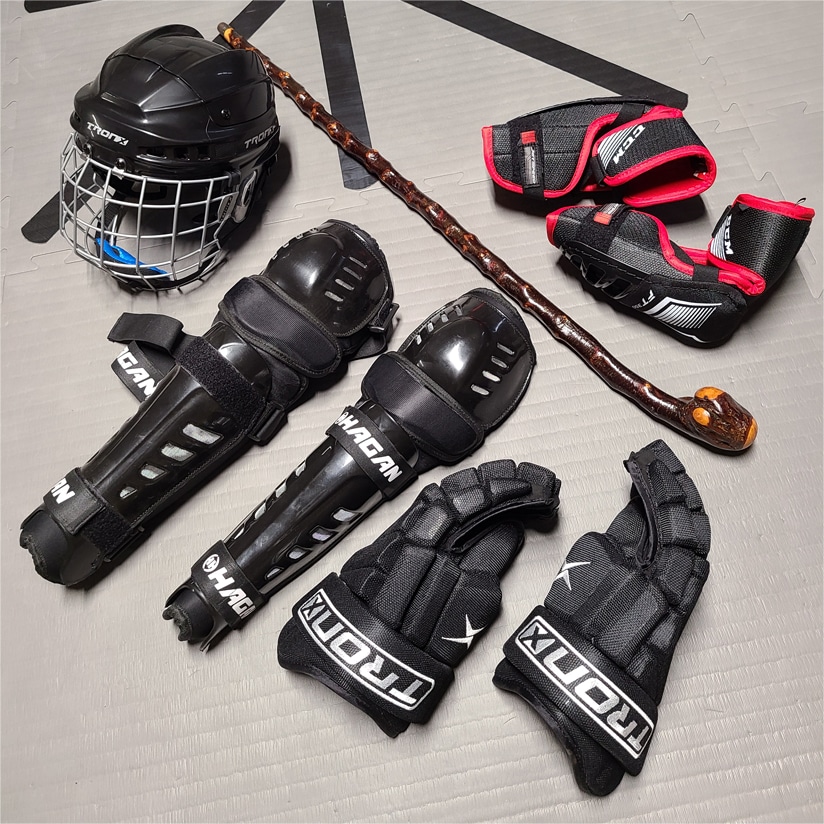
The exact gear depends on the type of training, the level of contact, and the rules being used. There is no single perfect setup for every student or every drill, but several pieces of equipment are very useful for Irish Stick Fighting.
Helmet With Face Guard
A helmet with a face guard is one of the most important pieces of protective equipment for sparring.
The head and face are obvious danger zones in any stick-based martial art. Even a controlled strike can cause injury if it lands on the face, eyes, nose, teeth, or head.
Good options may include:
- Hockey helmet with cage
- Lacrosse helmet
- Fencing or HEMA-style helmet
- Martial arts sparring helmet with face protection
For many students, a hockey helmet with a full face cage is a practical and accessible option. It protects the head while giving enough visibility for movement and sparring.
Hockey Gloves or Padded Gloves
Hands are frequent targets in stick fighting, and they are also easy to injure.
A strike to the fingers, knuckles, thumb, or wrist can quickly end a training session. That is why strong hand protection is important.
Hockey gloves are a good option because they are designed to protect the hands from impact while still allowing grip and movement. Lacrosse gloves may also work well, depending on the level of contact and the type of stick being used.
For Combat Shillelagh training, the gloves should allow you to hold the shillelagh securely while protecting the fingers, knuckles, and wrist.
Elbow Pads
Elbow pads are another useful piece of equipment.
In Irish Stick Fighting, the arms may be exposed during striking, blocking, checking, and close-range movement. The elbows can take accidental contact during partner drills or sparring.
Hockey, lacrosse, or martial arts elbow pads can help reduce injury risk while still allowing natural movement.
Knee and Shin Pads
Footwork is a major part of Irish Stick Fighting. Students move, angle, step, pivot, and adjust distance constantly.
During sparring or partner drills, the legs may also become accidental targets. Shin and knee protection can help protect against low-line contact, missed strikes, bumps, and falls.
Good options include:
- Soccer shin guards
- Hockey shin guards
- Martial arts shin guards
- Knee pads used for volleyball, wrestling, or tactical training
For higher-contact training, stronger shin and knee protection is better.
Forearm Protection
Forearms often take contact in stick training. A student may check, cover, shield, or accidentally receive a strike on the arm.
Forearm guards can be helpful, especially for beginners or during partner drills with contact.
These can include lacrosse arm guards, hockey arm protection, HEMA forearm guards, or other padded protective gear.
Mouthguard
A mouthguard is strongly recommended for sparring.
Even with a helmet and face cage, accidental contact can happen. A mouthguard helps protect the teeth, jaw, and mouth. It is inexpensive, easy to use, and worth having in any contact martial arts training bag.
Groin Protection
For male students, groin protection is a smart addition for partner drills and sparring.
Accidental low contact can happen in any martial art, especially when people are moving dynamically with sticks. A protective cup is a simple way to reduce that risk.
Chest or Rib Protection
For some types of sparring, chest or rib protection may also be useful.
This is especially true if students are working with stronger contact, heavier training sticks, or drills that include body targeting.
Options may include padded martial arts chest protectors, lacrosse rib guards, or other torso protection.
Training Shillelaghs and Safer Practice Tools
Protective equipment is only one side of safe training. The training weapon itself also matters.
A real hardwood shillelagh can cause serious injury. It should be respected as a serious tool, not treated like a toy. For many drills, especially partner drills, beginners should consider using a safer training version of the shillelagh.
Combat Shillelagh provides custom instructions for students on how to make an inexpensive training shillelagh using a dowel rod with a tennis ball on the end.
This is a simple, affordable option for safer practice.
The dowel gives the student the feel of a stick-like training tool, while the tennis ball on the end helps reduce the risk of injury from thrusting, impact, or accidental contact. It is not a perfect replacement for a real shillelagh, but it can be extremely useful for learning movement, distance, angles, targeting, and partner drills at a safer level.
This kind of training tool is especially helpful for:
- Beginners
- Home training
- Partner drills
- Controlled contact drills
- Distance and targeting practice
- Learning mechanics before moving to harder tools
A training shillelagh allows the student to practice more safely while still developing important skills.
Why Training Tools Matter
The tool you choose should match the drill.
If you are learning solo footwork, a real shillelagh may be appropriate. If you are practicing slow movement with a partner, a lighter training stick may be better. If you are sparring, padded or safer training tools may be necessary along with protective equipment.
A serious training progression might look like this:
Start with solo movements using a light stick or training shillelagh.
Move into slow partner drills using controlled speed.
Add protective equipment for contact drills.
Increase speed only when control is maintained.
Use sparring rules that match the experience level of the students.
This kind of progression allows students to build real skill without rushing into unsafe contact.
Control Matters More Than Gear
Protective equipment helps, but gear does not make you invincible.
A helmet does not mean you should hit your partner in the head as hard as possible. Gloves do not mean hand strikes are harmless. Pads reduce risk, but they do not remove risk.
Control is still the most important safety factor.
Good training partners understand this. They communicate clearly, adjust intensity, respect limits, and stop when something feels unsafe.
In Combat Shillelagh, the goal is not reckless impact. The goal is practical skill developed through structured, responsible training.
Train Progressively
Irish Stick Fighting should be trained progressively.
A new student should not immediately jump into full-speed sparring. They need time to learn the basics first.
A safe progression includes:
- Solo movement
- Basic grip and guard work
- Footwork drills
- Striking mechanics
- Slow partner drills
- Controlled defensive drills
- Contact drills with protective gear
- Sparring with agreed rules and intensity
This progression helps students build confidence and ability while reducing the chance of injury.
Communicate With Your Training Partner
Before any partner drill or sparring session, both students should understand the goal of the drill.
Are you working slowly?
Is light contact allowed?
Are head strikes included?
Are hand strikes allowed?
Are thrusts allowed?
Is the drill cooperative or resistant?
What level of intensity is expected?
Clear communication prevents many injuries. Problems often happen when one person thinks the drill is light and technical while the other person thinks it is competitive and hard contact.
Before you begin, agree on the rules.
Safety for Home and Distance Learning Students
Many Combat Shillelagh students train remotely, which makes safety even more important.
If you are training at home, make sure you have enough space. Check the area around you before swinging a stick. Move furniture, pets, children, breakable objects, ceiling fans, lamps, and anything else that could create a hazard.
For home practice, students should start slowly and focus on mechanics. Video review, mirror work, and structured lessons can help students build skill without needing to rush into partner contact.
A homemade training shillelagh with a dowel rod and tennis ball can also be a good option for home training, especially when space is limited or when practicing movements that do not require a hardwood stick.
Safety Equipment Checklist
For Irish Stick Fighting sparring or higher-contact training, useful protective gear may include:
- Helmet with face guard
- Hockey gloves or lacrosse gloves
- Elbow pads
- Forearm guards
- Knee pads
- Shin guards
- Mouthguard
- Groin protection
- Chest or rib protection
- Safer training shillelagh or padded training stick
Not every drill requires every piece of equipment. The more speed, resistance, and contact you add, the more protection you should consider.
Final Answer
For Irish Stick Fighting, you should train with a combination of control, progressive speed, proper protective gear, and safe training tools.
Use speed as a safety valve. Start slowly, build control, and only increase speed when the technique remains safe and clean. For sparring, protective equipment such as hockey gloves, helmets with face guards, knee and shin pads, elbow pads, forearm guards, mouthguards, and groin protection are all good options.
Students can also use a training version of the shillelagh. Combat Shillelagh provides custom instructions for making an inexpensive training tool using a tennis ball on the end of a dowel rod. This gives students a safer way to practice movement, distance, targeting, and partner drills before moving into harder-contact training.
Irish Stick Fighting can be trained safely, but only when students respect the weapon, respect their partners, and use the right combination of control, equipment, and common sense.