
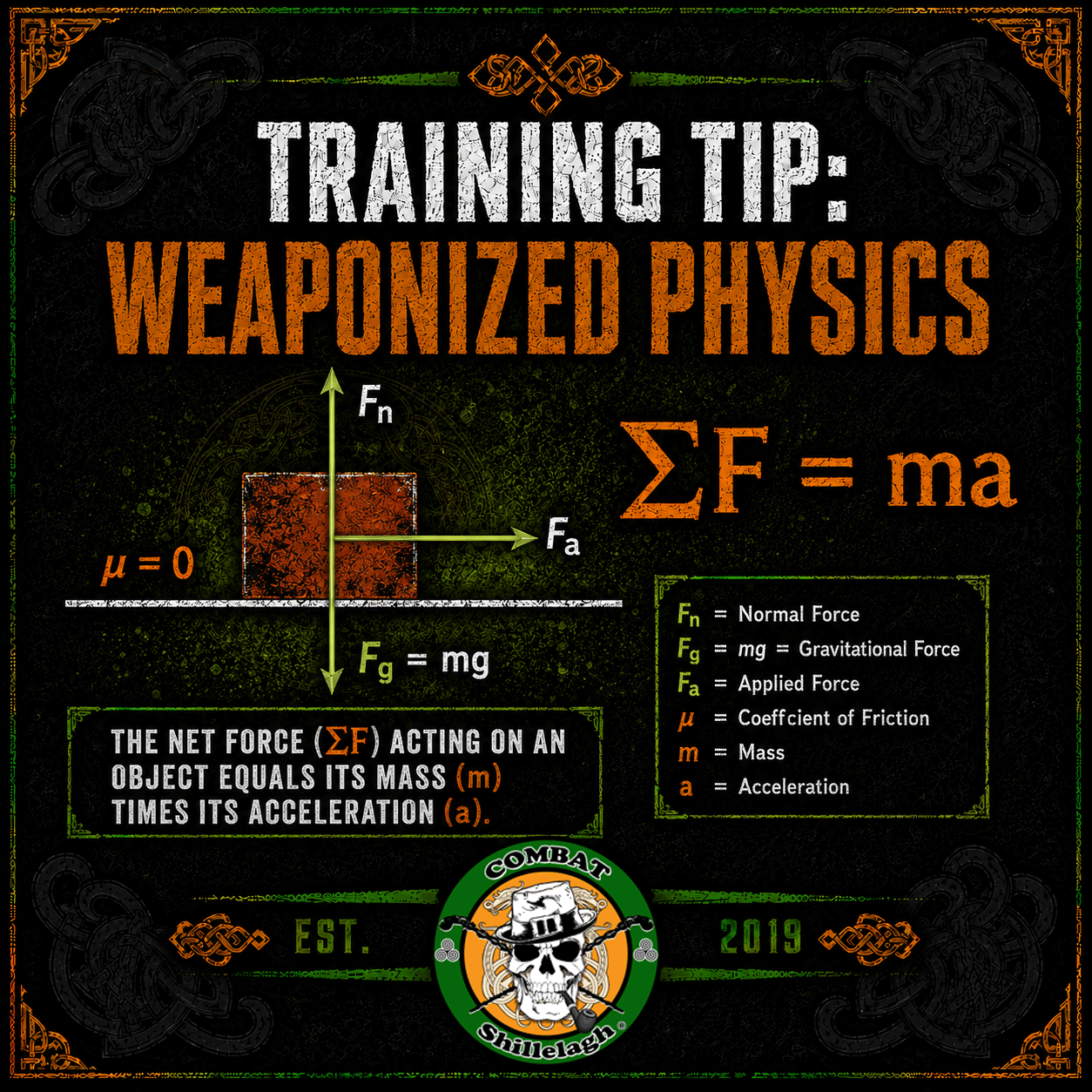
At its most basic level, a shillelagh is a force multiplier. It gives the person holding it additional reach, leverage, mass, and the ability to concentrate force into a relatively small striking surface. That may sound obvious, but once we begin looking more closely at what is happening during a strike, we quickly discover that Irish Stick Fighting is really an applied study of physics. A shillelagh or bata may look like “just a stick,” but the moment we begin moving it with purpose, we are working with concepts such as mass, acceleration, leverage, rotational movement, angles, arcs, vectors, momentum, and force. Good technique allows us to take those principles and organize them into efficient movement. In other words, we are learning to weaponize physics.
One of the simplest places to begin is with Newton’s Second Law of Motion: Force = Mass × Acceleration (F = ma). The important word there is multiply. Increasing mass can increase force, and increasing acceleration can increase force. A traditional shillelagh often has additional mass concentrated toward the knob or striking end. When that mass is accelerated through a strike, it contributes to the amount of force that can be delivered to the target. But that equation is only the beginning of the discussion.
The Shillelagh Is a Lever
One of the reasons a stick is such an effective tool is leverage. Your hand becomes part of the pivoting system, while the length of the weapon extends the movement created by the hand, arm, torso, and body. A relatively small movement near the hand can create a much larger movement at the opposite end of the shillelagh. The farther the striking portion of the weapon travels from the pivot point, the greater the distance it can cover during the same rotational movement.
This is one reason we continually emphasize proper grip, hand position, and understanding where to hold the bata. Moving the hands is not merely a stylistic choice. It changes the mechanical properties of the weapon. A longer effective lever can increase reach and create greater speed at the end of the stick, but it may also require more control. A shorter grip may sacrifice some reach while improving handling at closer range. Neither position is automatically right or wrong. Each changes the physics of the tool and therefore changes what the weapon is best suited to do at that moment.
The Entire Body Creates the Strike
One of the biggest mistakes a beginning student can make is thinking that the arm swings the shillelagh. The arm certainly participates, but powerful and efficient striking involves much more than the shoulder and elbow. This connects directly to our discussions about the kinetic chain.
The feet interact with the ground. The legs help move and stabilize the body. The hips rotate. The torso transfers that movement. The shoulder and arm continue the chain, and finally the hand delivers that energy into the shillelagh. The stick becomes the final link in the system.
If one part of that chain is disconnected, we lose efficiency. If the feet are poorly positioned, the rest of the body has a weaker platform from which to work. If the hips do not contribute, the arm may try to make up the difference. If the shoulder becomes tense, it can slow the movement rather than strengthen it. This is why good body mechanics often produce more force with what appears to be less effort. The student is not necessarily becoming stronger. They are becoming better at organizing the forces already available to them.
Acceleration Matters More Than Muscling the Weapon
Because acceleration contributes directly to force, there is an understandable temptation to think that faster is always better. But speed without structure is not the goal. Trying to muscle the shillelagh through every strike can create excess tension. That tension may actually slow the weapon, disrupt body alignment, and interfere with recovery. Instead, we want the body to accelerate the weapon efficiently while maintaining control.
This is where relaxation becomes important. The body can remain relatively relaxed during much of the movement and then introduce the appropriate amount of structure and tension at the right moment. When students remain tight throughout the entire strike, they are essentially fighting against their own movement. Efficient acceleration comes from coordinated motion rather than brute force.
Arcs, Angles, and Vectors
A shillelagh rarely travels in a perfectly straight line. Many strikes follow arcs created by the rotation of the body and weapon. Understanding those arcs helps us think more intelligently about where the stick travels, where maximum speed develops, and where the weapon is likely to continue after contact. This also connects directly to our 9 Gates and striking-angle concepts.
Every strike has direction. In physics, a force that includes both magnitude and direction can be represented as a vector. We do not need to perform mathematical calculations during training, but thinking in terms of direction is extremely useful. Where is the force going? Where is the opponent’s structure strongest? Where is it weakest? Are we striking directly into their strongest line of resistance, or are we applying force at an angle that makes their structure easier to disrupt? These questions become even more important when we move beyond striking and begin using the shillelagh for controlling, framing, levering, and manipulating structure.
Leverage Changes the Game at Close Range
The physics of the shillelagh do not disappear when the distance closes. At longer range, we often think about acceleration and impact. At closer range, leverage can become increasingly important.
A stick placed against part of the body can function as a lever. Small movements at one end may produce significant pressure somewhere else. The weapon can help us control a limb, influence posture, create frames, redirect movement, or disrupt balance. This is where a student begins realizing that the bata is not simply something used to hit another person. It is a mechanical tool. Its usefulness depends upon how intelligently we apply it.
Structure Determines Whether Physics Works for You or Against You
Physics is always present whether our technique is good or bad. If you overextend during a strike, physics will still apply. The problem is that it may now be working against your balance. If your arms move outside your Body Envelope, the mass of the shillelagh can pull your structure farther away from your base. If your spine becomes badly misaligned, the force you generate may no longer travel efficiently through the body. If you lean forward to gain a few extra inches of range instead of moving your feet, the momentum of your own strike may make recovery more difficult.
This is why our discussions about body alignment, footwork, the Body Envelope, range, and kinetic chain are all connected to weaponized physics. They are different ways of teaching the body to manage forces efficiently. We want to create force without allowing that same force to destroy our own structure.
Momentum and Recovery
Another important concept is momentum. Once the shillelagh is moving, it tends to continue moving. That can be useful when linking strikes together, but it can also become a liability if we allow the weapon to pull us into poor positions.
Every strike therefore has two problems to solve: how to create useful movement and how to manage what happens after that movement. Recovery matters. A hard strike that leaves you off balance, overextended, or unable to defend may not be a particularly good strike. A slightly less dramatic strike that allows you to immediately move, defend, change direction, or deliver another attack may be far more useful. The goal is not simply maximum force. The goal is appropriate force combined with control.
Physics Helps Explain Why Technique Matters
One of the values of looking at martial arts through the lens of physics is that it removes some of the mystery. Good technique is not magic. When an experienced practitioner appears to generate surprising power without obvious muscular effort, there are mechanical reasons for it. Their body is aligned. Their timing is better. Their kinetic chain is coordinated. Their leverage is appropriate. Their weapon is traveling through an efficient arc. They are accelerating the correct mass in the correct direction at the correct time.
What sometimes looks effortless is often the result of very efficient mechanics. This is also why small details matter so much. A few degrees of difference in an angle can change how force travels. A slight change in grip can alter leverage. A poorly positioned foot can interfere with rotation. Excessive tension can reduce acceleration. The details influence the physics.
From Technician to Martial Artist
Early in training, students naturally focus on technique. Hold the shillelagh this way. Move the foot here. Strike along this line. Recover to this position. That structure is necessary. But eventually, we want students to understand the principles underneath those movements.
Once you understand leverage, you begin seeing levering opportunities that were never presented as formal techniques. Once you understand angles, you begin finding better lines of attack and defense. Once you understand range, you begin manipulating distance rather than simply standing at it. Once you understand momentum and arcs, combinations begin flowing more naturally. This is where the art begins to open up.
The bata has not changed. Your understanding of it has.
That transition is important because we do not want to produce students who can only reproduce memorized movements. We want practitioners who understand why those movements work and can adapt those principles to changing situations. A shillelagh may be a simple piece of wood, but simplicity does not mean limitation. In trained hands, it can strike, defend, control, redirect, frame, lever, manipulate, and disrupt.
What makes those possibilities work is not magic and not mythology. It is mechanics. It is timing. It is structure. It is leverage. It is movement. And underneath all of those things is physics.
When we study Irish Stick Fighting, we are learning how to take those fundamental laws and put them to practical use. We are learning how to generate force efficiently, how to direct it intelligently, and how to preserve our own structure while disrupting someone else’s. That is what we mean when we talk about weaponizing physics.