
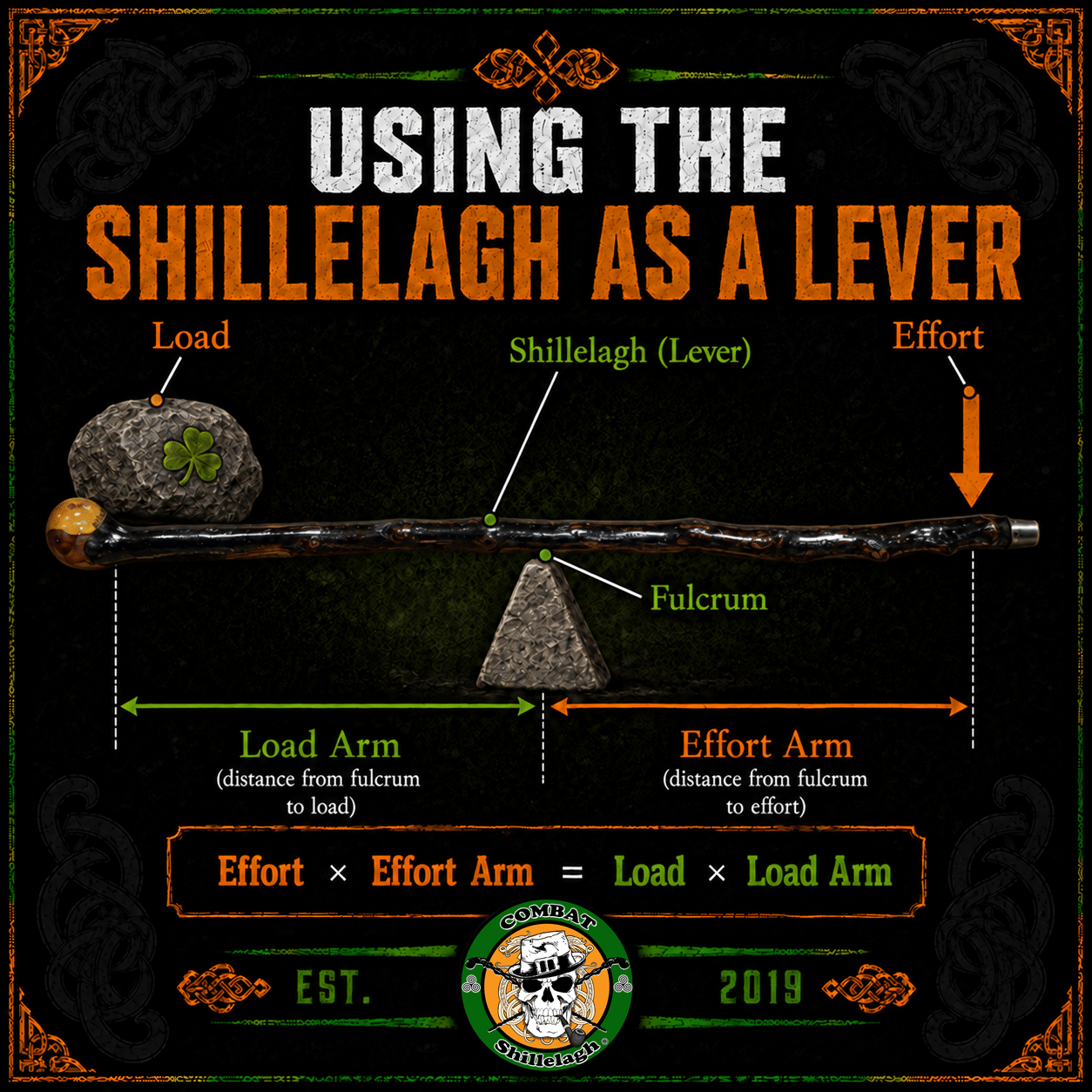
Most students initially think of the shillelagh as a striking weapon. That makes perfect sense. The most obvious use of a three-foot piece of hardwood is to swing it and hit something. As training progresses, students usually become equally comfortable using the shillelagh defensively for blocks, parries, and interceptions. In many ways, even a block can be understood as a type of strike directed against an incoming weapon. But the shillelagh becomes much more interesting when you stop thinking about it only as something used to strike and begin thinking about it as a lever.
We all remember Archimedes, right? The basic principle of leverage is simple. A lever allows us to use mechanical advantage to move or manipulate something with greater force than we could easily produce through muscular strength alone. When used appropriately, the shillelagh is essentially one long lever that you happen to be holding in your hands.
This changes the way you begin looking at the weapon. Instead of asking only, “How can I strike with this?” you start asking, “How can I use the length of this weapon to create mechanical advantage?”
Understanding the Parts of the Lever
A basic lever contains several important components: the beam, the fulcrum, the load, and the effort. When we apply those concepts to the shillelagh, the relationship becomes fairly easy to understand. The beam is the shillelagh itself. The fulcrum is the pivot point or point of contact. The load is whatever you are attempting to move or manipulate, and the **effort is the force you apply through your hands and body.
That force might involve pushing, pulling, rotating, turning, or combining several movements together. The important point is that you are no longer relying exclusively on the strength of your arms. You are using the length of the shillelagh to amplify the effect of your movement.
This is one of the reasons that proper body mechanics remain so important. The stick does not create leverage by itself. You still need structure, alignment, footwork, positioning, and coordinated body movement. The weapon simply gives you a mechanical tool that can amplify what your body is already doing.
From Striking to Body Manipulation
As students progress into more advanced material, the shillelagh increasingly becomes a tool for body manipulation and positional control. Once contact has been established, the length of the weapon can provide tremendous mechanical advantage.
For example, one portion of the shillelagh may establish a contact or pivot point while force is applied through another portion of the weapon. Instead of trying to move an opponent through strength alone, you are using leverage to influence their structure, posture, balance, or position.
You can see this principle appearing in higher-level material such as the Level III Stanzas commonly referred to as “Crushing the Hip” and “Breaking the Elbow.” The individual technique is less important than understanding the principle underneath it. What matters is recognizing that the weapon is being used as a lever against a particular structure.
That understanding is much more valuable than simply memorizing where to put your hands.
If you understand why the leverage works, you can begin recognizing the same mechanical principle in other positions.
Leverage Works Both Ways
One of the fascinating things about leverage is that the relationship between the fulcrum, load, and effort can change depending on what you are trying to accomplish. The shillelagh does not always need to be positioned in exactly the same way.
This becomes especially noticeable when you begin studying weapon control and disarming concepts. In those situations, the other person’s grip on a weapon can effectively become part of the pivot point. Instead of trying to overpower their hands directly, the length of the weapon allows rotational pressure to be applied through a much larger mechanical advantage.
Again, the principle matters more than any individual technique.
Trying to win a strength contest against someone’s grip is usually inefficient. Using leverage allows you to approach the same problem through mechanics instead of relying entirely on strength.
This is an important distinction within principle-based training. When something requires enormous muscular effort to accomplish, it is often worth asking whether your structure, angle, positioning, or leverage could be improved.
The Longer the Lever, the Greater the Possibilities
The length of the shillelagh is one of its greatest mechanical advantages. A three-foot weapon gives you a considerable amount of space through which to apply force. Where you place your hands, where contact occurs, and where the pivot point develops can dramatically change the effect you create.
This connects directly to our discussions about dynamic hand positioning. Your hands should not remain permanently fixed to one location on the shaft. Sliding, shifting, and changing hand positions can alter the effective length of your lever and change the amount of mechanical advantage available to you.
Your footwork changes the relationship even further. Step to a different angle and the lever changes. Rotate your body and the direction of force changes. Move your hands and the effective length changes. Shift the contact point and you may create an entirely different mechanical relationship. This is why advanced stick work begins looking much less like simply swinging a weapon. The shillelagh becomes a tool for manipulating force.
Stop Thinking of the Shillelagh as Just a Stick
There is a much larger lesson here. The more advanced your training becomes, the less useful it is to think about the shillelagh simply as something used for hitting. It can strike. It can block. It can intercept. It can create frames. It can redirect force. It can control space. It can manipulate structure. And, when the circumstances allow it, it can function as a powerful lever.
Once you start looking at the weapon this way, many advanced movements begin making much more sense. Instead of memorizing a collection of unrelated techniques, you begin recognizing a common mechanical principle appearing again and again.
That is exactly what we want from principle-based instruction.
Do not simply learn where the shillelagh goes. Understand why placing it there works. Understand where the pivot point is. Understand what represents the load. Understand where your effort is being applied and how the length of the weapon magnifies that effort.
Once you understand those relationships, the shillelagh stops being simply a three-foot striking weapon in your hands. It becomes a lever, and that opens up an entirely different way of understanding what the weapon can do.