Irish Stick Fighting is a weapon-based martial art. That reality should shape the way we train from the beginning. A shillelagh, bata, cudgel, or even a simple wooden training stick can generate significant force, and many of the methods we practice involve striking, controlling limbs, manipulating joints, disrupting balance, throwing, and working at close range. Good training therefore requires more than enthusiasm. It requires a deliberate approach to safety that allows us to practice realistically without needlessly injuring the people we rely on as training partners.
For us, safe training is built around three major ideas: controlling speed, using appropriate protective equipment, and selecting the right training weapon for the level of intensity being practiced. None of these ideas exist independently. They work together to create an environment where students can explore the system, pressure-test concepts, and gradually increase intensity while still maintaining control.
Speed Is the Primary Safety Valve
The most important safety tool we have is also the simplest: speed.
Almost everything in our Irish Stick Fighting system can be practiced safely if it is done slowly enough and with proper control. Can you practice hitting another person with the bata? Yes, provided the movement is controlled and the contact is appropriate for the drill. Can you practice joint manipulations, takedowns, throws, close-range controls, and ground skills? Absolutely, but the pace has to match the level of risk involved.
Slowing down is not a lesser form of training. In many cases, it is better training.
When students move too quickly before they understand the mechanics, they often compensate with tension, strength, momentum, or guesswork. They may technically complete the movement, but they are not necessarily learning the underlying principle. Slower practice gives us time to understand body mechanics, posture, range, timing, angles, balance, and the relationship between our own structure and that of our training partner.
This connects directly to many of the concepts we discuss elsewhere in Combat Shillelagh. Body alignment is easier to evaluate when the movement is slow enough to observe. The Body Envelope is easier to maintain when the student is not chasing speed. The kinetic chain can be developed correctly when the student has time to feel how the feet, hips, torso, arm, and shillelagh work together. Footwork becomes deliberate rather than frantic.
There is also an important practical benefit. In a real violent encounter, speed will usually increase on its own. Stress, adrenaline, fear, and urgency naturally accelerate movement. We do not need to manufacture that speed prematurely during every training session. What we need to build first are reliable movement patterns. If the mechanics have been practiced carefully and correctly, those patterns have a better chance of surviving when the pace increases.
A useful rule is simple: increase speed only after you have demonstrated control. If control disappears as speed increases, slow the drill back down.
Protective Equipment Allows Us to Increase Intensity
At some point, however, we do want to move faster. We want to experience timing, distance, resistance, pressure, and the reality of trying to land a strike against someone who is moving. That is where protective equipment becomes essential.
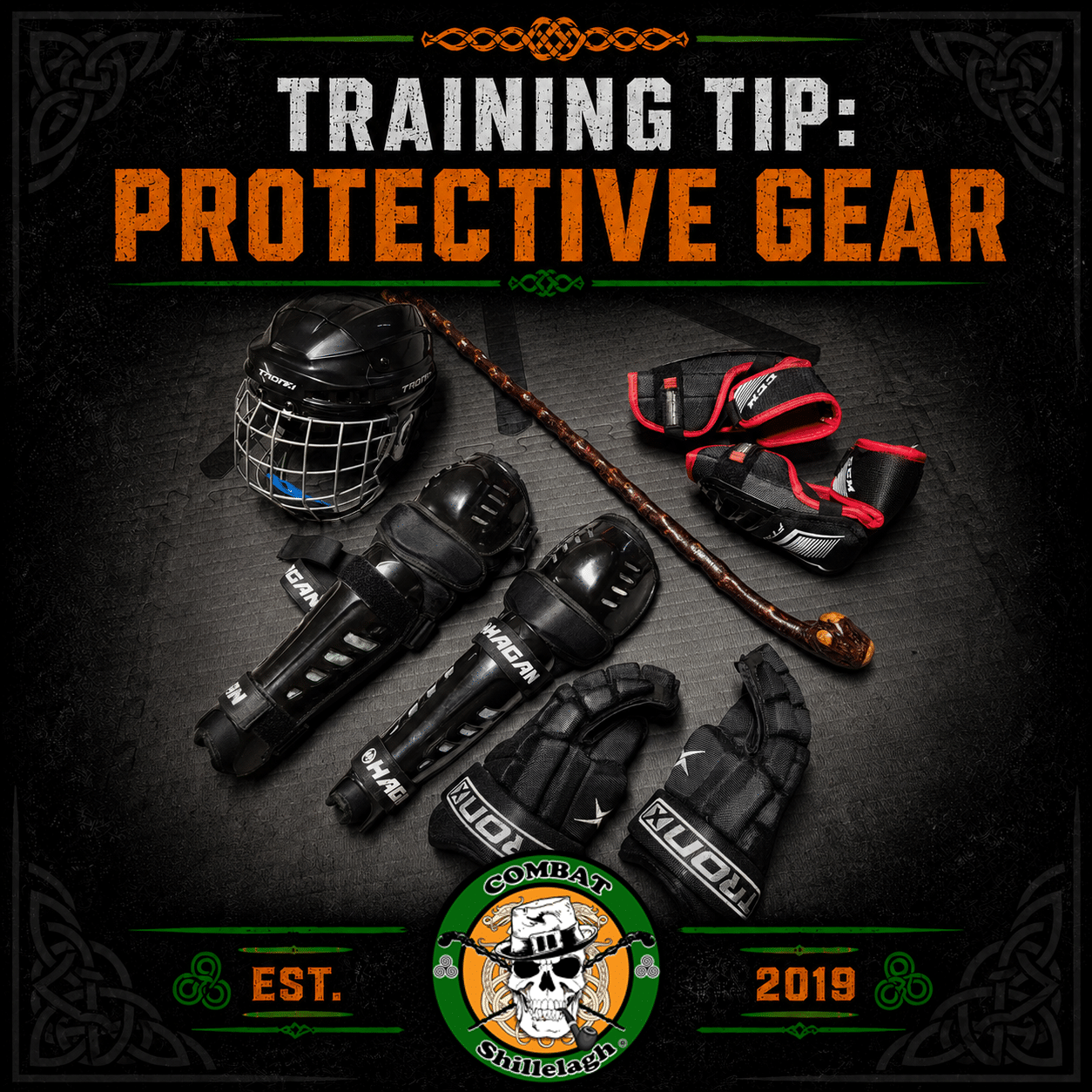
For Irish Stick Fighting, hockey equipment works extremely well because it is specifically designed to protect the body from impact while still allowing mobility. A helmet with a full face cage should be one of the first pieces of equipment considered when students begin making meaningful contact. The face, eyes, teeth, and head are not areas where we should casually accept unnecessary risk.
Hockey gloves are also extremely valuable. The hands are exposed during weapon training, and even a relatively light strike to the fingers or knuckles can end a training session quickly. Gloves provide protection while still allowing the practitioner to maintain a functional grip on the shillelagh.
Forearm and elbow protection are equally useful, particularly during drills where strikes may be intercepted or where the arms become targets. Knee and shin protection can also be added as intensity increases. The exact equipment can vary depending on the drill, but the principle should remain consistent: the faster and harder the training becomes, the more protection we should introduce.
You do not need the most expensive equipment available. Used sporting-goods stores, secondhand shops, online marketplaces, and inexpensive brands can provide perfectly functional protective gear. The objective is not to look like a professional hockey player. The objective is to protect the parts of the body most likely to be injured during contact training.
The important thing is not simply owning protective gear but understanding what it does and does not allow. Putting on a helmet does not give someone permission to swing recklessly. Gloves do not make the hands indestructible. Protective equipment increases our margin for error; it does not eliminate the need for control.
Use the Right Training Shillelagh
The third major component is the weapon itself.
There is something special about training with an authentic shillelagh. The shape, balance, grip, and natural characteristics of the wood are part of the experience of learning Irish Stick Fighting. A well-made wooden training shillelagh can also be an excellent tool for solo practice, technical drills, and controlled partner work.
But a solid piece of wood is still a solid piece of wood.
When we begin increasing speed or making contact with a partner, it often makes sense to use a safer trainer. Fortunately, creating a basic training shillelagh does not have to be expensive or complicated. One of the simplest versions uses a one-inch wooden dowel, a tennis ball, and hockey tape. The dowel provides the basic length and structure of the weapon, while the tennis ball helps create a safer striking end and the hockey tape secures the trainer while improving grip. We have instructions on our Youtube Channel (https://youtu.be/AC07Nbgi398)
It may not last forever. It does not have to. A training weapon is a piece of equipment. If you spend relatively little money building one, use it repeatedly, and eventually wear it out, then it has done its job. Make another one and keep training.
The larger point is that students should match the weapon to the drill. There is no reason to use the hardest possible weapon simply because it feels more authentic. If you are learning a new partner drill, a safer trainer allows you to concentrate on movement without worrying that a small mistake will seriously injure someone. As skill and control improve, other training tools can be introduced where appropriate.
Safety Should Change With the Drill
One mistake students sometimes make is thinking of training as either “safe” or “realistic,” as though those two goals are always in conflict. They are not. Good martial arts training adjusts the variables depending on what we are trying to learn.
If the objective is technical understanding, slow the movement down.
If the objective is improving timing, increase the speed but reduce the contact.
If the objective is learning what it feels like to make meaningful contact, add protective equipment and use an appropriate trainer.
If the objective is testing a technique against resistance, introduce resistance gradually rather than jumping immediately to an all-out struggle.
We can adjust speed, contact, resistance, protective equipment, weapon type, and complexity independently. That gives us an enormous number of ways to train the same concept without turning every drill into a fight.
This is particularly important in a weapon-based system. The consequences of poor judgment are higher when a stick is involved. A training partner is not an obstacle standing between you and victory. They are the person making it possible for you to develop your skill. Protecting them is part of being a good martial artist.
Train for Longevity
The purpose of training is to become better over time. That becomes difficult if students are constantly injured.
There is sometimes a temptation in martial arts to treat unnecessary injuries as evidence of toughness or realistic training. In reality, frequently injuring your hands, head, elbows, knees, or training partners usually means less training, not more. An injury that keeps someone off the mats for six weeks does nothing to improve their Irish Stick Fighting.
We want students to develop power, confidence, timing, resilience, and the ability to function under pressure. We also want them to be able to come back and train tomorrow.
That requires judgment.
Train slowly enough to learn. Wear protective equipment when the intensity demands it. Use a training shillelagh appropriate to the drill. Increase resistance and speed gradually. Communicate with your training partners, and remember that control is a skill in its own right.
Irish Stick Fighting deals with serious subject matter. We are studying a weapon and learning methods intended to function under difficult circumstances. Precisely because of that, our training should be intelligent rather than reckless.
Train with purpose. Train with control. Protect your partners. Build the skill today that you will still be able to practice years from now.