When most people first see a shillelagh, they think of an Irish walking stick. They may picture an old gentleman strolling down a country road, a blackthorn stick resting comfortably in his hand.
That image is not necessarily wrong, but it is incomplete.
The shillelagh occupies a fascinating place between ordinary tool, cultural symbol and practical weapon. It could support a traveler on a long road, help someone negotiate rough terrain and serve as a visible expression of Irish identity. When circumstances demanded it, that same stick could also become an effective instrument of personal defense.
This dual purpose is one reason the shillelagh became so deeply embedded in Irish history and folk music. It was familiar enough to appear harmless, yet formidable enough that everyone understood what it could do.
A Walking Stick in an Age of Restriction
Following the political and military upheavals of the seventeenth century, a collection of restrictions known collectively as the Penal Laws was imposed upon Irish Catholics. These laws did not arrive all at once, nor were they enforced with equal severity in every place or period. Together, however, they restricted Catholic participation in political life, land ownership, education, military service and numerous professions. Catholics were also prohibited from possessing firearms and various weapons of offense or defense.
This is the environment in which the cultural importance of the shillelagh must be understood.
It is tempting to say that Irish people simply disguised forbidden weapons as walking sticks. The historical reality is more complicated. There was no single Penal Law declaring that a blackthorn stick was an officially approved substitute for a sword. Nevertheless, a stout walking stick occupied a practical gray area. It was an ordinary object that could be carried for legitimate daily use, but it could also be employed with considerable force.
That made the shillelagh a form of hidden capability.
The weapon was not hidden because nobody could see it. It was hidden in plain sight because its purpose depended upon the knowledge, intention and training of the person carrying it. To an observer, it was a walking aid. To a trained practitioner, it could be a striking weapon, a lever, a shield, a means of controlling distance and a way to defend against another armed person.
The shillelagh was therefore not merely a primitive club. It was a socially acceptable object that could preserve a measure of defensive readiness during periods when openly carrying a sword, pistol or military weapon could bring unwanted attention.
Blackthorn Was More Than a Convenient Branch
Blackthorn became closely associated with the shillelagh because it produces dense, resilient wood and frequently grows in naturally useful shapes. A suitable piece could be selected, cut, seasoned and worked into a durable stick with a substantial gripping or striking end.
The key word is seasoned.
A proper fighting stick was not normally a green twig casually broken from a hedge five minutes before a confrontation. Freshly cut wood contains moisture. As it dries, it can shrink, crack, warp or become unreliable. Preparing a quality shillelagh traditionally required patience. The maker selected the right growth, allowed it to cure and shaped it into a balanced implement.
That distinction becomes important when we encounter expressions such as “a sprig of shillelagh” in Irish songs. Modern listeners may imagine a tiny decorative branch, like a sprig of parsley placed beside a meal.
That is not what the phrase is communicating.
Within the language of the song, the “sprig” is an affectionate or playful term for a finished stick. It refers to a seasoned, serviceable implement carried with confidence. The phrase makes the weapon sound lighthearted, but the audience would have understood the underlying meaning.
Ireland’s Soundtrack of Defiance
Irish folk music often preserved ideas that official histories overlooked.
Songs traveled through families, public houses, military camps, fairs, political gatherings and immigrant communities. They carried warnings, jokes, memories and coded expressions of resistance. A singer could entertain a room while also telling a story about poverty, forced recruitment, emigration, political control or an ordinary person refusing to be intimidated.
Within these songs, the shillelagh rarely appears as a museum artifact. It is carried, inherited, raised, swung and used.
Sometimes it represents self-defense. Sometimes it signals that a fight has begun. Sometimes it is an heirloom connecting an immigrant family to Ireland. In other songs, it becomes a symbol of the common man standing against soldiers, bullies or hostile crowds.
The following five songs provide a useful introduction to the shillelagh’s place in Irish musical culture.
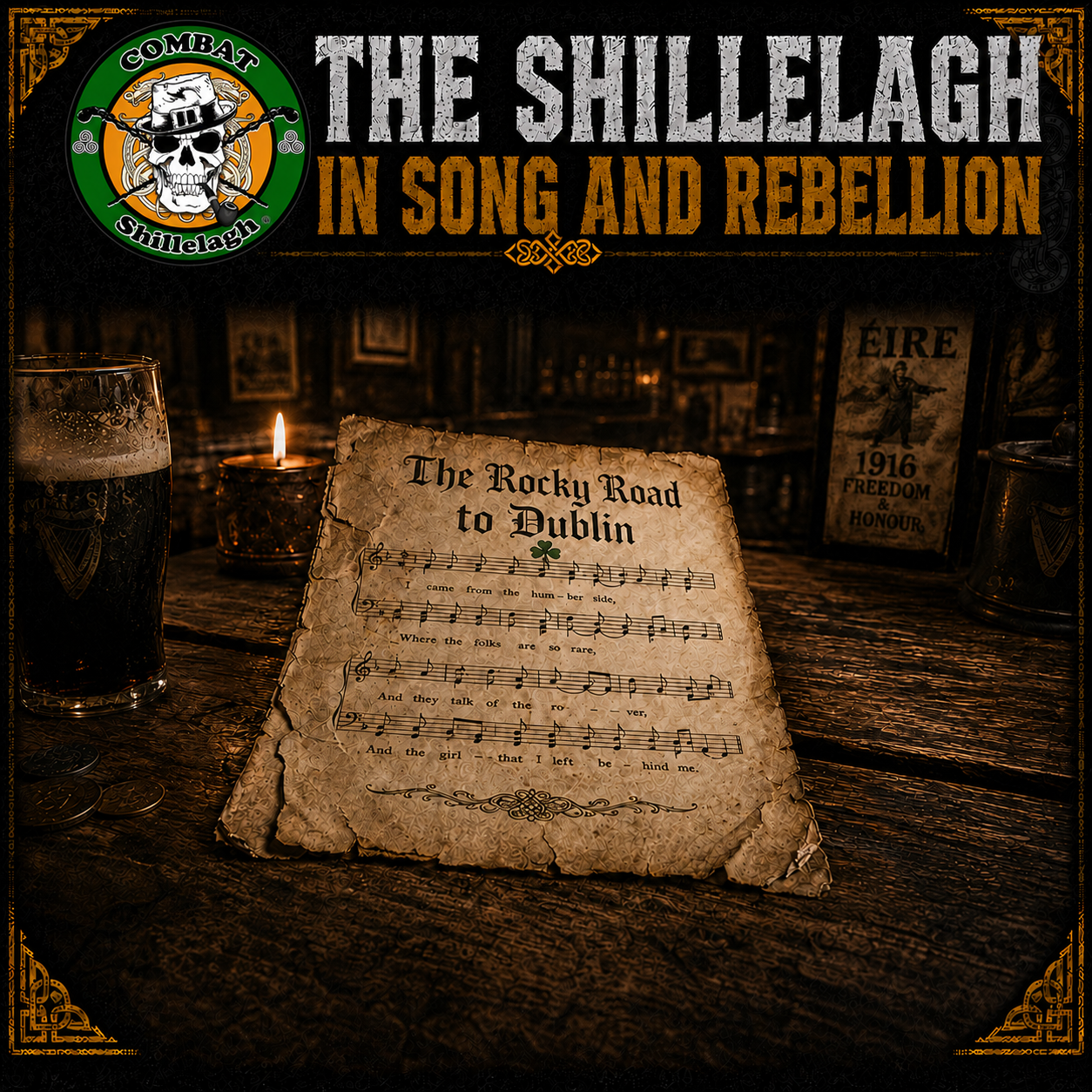
1. The Rocky Road to Dublin
“The Rocky Road to Dublin” follows a young Irish traveler leaving his home, passing through Dublin and eventually arriving in Liverpool. Early in the journey, he cuts a stout piece of blackthorn to help carry his bundle. Later, when he is mocked and attacked in Liverpool, the same stick becomes his means of fighting back.
The song is particularly valuable because it illustrates the shillelagh’s dual purpose. It begins as travel equipment. It helps the narrator carry his possessions and supports him on the road. When the situation changes, it becomes a defensive weapon.
Tactical meaning: The blackthorn is not simply a decorative badge of Irishness. It is a portable tool that allows the traveler to manage weight, maintain balance and respond immediately when surrounded. The moment in which he lets the shillelagh fly suggests a committed counterattack intended to break the momentum of multiple aggressors, not a polite exchange of single strikes.
The song also expresses something central to practical stick fighting: the environment determines the application. The same object used calmly during travel can be brought into action without changing equipment or drawing a separate weapon.
2. Arthur McBride
“Arthur McBride” is an anti-recruitment song in which two Irishmen encounter a British Army recruiting party. The recruiters attempt to tempt them with promises of money, uniforms and adventure. Arthur and his companion reject the offer, ridicule the soldiers and eventually defeat them in a physical confrontation.
Versions of the song describe a trusty shillelagh coming down upon the recruiters before their swords can be used effectively. The soldiers’ weapons are then thrown into the water. The ballad is generally understood as an anti-recruiting or anti-militarist song, with roots commonly associated with Ireland and particularly with the Donegal tradition.
Tactical meaning: The shillelagh is used preemptively once violence becomes unavoidable. Arthur and his companion do not stand at sword distance and trade blows according to military convention. They close the encounter quickly, strike before the recruiters can effectively deploy their blades and remove the opposing weapons from the situation.
The symbolism is equally important. Two civilians armed with ordinary sticks defeat representatives of an imperial military system. The shillelagh becomes the weapon of the independent man who refuses to surrender control of his future.
3. Finnegan’s Wake
Long before James Joyce borrowed the title, “Finnegan’s Wake” existed as a comic music hall song about Tim Finnegan, a laborer believed to have died after falling from a ladder. During the wake, an argument erupts, fighting begins and the gathering descends into chaos.
The phrase “shillelagh law” signals the beginning of the brawl. It describes a moment when discussion and social order are replaced by the immediate authority of the stick.
Tactical meaning: “Shillelagh law” does not refer to legislation passed by a government. It is a darkly humorous expression meaning that the dispute will now be settled through force. Once the sticks come into play, every participant must manage distance, movement, incoming strikes and multiple threats.
From a martial perspective, this is an uncontrolled environment rather than an organized duel. The song’s chaotic wake reminds us that historical stick encounters were not always clean contests between two prepared opponents. They could involve crowded rooms, improvised weapons, poor footing, alcohol and several people entering the fight at once.
4. The Sprig of Shillelagh
“The Sprig of Shillelagh” presents the stick alongside other familiar symbols of Irish identity, including the shamrock. The tone is often cheerful and romantic, which can cause modern listeners to overlook the practical meaning of the title.
A “sprig of shillelagh” should not be interpreted as a small, fragile twig. It refers playfully to a proper stick, selected and prepared for carrying. The expression reduces something formidable to a casual term, much as a swordsman might affectionately give his weapon a harmless nickname.
Tactical meaning: The phrase suggests familiarity and constant readiness. The owner does not regard the stick as unusual military equipment. It is part of his normal appearance and identity. That familiarity matters because an effective defensive tool must be carried, handled and understood before an emergency occurs.
The song also demonstrates how the shillelagh could function simultaneously as cultural emblem and practical implement. It could be displayed proudly without the bearer openly announcing aggressive intentions.
5. It’s the Same Old Shillelagh
Written by Pat White and first recorded in 1927, “It’s the Same Old Shillelagh” is an Irish-American novelty song about a man inheriting the stick his father brought from Ireland. The father carries it proudly, marches with it during St. Patrick’s Day celebrations and, according to the song’s exaggerated humor, possesses considerable ability to use it in a fight.
Although the song leans heavily into comedy, its underlying theme is inheritance.
Tactical meaning: The stick represents more than physical property. It carries family memory, learned behavior and cultural identity from one generation to the next. The father’s confidence with the shillelagh suggests that the value of the weapon lies not simply in owning it, but in knowing how to handle it.
That lesson remains relevant today. Purchasing a blackthorn walking stick does not automatically give someone the ability to defend themselves. The physical object must be paired with movement, targeting, distance, timing, body mechanics and judgment.
The shillelagh becomes meaningful when knowledge accompanies the inheritance.
The Difference Between Carrying a Stick and Training With One
These songs remind us that the shillelagh was never only about the wood.
The stick appears powerful because the person holding it understands when and how to use it. In one song it helps carry a traveler’s possessions. In another it interrupts the draw of a sword. Elsewhere it represents the beginning of a chaotic group fight or the transfer of family heritage across the Atlantic.
Each example points toward a different martial problem:
How do you carry and access the weapon naturally?
How do you generate power without overcommitting?
How do you manage an opponent armed with a longer or sharper weapon?
How do you move when several people are involved?
How do you use an everyday object without treating every encounter as an excuse for violence?
These are not questions that can be answered by collecting walking sticks or memorizing historical trivia. They require structured training.
Preserving the Art Without Freezing It in the Past
At Combat Shillelagh, we respect the historical and cultural roots of Irish stick fighting, but our objective is not to recreate a nineteenth-century faction fight or imitate a character from a folk song.
Our system approaches the shillelagh as a practical weapon for modern martial arts training and personal defense. Students learn striking mechanics, footwork, defensive structure, distance management, balance disruption, two-handed applications, combinations and responses to realistic forms of resistance.
The history gives the practice context. The songs give it character. The training gives it function.
Distance learning makes it possible for students around the world to study this material through an organized curriculum rather than relying on scattered demonstrations or random social media clips. Each lesson builds upon the previous material so that students develop actual skill instead of simply accumulating techniques.
The shillelagh survived in Ireland’s roads, stories, family traditions and music because it represented something larger than a stick. It was ordinary but capable. Humble but formidable. Visible to everyone, yet fully understood only by those who knew how to use it.
You can hear that understanding in the old songs.
The next step is learning to put it into practice. Be sure to check out our course options here: Distance Learning Courses