
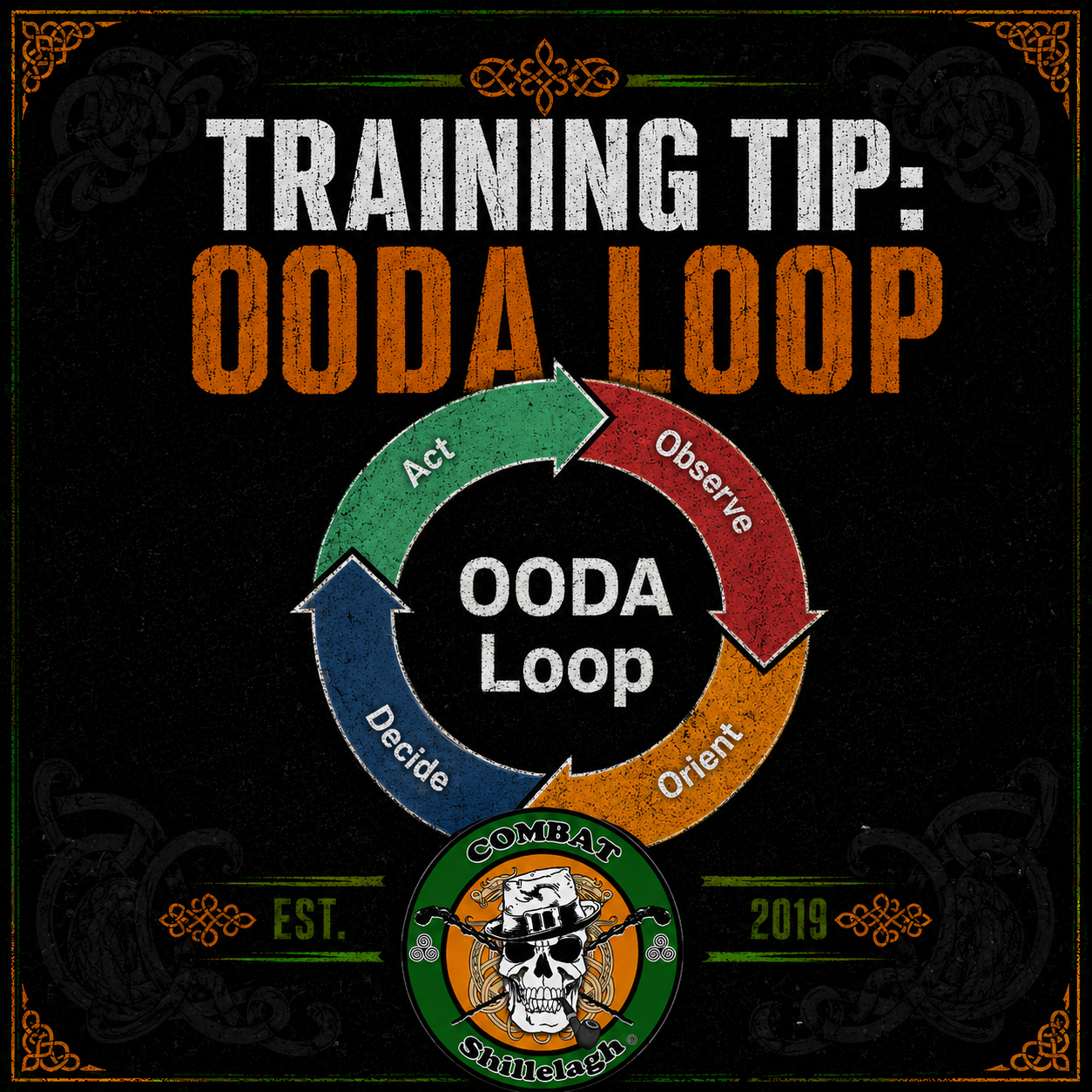
One of the most useful concepts for understanding timing, decision-making, and human reaction in Irish Stick Fighting is the OODA Loop. The term comes from the work of U.S. Air Force Colonel John Boyd and describes a recurring decision-making process: Observe, Orient, Decide, Act. While the model was originally developed in a very different environment, the underlying idea applies extremely well to martial arts because every physical exchange requires us to perceive information, make sense of it, choose a response, and then physically do something.
At its simplest level, the OODA Loop gives us another way to understand an idea we have discussed repeatedly throughout Combat Shillelagh training: action is generally faster than reaction. If one person initiates movement, the other person first has to recognize that something is happening before they can respond. That delay may only be a fraction of a second, but in a fast-moving weapon-based encounter, fractions of a second matter.
A commonly cited simple visual reaction time is somewhere around a quarter of a second, although real-world decision-making can be faster or much slower depending upon complexity, expectation, experience, stress, and the number of choices available. The important lesson is not that every OODA Loop takes exactly 250 milliseconds. The important lesson is that processing and responding take time, and anything that increases the amount of information the other person has to process can potentially increase that delay.
Observe, Orient, Decide, Act
The first stage is Observe. Something changes in the environment and your sensory system detects it. In Irish Stick Fighting, that might be a movement of the shillelagh, a shift in foot position, a change in distance, a shoulder beginning to rotate, or an opponent suddenly moving off the centerline. The second stage is Orient. Your brain attempts to understand what that information means. Is the weapon moving high or low? Is the person entering or retreating? Is the movement actually an attack? What angle is developing? Has the distance changed?
Then comes Decide. Once the situation has been interpreted, some response has to be selected. Do I move? Block? Change angle? Increase distance? Close distance? Counter? Do nothing? Finally, we Act. The chosen response has to be converted into physical movement. Then the process begins again.
This is why the word Loop matters. We are not performing OODA once during an encounter. We are continually observing new information, updating our understanding of the situation, making new decisions, and acting upon them.
Human Reaction Time Creates Opportunity
Think about what happens when someone begins a simple strike. The defender first sees movement. They recognize the direction of that movement. They begin forming an idea of the target. They select an appropriate response and then physically perform it. Meanwhile, the attacker is already moving.
That creates an inherent timing advantage for the person initiating the action. This does not mean attacking first automatically guarantees success. Distance, positioning, skill, anticipation, experience, and countless other variables matter. A trained person may also recognize familiar patterns early enough that they begin responding before the attack fully develops. But the basic relationship remains important: the person reacting is processing something that has already begun.
Once we understand that, we can begin seeing why so many of the concepts we have discussed throughout Irish Stick Fighting work together.
Feints and the OODA Loop
One of the easiest applications to understand is the feint. Suppose the movement initially suggests one target. The defender observes that movement, begins orienting toward it, and starts deciding how to respond. If the attack changes before their response is completed, the information they were using is no longer accurate.
Now their brain has to deal with something new. The value of the feint is not simply that it tricks someone. It introduces new information while they are already processing the old information.
Consider the difference between a predictable sequence and a changing one. If everything arrives at the same height, from the same side, and at the same rhythm, the defender gradually has fewer decisions to make. Their response becomes easier because they know what to expect. Change the target and suddenly another decision becomes necessary. Change the height and another adjustment becomes necessary. Change the angle and the relationship changes again.
This is why a high-to-low or low-to-high movement can create hesitation. The defender begins solving one problem and is then presented with another.
Corner to Corner and the OODA Loop
This connects directly to our discussion of corner-to-corner striking. Remember the tennis analogy: instead of continually sending the ball back toward the center, we make the opponent move from one extreme to the other.
A high target on one side followed by a low target on the opposite side is not simply difficult because the weapon has to travel farther defensively. It also forces the defender to continually reorient. The first attack says, “Deal with something high and left.” The next problem becomes, “Now deal with something low and right.” The body has to move, but the brain also has to update the problem.
If the defender falls behind that cycle, they increasingly become reactive. They are solving yesterday’s problem while you are already creating today’s. That is one of the major objectives behind many of our striking patterns. We are not simply trying to move the stick quickly. We are trying to continually change the information being presented to the other person.
Broken Rhythm Makes Prediction Harder
The OODA Loop also connects naturally with broken rhythm. Human beings are remarkably good at recognizing patterns. If someone attacks with the same cadence repeatedly, the defender begins predicting when the next movement will occur. Prediction can dramatically reduce reaction time because the person is no longer waiting for every piece of information before beginning their response.
If the rhythm is always: One… two… three… four… you quickly know where the next beat belongs.
Broken rhythm changes that: One… two…… three-four… pause… one. Now prediction becomes more difficult.
The technique itself may not have changed. What changed was the timing of the information. This is another way of influencing the other person’s decision-making process. A pause may cause an early response. A sudden acceleration may arrive before they expected it. A change in cadence can force them to stop relying on prediction and begin processing the movement again. That costs time.
Dynamic Range Can Disrupt the Loop
Our discussion of Dynamic Range becomes even more interesting when viewed through the OODA Loop. Distance is information. If you are standing outside effective range, the opponent sees one set of possibilities. Move suddenly into range and the situation changes. Pulse back out and the situation changes again. Move off the X and the angle changes along with the range.
This is why pulsing is more than simply moving forward and backward. Imagine approaching slowly, suddenly accelerating into range, then moving back out before the opponent completes their response. On the next entry, instead of moving straight in, you change angle.
Now several variables have changed: Distance. Angle. Speed. Timing. Rhythm. Each change creates new information that has to be processed. This is where the concepts of OODA, Dynamic Range, broken rhythm, and the 9 Gates begin functioning as parts of the same system.
Keep Your Own Loop Simple
There is another side to the discussion that is just as important. We do not only want to complicate the other person’s decision-making. We want to simplify our own. This is one of the reasons we spend so much time on fundamentals.
If you have to consciously remember where your feet go, where your hands belong, how to hold the shillelagh, how to maintain your Body Envelope, and how to recover after every strike, your own processing capacity becomes overloaded very quickly. This connects directly with our discussion of the Four Stages of Competence.
At first, everything requires conscious attention. As the fundamentals become more deeply ingrained, many of those mechanical decisions begin happening automatically. You no longer have to consciously think about every part of the movement. That frees up attention for the larger problem.
Instead of thinking, Where should my elbow be?, you can pay attention to what the other person is doing. Instead of thinking, How do I perform this strike?, you can recognize whether the strike is appropriate. Instead of thinking, Which foot should move?, you can concentrate on distance, timing, position, and changing threats.
This is one of the most important reasons we practice fundamentals repeatedly. Automatic movement reduces the amount of conscious processing required to act.
Experience Improves Orientation
The Orient stage is particularly important in martial arts. Two people can observe exactly the same movement and interpret it very differently based upon experience.
A beginner may simply see a stick moving. An experienced practitioner may recognize the shoulder rotation, foot position, hand position, angle, and likely target before the strike fully develops. Training gives us a larger library of recognizable patterns.
That can shorten our own OODA Loop because we are not seeing every situation as completely new. We have seen similar movements before. We have practiced responding to them. Our brain can compare the current situation with previous experience and make a faster decision.
This is also why good training should eventually move beyond perfectly cooperative drills. If everything always happens in exactly the same sequence, we are learning choreography rather than developing recognition and decision-making. Drills build skills. Open practice teaches us when to use them.
Do Not Think of OODA as a Stopwatch
It is useful to avoid treating the OODA Loop as though there is literally a 250-millisecond stopwatch running inside someone’s head. Human performance is more complicated than that. Familiar movements can produce extremely fast responses. Complex or unexpected situations can take substantially longer. Anticipation can reduce delays, while confusion can increase them.
The practical lesson is simpler. People need time to perceive changes and respond to them. Predictability helps them. Novelty, changing angles, changing distances, and changing rhythms make the problem more difficult.
Good training allows us to recognize information more quickly while reducing the amount of conscious thought required for our own fundamental movements. That is what makes the model useful.
Stay Ahead of the Problem
Ultimately, the OODA Loop gives us another framework for understanding many of the concepts we already practice in Irish Stick Fighting. Feints change the expected target. Corner-to-corner patterns change height and direction. Broken rhythm changes timing. Dynamic Range changes distance. The 9 Gates change angles. Good footwork changes position. Strong fundamentals simplify our own decision-making.
All of these things affect how quickly each person can understand and respond to what is happening. The goal is not simply to move faster. The goal is to make better decisions sooner while continually changing the problem the other person is trying to solve.
If the defender is still responding to your first movement while you are already transitioning into the next, they are behind the cycle. If the distance changes while they are deciding what to do, they have to update the problem. If the angle changes again, they have to reorient. If the rhythm changes, prediction becomes less reliable.
That is where the OODA Loop becomes particularly valuable to the study of Irish Stick Fighting. It gives us a way to understand why timing, rhythm, distance, angles, feints, and combinations matter beyond the physical movements themselves.
The shillelagh may be moving through space, but the real contest is also taking place inside two nervous systems that are constantly trying to understand what happens next. Observe. Orient. Decide. Act. Then do it again.
The better we become at moving through our own loop while influencing the other person’s ability to move through theirs, the more sophisticated our understanding of Irish Stick Fighting becomes.