
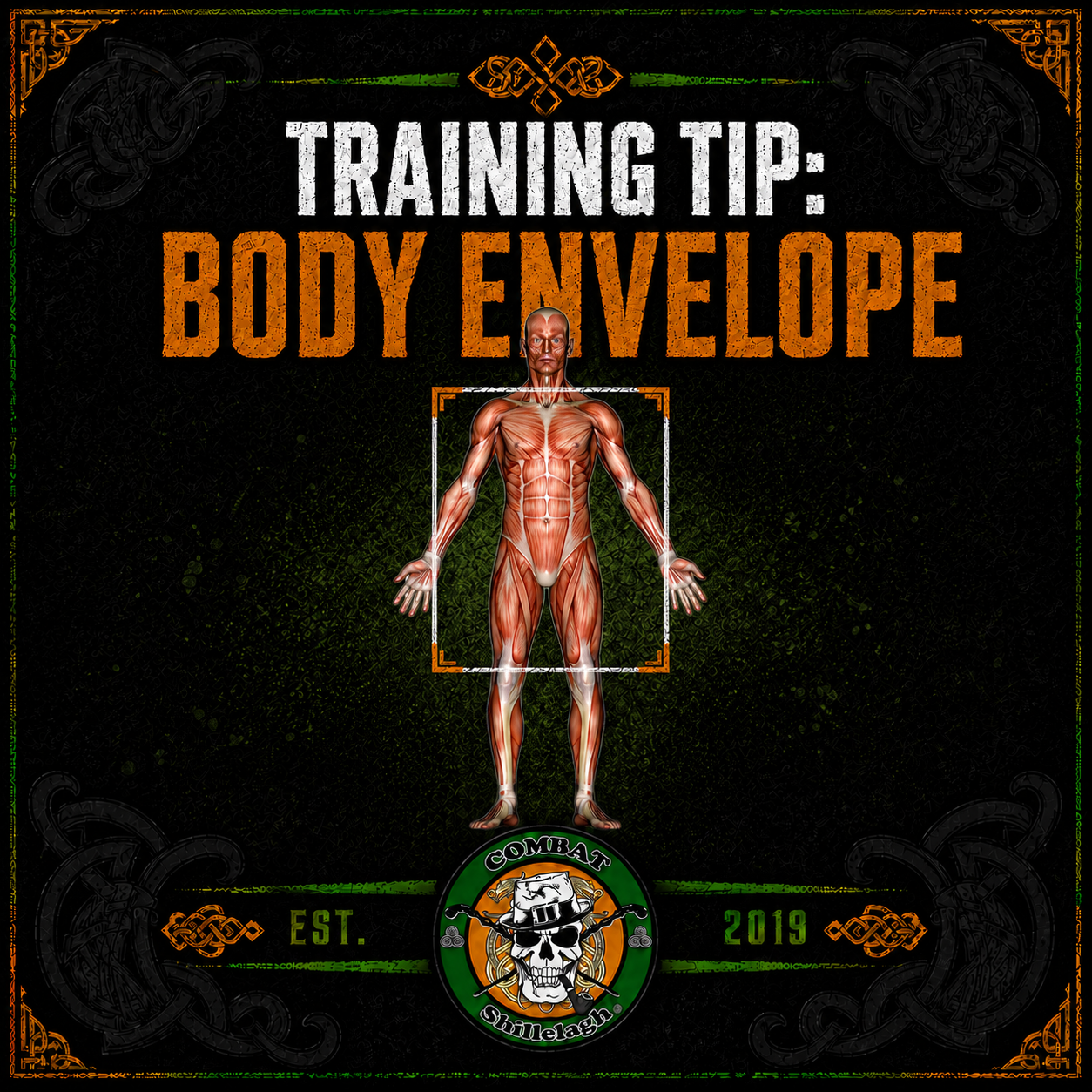
As students progress into the higher levels of Irish Stick Fighting, one of the concepts we spend more and more time discussing is structure. It is not enough to simply know how to swing a shillelagh, recognize a target, or move through a technique. The goal is to maintain your own balance, posture, and mechanical advantage while simultaneously trying to disrupt the structure of the person in front of you. Buried inside that larger discussion is a simple but extremely useful concept we call the Body Envelope.
Imagine that you are wearing a cardboard box roughly the size of a washing machine. The box sits around your torso with openings cut for your arms, legs, and head. You can move freely, but the walls of that imaginary box establish a three-dimensional boundary around your body. That boundary represents your Body Envelope. In most situations, we want our elbows, hands, and working structure to remain within or reasonably connected to that space.
The reason is simple: the farther your limbs travel outside your natural structure, the more likely you are to begin overextending. Once you overextend, your body has to compensate. Your shoulders may move ahead of your hips, your spine may begin to lean, your weight may shift too far toward one leg, or your hips may move backward in an attempt to counterbalance what your upper body is doing. At that point, you may still be holding a shillelagh and you may even still be able to hit something, but your structure is beginning to work against you.
That matters because in Irish Stick Fighting, the weapon adds leverage to everything you do. A shillelagh extends beyond the hand, which means movement at the shoulder, elbow, wrist, hips, and feet is magnified at the end of the stick. Small errors in body mechanics can become much larger errors at the striking end of the weapon. If you reach too far with the arm, the stick encourages you to reach even farther. If you lean toward the target to gain a few more inches of range, you may move your center of gravity beyond your base. If that happens, you have given up one of the things we are constantly trying to preserve: the ability to move again immediately.
The Body Envelope gives us a simple visual reference for preventing that problem. Rather than trying to reach farther with the upper body, we move the entire envelope. If the target is too far away, move your feet. If the angle is wrong, change the angle. If you need to create pressure, move your structure into a position where the weapon can work effectively without forcing the body into an unstable posture.
This connects directly to our discussions about footwork, range, body alignment, and the kinetic chain. The feet establish the base. The legs and hips move the body. The torso rotates. The shoulder, arm, hand, and shillelagh then transmit that movement toward the target. When those pieces remain connected, power travels efficiently through the body and into the weapon. When the arms begin operating far outside the Body Envelope, that connection starts to break down.
One way I often describe the concept to students is to imagine that the box around their body is filled with water. Your job is to move without spilling it. You can step, rotate, change angles, advance, retreat, and reposition yourself, but you do not want to tip the entire container every time you move. That mental image encourages the spine to remain naturally aligned while allowing the body to move underneath it.
The important word here is naturally. Keeping the spine aligned does not mean standing stiff and perfectly vertical at all times. Fighting is dynamic. We rotate, compress, extend, lower our level, change direction, and move through different ranges. The goal is not rigidity. The goal is to avoid unnecessary distortion of the body.
If you throw a strike and have to dramatically lean your chest forward to reach the target, you have probably moved outside your envelope. If your hips shoot backward while your hands move forward, you are compensating for lost balance. If your elbow flies far away from your body and the shoulder rises toward your ear, you may be trying to manufacture movement with the arm rather than allowing the entire body to participate. The strike might still land, but you have made the next movement more difficult.
This is where the Body Envelope becomes more than a posture exercise. It becomes a tactical concept.
Irish Stick Fighting requires continuous transitions between offense, defense, movement, and recovery. The end of one action should leave us capable of immediately beginning another. A strike should not leave us hanging over the front foot. A defensive movement should not twist us into a position that requires us to reset before responding. A step should not carry our body so far outside its base that we have to regain our balance before changing direction.
Maintaining the Body Envelope helps preserve that ability to continue.
It also makes it harder for another person to disrupt our structure. If our elbows are excessively extended and disconnected from our body, they become easier to manipulate. If our shoulders are ahead of our hips, pressure against the upper body can have a much greater effect on our balance. If our spine is already leaning, it takes less force to move us farther in that direction. Good structure does not make us immovable, but it reduces the mechanical advantages we accidentally give away.
This principle becomes even more important as distance closes. At longer ranges, we may have more room to recover from poor posture. At closer range, where the stick may be used for shorter strikes, checking, framing, controlling, leveraging, or other combative actions, disconnected elbows and poor spinal alignment can become immediate problems. The Body Envelope helps keep the weapon connected to the stronger structure of the body rather than leaving the arms to operate independently.
A simple way to work on this during training is to periodically stop in the middle of a movement and check yourself. Where are your elbows? Where is your head in relation to your hips and feet? Is your spine reasonably aligned? Could you move immediately in another direction? Could you strike again without first having to recover your balance?
You can also record yourself performing basic strikes, combinations, and footwork drills. Watch the video while paying less attention to the shillelagh and more attention to the body carrying it. You may discover that the weapon looks fine while the structure underneath it is doing far more work than necessary.
The Body Envelope is ultimately a very simple idea, but that simplicity is what makes it useful. Keep the limbs connected to the body. Maintain your structure. Move your feet rather than continually reaching. Keep the spine organized. When you need to change range or angle, move the entire envelope instead of throwing part of yourself outside of it.
As skill develops, these ideas stop feeling like separate rules. Your elbows naturally stay connected. Your feet move when they need to move. Your spine remains organized through transitions. The shillelagh begins to feel less like an object attached to the end of your arm and more like an extension of the structure underneath it.
That is the real value of the Body Envelope. It gives us a simple way to understand a much larger principle of Irish Stick Fighting: protect your own structure while looking for opportunities to compromise theirs.