
Martial arts traditions around the world have developed different ways to describe the journey from beginner to mastery. One of the most useful models comes from the Japanese concept of Shu-Ha-Ri. Even though the term itself is Japanese, the progression it describes applies remarkably well to Irish Stick Fighting because it explains something every serious student eventually experiences: first you learn the structure, then you begin to explore beyond it, and finally the structure becomes so deeply internalized that you are no longer consciously thinking about it.
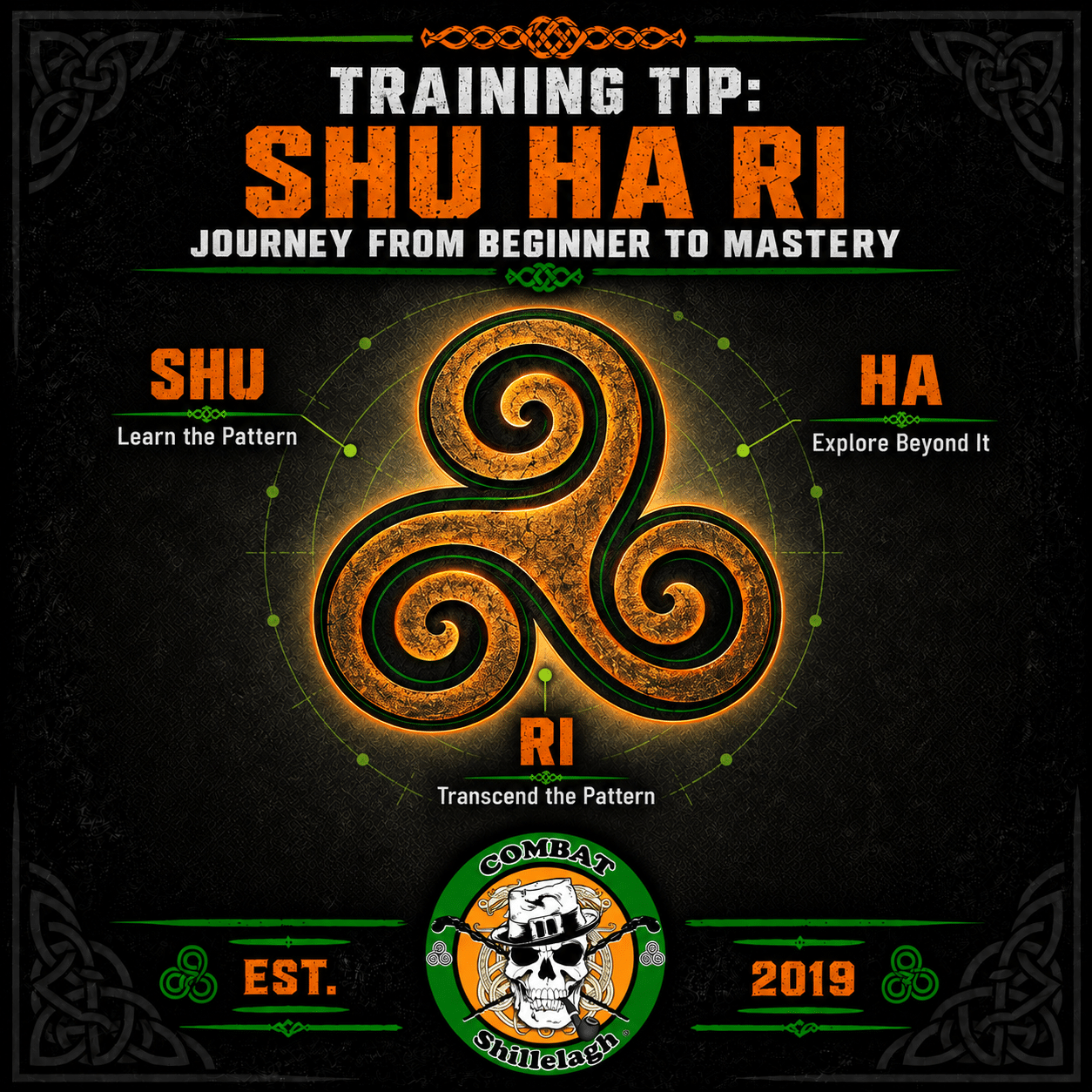
For Irish Stick Fighting, we can think of Shu-Ha-Ri as three connected stages of development. A useful Irish visual metaphor is the Triskelion, or triple spiral. The Triskelion appears throughout ancient Irish and Celtic art and consists of three interconnected spirals flowing from a common center. Rather than seeing Shu, Ha, and Ri as three separate boxes, imagine them as those three spirals. Each stage grows out of the one before it, each remains connected to the center, and together they represent an ongoing cycle of learning, exploration, and refinement.
Shu: Learn the Pattern
The first stage, Shu, can be understood as following the rules. For a new student of Irish Stick Fighting, this means learning the fundamental movements exactly as they are taught. You are developing the basic vocabulary of the art: how to stand, how to hold the shillelagh, how to move your feet, how to strike along the Nine Gates, how to block, how to manage distance, and how to coordinate your entire body behind the weapon.
This is not the stage for trying to reinvent everything. At Shu, repetition matters because your body is still learning what correct movement feels like. If you have to stop and consciously think about how your feet should move, where the shillelagh should travel, or what angle a strike should follow, then the fundamentals are not yet automatic. This is why we place so much emphasis on practicing the basics correctly. Simply repeating a movement hundreds of times does not guarantee improvement if you are repeating poor mechanics. The goal is not just practice. The goal is correct practice.
At this stage, your instructors help refine the gross motor skills, correct your posture, adjust your grip, improve your distance, and make sure your strikes and blocks follow the intended lines. Questions are always encouraged because you should understand the principles behind what you are doing, but the larger goal is to give your body enough high-quality repetitions that those movements begin to become familiar. If we use the Triskelion as our visual model, Shu is the first spiral moving outward from the center. It establishes the foundation from which everything else grows.
Ha: Understand the Pattern Well Enough to Break It
The second stage, Ha, is where training begins to become much more interesting. Ha is often described as breaking the rules, but that phrase can easily be misunderstood. Breaking the rules does not mean ignoring the fundamentals. It means you have practiced them long enough to understand why they exist, when they apply, and when changing them may create a better answer.
For example, at the Shu stage you may learn a particular response to a specific strike. You practice that response repeatedly so you understand the movement, distance, angle, and timing. At the Ha stage, you begin asking new questions. What happens if the opponent changes direction halfway through the attack? What if they are taller or shorter? What if they step inside instead of remaining at long range? What if you move forward instead of backward? What if your initial block becomes a strike? What if you use the head of the shillelagh to hook or clear instead of simply intercepting the attack?
Now you are beginning to experiment. The Nine Gates are a good example. At first, they provide a framework for understanding gross striking and movement angles. You learn the lines and train them consistently. Later, you begin to see all the angles that exist between those major lines. You start changing height, trajectory, timing, rhythm, and distance. The framework has not disappeared. You simply understand it well enough to work beyond its most basic form.
This is also where combination striking, broken rhythm, feints, weapon manipulation, and more advanced footwork begin to come alive. Techniques stop appearing as isolated answers and start becoming adaptable pieces that can be connected in different ways. If Shu is training inside the box, Ha is understanding the box well enough to move beyond its edges. The second spiral of the Triskelion represents that expansion. You are still connected to the same center, but your understanding is becoming broader.
Ri: The Art Comes Alive in the Moment
The third stage, Ri, is often described as transcending the rules. This is the stage associated with mastery, but mastery should not be confused with knowing the largest number of techniques. Ri is about reaching a point where you no longer need to consciously search for a technique. The situation presents itself, and your body responds.
In our training, we sometimes describe this as “the art comes alive in the moment.” Another way to say it is that opportunities simply begin to present themselves. You are no longer thinking, “He did attack number one, so now I perform defense number three.” Instead, you recognize distance, pressure, timing, movement, and opportunity as one fluid problem. Your response emerges from everything you have trained.
This is closely related to the concept of unconscious competence. The movements are embedded deeply enough that you do not have to consciously assemble every piece. This becomes particularly important in Combat Shillelagh because our training is based on principles that can move across different weapons and contexts. We work with the traditional shillelagh, walking-stick length weapons, cudgels, longer staffs and wattles, blades, and empty-hand applications.
At the beginning, those may appear to be separate categories. At Ri, the similarities become much more obvious than the differences. A movement learned with the shillelagh may suddenly appear in an empty-hand application. A principle learned from a blade may show up while working with a walking stick. A leverage concept originally practiced with the shaft of the shillelagh may appear when controlling an arm. The specific tool changes, but the underlying body mechanics, angles, timing, structure, and principles remain familiar.
Eventually, you are no longer collecting techniques. You are understanding movement. That is Ri.
The Three Spirals Are Always Connected
One of the reasons the Triskelion is such a useful metaphor for Shu-Ha-Ri is that the three stages should not be understood as a straight line that you complete once. Even advanced practitioners return to Shu. You may have decades of experience and then begin learning a new weapon, drill, or principle. Suddenly, you are back to carefully copying movement and repeating fundamentals. As your understanding grows, you move into exploration again. Eventually, the new knowledge becomes integrated into everything else you know, and then the cycle begins again.
Shu leads to Ha. Ha leads to Ri. Ri eventually reveals another layer of Shu. That is one of the realities of serious martial arts study: the more you learn, the more you begin to recognize how much more there is to understand.
The Goal Is Not to Rush the Process
Students naturally want to progress quickly. They want the next technique, the next rank, and the next level. There is nothing wrong with ambition, but Shu-Ha-Ri reminds us that certain parts of martial development simply require time. There is no reliable shortcut around repetition. You cannot intelligently break a rule you never truly learned, and you cannot transcend a principle you never internalized. The freedom associated with advanced practice is built on thousands of repetitions of foundational movement.
So, early in your training, embrace Shu. Learn the structure and practice it correctly. As your fundamentals become stronger, explore Ha. Test the boundaries. Change the timing, distance, rhythm, and angle. Learn why the principles work rather than simply memorizing what to do. Over time, allow Ri to develop naturally.
Eventually, the shillelagh begins to feel less like a weapon you are manipulating and more like an extension of your movement. Techniques blend together. Distances change naturally. Opportunities appear without conscious searching. The differences between weapon categories become less important because you recognize the common principles underneath them.
Like the three spirals of the Irish Triskelion, these stages remain connected around a common center: learn the pattern, explore the pattern, transcend the pattern, and then return to the beginning with new eyes.
The deeper you go into the art, the more there is to see.