Yes, Irish Stick Fighting is real.
It is not just folklore, performance, or something invented for tourists. Irish Stick Fighting has deep historical roots, practical self-defense value, and a strong connection to Irish martial culture. The traditional Gaelic term often associated with Irish Stick Fighting is bataireacht, a broad word referring to Irish methods of fighting with a stick, cudgel, walking stick, or shillelagh.
Like many traditional martial arts, Irish Stick Fighting has changed over time. Some methods were preserved through family lines. Some were reconstructed or revived through historical study and martial practice. Some modern systems, like Combat Shillelagh, have taken the core idea of the Irish shillelagh and built a robust, structured, reality-based self-defense system around it.
So, is Irish Stick Fighting real?
Absolutely. The better question is: what kind of Irish Stick Fighting are you learning, and how practical is the system behind it?
The Rich History of Bataireacht
Bataireacht is commonly used today as a general term for Irish Stick Fighting. It comes from the Irish word bata, meaning stick, and refers broadly to the practice of fighting with sticks.
It is important to understand that bataireacht is not the name of one single school or style. It is a broad term. Different families, regions, teachers, and modern systems may all use the term in different ways.
Historically, Irish stick fighting was connected to everyday life. A stick was a practical object. It could be used for walking, working, traveling, herding, and personal defense. Unlike a sword or firearm, a walking stick did not necessarily mark someone as armed in an obvious way. But in skilled hands, it could become a serious defensive tool.
The shillelagh became one of the most recognizable forms of the Irish fighting stick. Traditionally associated with Irish identity and rural life, the shillelagh was more than a symbol. It was a functional piece of hardwood that could serve as both a walking stick and a weapon.
That makes Irish Stick Fighting very real in both cultural and practical terms.
The Shillelagh as a Self-Defense Tool
The shillelagh has long been associated with personal protection in Ireland.
A strong stick gives the defender major advantages. It extends reach. It increases impact. It helps create distance. It can be used to strike, guard, check, deflect, press, or control. It can also help a smaller or older person defend against someone larger, stronger, or more aggressive.
This is one of the reasons stick fighting exists in so many cultures around the world. The stick is one of the most natural human tools. It is simple, available, and effective.
In the Irish context, the shillelagh became the cultural expression of that reality. It was a walking aid, a symbol of Irish toughness, and, when needed, a practical defensive weapon.
That history matters because it shows that Irish Stick Fighting was not based on fantasy. It came from a world where ordinary people carried sticks and sometimes had to use them.
Faction Fights and Irish Stick Fighting
One of the strongest pieces of historical evidence for Irish Stick Fighting is the history of faction fighting in Ireland.
Faction fights were violent clashes between rival groups, families, communities, or local factions. These fights could happen at fairs, markets, festivals, funerals, public gatherings, or other community events. They were often chaotic, dangerous, and deeply tied to local loyalties and conflicts.
The shillelagh and other fighting sticks were commonly associated with these encounters.
This part of history should not be romanticized. Faction fights were not friendly sparring matches. They could result in serious injury or death. But they are important because they show that stick fighting had a real role in Irish combative culture.
Irish Stick Fighting was not merely dance, display, or myth. It was connected to real-world violence, rivalry, defense, and group conflict.
Modern students are not training to recreate faction fights. That would be irresponsible and unnecessary. But understanding that history helps explain why Irish Stick Fighting deserves to be taken seriously as a martial tradition.
Why Some People Think Irish Stick Fighting Is Not Real
Some people doubt Irish Stick Fighting because it is not as visible today as more famous martial arts.
Most people have heard of Karate, Judo, Boxing, Wrestling, Taekwondo, Muay Thai, or Brazilian Jiu-Jitsu. Far fewer have heard of bataireacht or shillelagh-based self-defense.
That does not make it fake. It just means it is less widely known.
Many traditional martial arts were once local, family-based, regional, or culturally specific. They did not always have commercial schools, uniforms, ranking systems, or international organizations. Irish Stick Fighting developed in a different cultural setting than many Asian martial arts, so it does not always look like what people expect a martial art to look like.
Another reason people misunderstand it is because the shillelagh has sometimes been reduced to a souvenir or stereotype. Many people see it as a decorative Irish walking stick rather than as a serious martial tool.
But the fact that something has become symbolic does not erase its practical past.
The shillelagh can be both a cultural symbol and a functional weapon. Irish Stick Fighting can be both a heritage art and a real martial practice.
Irish Stick Fighting Today
Today, Irish Stick Fighting exists in several forms.
Some people study it for cultural preservation. Some approach it through historical martial arts. Some learn family or lineage-based methods. Some use it as a practical self-defense system. Some train for personal interest, fitness, heritage, or martial development.
Because bataireacht is a broad term, not every school teaches the same way. Some methods may focus more on history. Others may focus on combatives. Others may organize the material into modern curriculum, ranks, drills, and structured training.
This variety is normal. It exists in many martial arts.
The important question is not whether Irish Stick Fighting is real. It is.
The more useful question is whether a particular system teaches it in a way that is organized, practical, safe, and effective.
Combat Shillelagh and the Modern Revival of Shillelagh-Based Training
Modern combative systems like Combat Shillelagh are helping bring serious shillelagh-based martial training to students around the world.
Combat Shillelagh is centered around the Irish shillelagh as a practical defensive tool. It is not treated as a costume prop, parade item, or wall decoration. It is treated as the foundation of a complete martial system.
The system is built around robust self-defense concepts, including:
- Single-stick training
- Two-stick training
- Stick and blade concepts
- Empty-hand concepts
- Footwork and body movement
- Striking and guarding
- Distance management
- Close-range body manipulation
- Joint control using the shillelagh as a lever
- Posture and spine disruption
- Practical self-defense response
This kind of structure helps modern students understand how the shillelagh can be used at different ranges and under different conditions.
At longer range, the shillelagh can be used to strike, guard, intercept, and maintain distance.
At middle range, it can be used to check, frame, redirect, and control space.
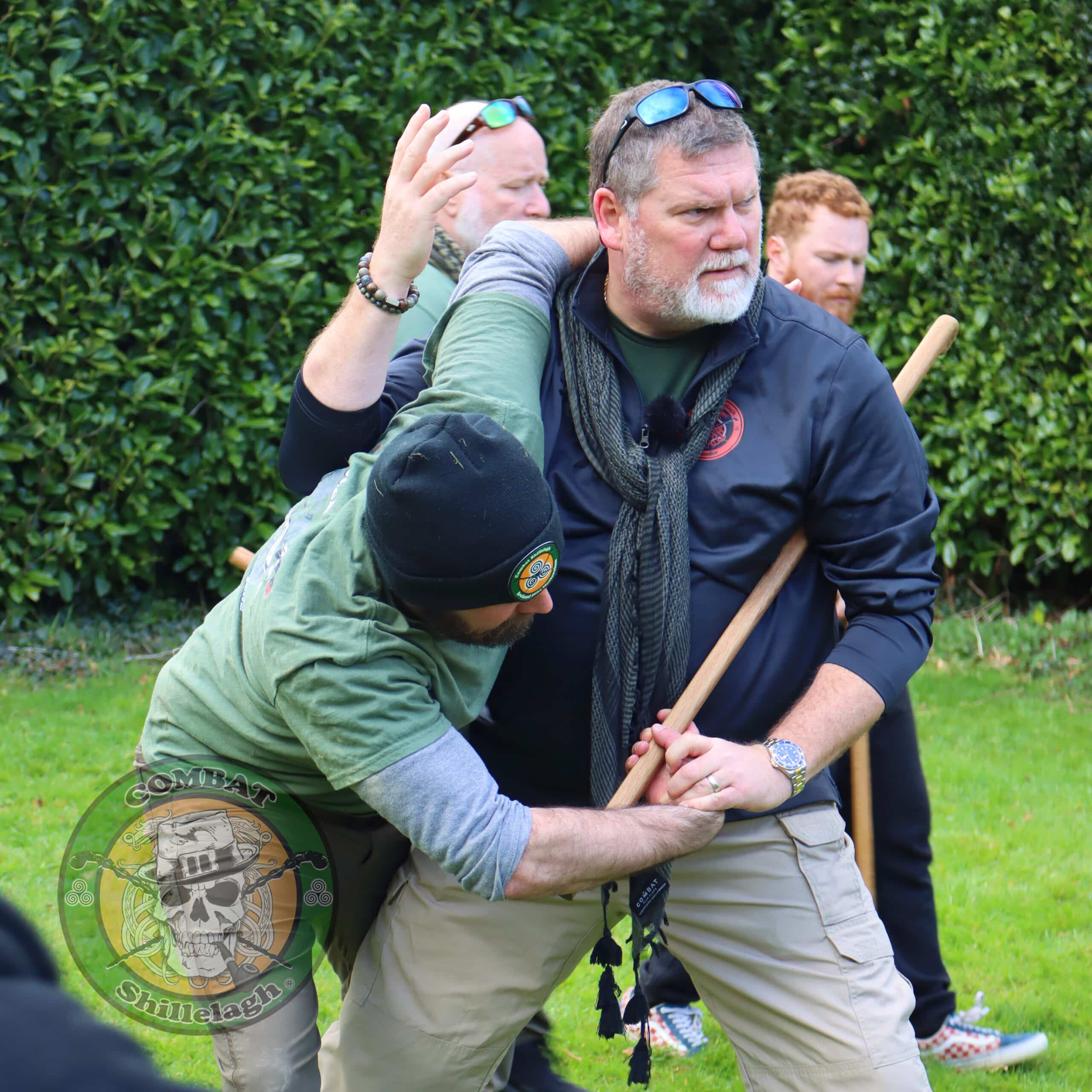
At close range, it can be used as a lever for body manipulation, joint control, posture disruption, and defensive escape.
That is what makes a system like Combat Shillelagh more than historical interest. It is a practical martial system built around the traditional Irish shillelagh.
A Robust Martial System Centered Around the Shillelagh
Combat Shillelagh brings together multiple layers of training while keeping the shillelagh at the center.
The single-stick material teaches the student how to use the shillelagh as a direct defensive tool. The two-stick material develops coordination, timing, range awareness, and the ability to manage multiple lines of attack and defense. Stick and blade concepts help students understand how weapons change distance, targeting, and risk. Empty-hand concepts help students continue functioning if the range collapses or if the shillelagh is not immediately available.
All of these areas connect back to the same core ideas:
Move with structure.
Control distance.
Protect yourself.
Use leverage instead of strength.
Disrupt the attacker’s balance and posture.
Create an opportunity to escape.
Use the shillelagh responsibly and effectively.
This is what a real martial system should do. It should give students principles, not just isolated techniques. It should train movement, timing, power, control, awareness, and judgment.
Combat Shillelagh uses the Irish shillelagh as the central tool for teaching those principles.
Irish Stick Fighting Is Both Historical and Practical
One of the most interesting things about Irish Stick Fighting is that it lives in both worlds.
It has historical roots in Irish culture, bataireacht, rural life, faction fighting, and the practical use of sticks for self-defense.
At the same time, it can still be useful today when trained properly.
Modern students may not be preparing for a faction fight at an Irish fair, but the underlying self-defense concepts still matter. Distance still matters. Timing still matters. Leverage still matters. Striking mechanics still matter. Awareness still matters. The ability to use an everyday object defensively still matters.
That is why the shillelagh remains relevant.
It is a traditional weapon, but the principles behind it are timeless.
Why Irish Stick Fighting Still Matters
Irish Stick Fighting matters because it preserves a part of Irish martial heritage that deserves more attention.
When people think of Irish culture, they often think of music, dance, poetry, storytelling, sports, and language. Those are all important. But martial traditions are also part of cultural history.
The shillelagh represents a practical side of Irish heritage. It reflects self-reliance, toughness, survival, and the ability of ordinary people to protect themselves with a simple tool.
Modern systems like Combat Shillelagh help keep that tradition alive in a responsible way. They give students a way to study the shillelagh not only as an artifact of the past, but as a living martial tool.
Final Answer
Yes, Irish Stick Fighting is real.
It has roots in the rich history of bataireacht, the practical use of the shillelagh for self-defense, and the culture of faction fighting in Ireland. The shillelagh was not just a walking stick or souvenir. It was a functional tool that could be used for protection, distance, striking, guarding, and control.
Today, modern combative systems like Combat Shillelagh are bringing robust shillelagh-based martial training to students around the world. Combat Shillelagh builds a complete self-defense system around the Irish shillelagh, including single-stick, two-stick, stick and blade, empty-hand, close-range control, joint manipulation, posture disruption, and practical defensive movement.
Irish Stick Fighting is real historically, culturally, and practically.
For anyone interested in Irish heritage, weapon-based martial arts, or practical self-defense, the shillelagh offers a powerful connection between the past and the present.