
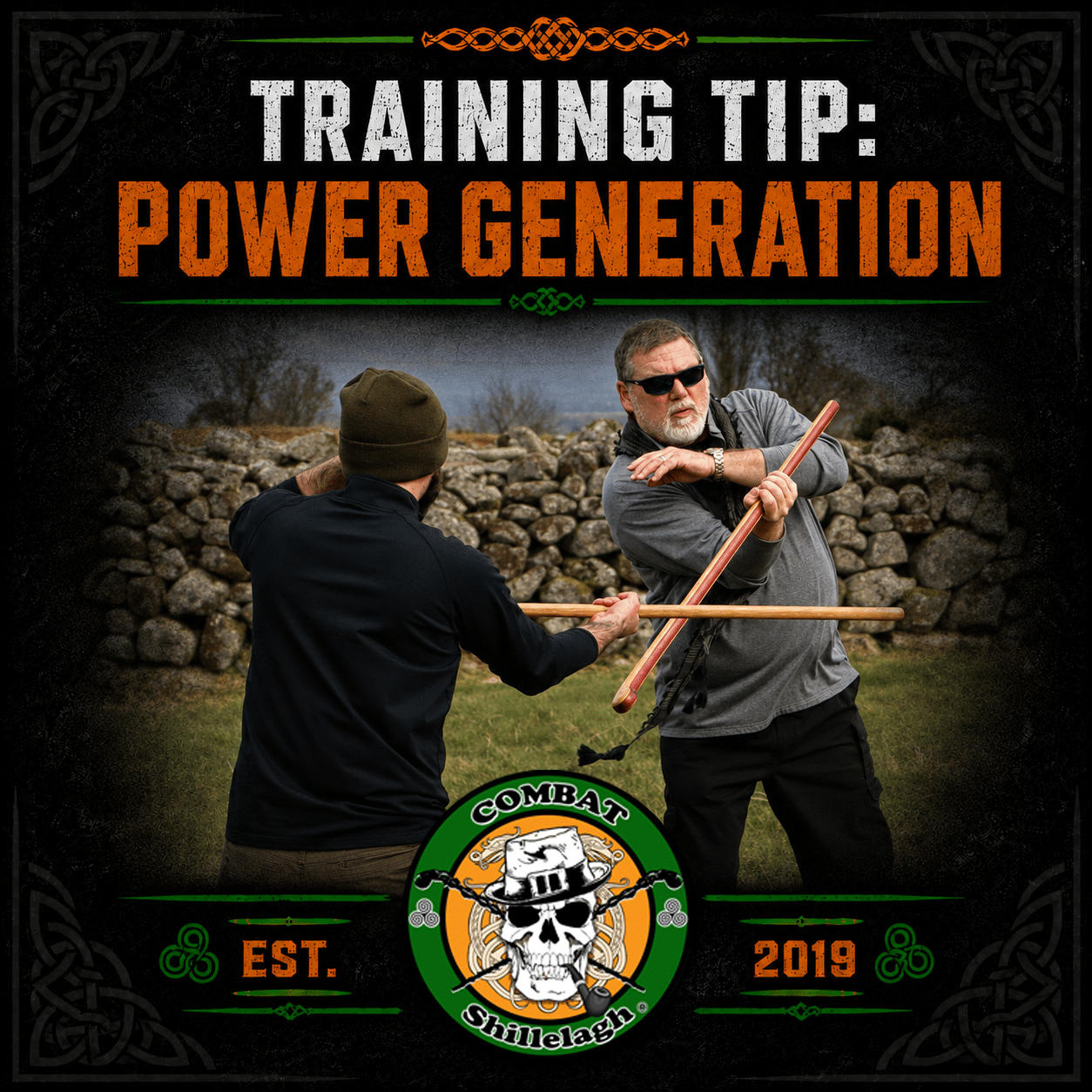
Power is one of the most misunderstood concepts in martial arts. When people first begin training with a bata or shillelagh, there is often a natural assumption that hitting harder simply means swinging harder. Put more muscle into the movement, move the stick faster, and the result should automatically be more powerful. In practice, effective power generation is much more sophisticated than that. A strong strike is the result of structure, timing, alignment, relaxation, footwork, rotation, and coordinated movement working together. The goal is not to make one part of the body work harder. The goal is to make the entire body contribute to the strike at the same moment.
Power Is More Than Strength
Upper-body strength certainly has a role in Irish Stick Fighting. The shoulders, arms, forearms, hands, back, and chest all contribute to controlling and accelerating the weapon. A physically strong practitioner may be able to generate considerable force using the arms alone. This is also one of the first methods new students instinctively use because it feels natural. Pick up a stick, tighten the muscles, and swing it.
The limitation is efficiency. Arm-dominant striking becomes tiring very quickly, particularly during extended training. It can also cause the student to overcommit the upper body, pull themselves out of alignment, and create a slower recovery after the strike. The harder the practitioner tries to muscle the weapon, the more tension can begin interfering with speed and fluidity.
That does not mean every strike needs maximum whole-body power. Quick jabs, flicks, feints, snap strikes, and other fast movements may intentionally use more isolated arm and wrist motion. Sometimes speed is more important than maximum impact. The important point is that the practitioner should understand the difference between deliberately using a quick arm-driven strike and relying on the arms because the rest of the body is not participating.
Unification of Body Movement
One phrase we use frequently in training is unification of body movement. It describes the concept of moving the body as a coordinated whole rather than as a collection of independent parts.
Instead of thinking, “My arm swings the bata,” begin thinking, “My body moves the bata.”
The feet interact with the ground. The legs drive movement. The hips and torso transfer that movement upward. The shoulders and arms transmit it through the weapon. Finally, the energy travels through the bata and into whatever training target you are striking.
This creates what is sometimes described in martial arts as a kinetic chain. Each link contributes to the next. When those links are properly coordinated, even a relatively small movement can generate impressive power. When they are disconnected, the practitioner may look like they are working extremely hard while producing surprisingly little effect.
This is why good power generation often looks easier than poor power generation.
The Feet Are Where Power Begins
Although the bata is held in the hands, a significant portion of effective striking power begins at the ground. The feet provide the foundation from which everything else moves.
Footwork can add momentum, transfer body weight, create rotation, and improve alignment. When the feet and the strike happen together, the practitioner can place far more of their body mass behind the movement than they could with an isolated arm swing.
A useful example is the drop step. Rather than planting the feet and then swinging the weapon afterward, the step and strike are coordinated so they arrive together. As the foot settles into position, the body weight and weapon connect at approximately the same moment.
This timing is critical. If the foot lands and the strike follows noticeably later, much of the benefit has already been lost. If the weapon arrives before the body structure is established, the strike may once again become primarily arm driven. The objective is synchronization.
Foot, body, hand, and bata arrive together.
Rotation and the Spine
Another major source of power is rotational movement. The human body is extremely capable of generating force through rotation, particularly when the hips, torso, shoulders, and arms work together.
Think of the spine as a central axis around which the body can turn. When the torso rotates, the larger muscles of the body contribute to accelerating the weapon. The arm then becomes less of an independent engine and more of a transmission system carrying that movement into the bata.
This rotational power appears naturally in many diagonal and horizontal strikes. A strike moving across the body becomes stronger when the torso participates instead of leaving the shoulder and arm to perform all of the work.
However, rotation should not be confused with aggressively twisting the lower back. Good movement distributes rotation throughout the body. The feet turn or reposition, the legs and hips participate, the torso rotates, and the shoulders continue the movement. Everything remains connected.
At more advanced levels, this movement can develop into what might be described as a corkscrew action. The practitioner rotates while simultaneously allowing the body’s weight and structure to settle into the strike. Instead of moving purely horizontally, the movement may combine rotation, forward movement, and a slight downward compression. This allows several sources of force to arrive together.
Linear Power and Thrusting
Not every powerful movement is rotational. Irish Stick Fighting also uses linear power, particularly during thrusts and compact close-range movements.
Linear power is created when the body drives along a relatively direct line. The arms may extend, but once again they should not necessarily be doing all of the work. A small step, forward shift of body weight, or coordinated movement of the feet can dramatically change the effectiveness of the motion.
This becomes especially valuable when space is limited. A large swinging strike requires room to accelerate. A compact thrust may require far less distance. By coordinating the weapon with the movement of the body, the practitioner can generate substantial force without needing a large wind-up.
This is another reason good footwork and body mechanics matter so much. Power should remain available even when the movements become smaller.
Relaxation, Acceleration, and Timing
One of the strange lessons students eventually discover is that trying harder can sometimes produce less power. Excessive muscular tension slows movement, interrupts the kinetic chain, and makes transitions more difficult.
Effective striking often begins with relative relaxation. The body accelerates the weapon smoothly, structure becomes increasingly important as the strike develops, and everything connects at the moment of contact. The practitioner then needs to recover rather than remaining rigid and overextended.
This combination of relaxation and structure allows speed and body weight to work together.
Think of power generation as a sequence:
Relax → move → accelerate → align → connect → recover.
If you begin the movement completely tense, you sacrifice speed. If you remain structurally loose at impact, energy can dissipate through the body instead of traveling efficiently through the weapon. Timing is what connects the two.
Structure Determines Where the Power Goes
Generating energy is only part of the equation. The body must also be properly aligned so that the force travels through the intended pathway.
Poor posture, collapsed wrists, misaligned shoulders, disconnected hips, or unstable foot placement can all cause energy to leak out of the movement. Proper skeletal alignment gives the strike a stable framework.
This is why power training should never become an excuse for uncontrolled swinging. Good mechanics should make the movement more controlled, not less.
When training power, particularly with a weighted blackthorn shillelagh or heavier training bata, students should develop these mechanics progressively and use appropriate protective equipment, striking pads, or training targets. The objective is to improve control and coordination while building power, not simply to see how hard you can swing.
Power Comes From Coordination
Ultimately, the fundamentals of power generation in Irish Stick Fighting come down to one central idea: the entire body should contribute to the movement.
The arms guide and accelerate the bata. The shoulders and torso add rotation. The hips connect the upper and lower body. The legs move body weight. The feet provide the connection to the ground. Proper structure keeps everything aligned, while timing ensures that all of those components arrive together.
A powerful strike should not feel like your arm is dragging the rest of your body behind it. It should feel like the weapon is being carried by a wave of coordinated movement beginning at the ground and traveling through your entire structure.
As students become more experienced, they usually discover that power requires progressively less visible effort. Movements become smaller, cleaner, faster, and more efficient. Instead of trying to overpower the bata, they learn how to use movement, gravity, momentum, rotation, and body weight to make the weapon work for them.
That is the real foundation of power generation: not greater effort, but better mechanics.
Learn to connect the feet to the hips, the hips to the spine, the spine to the shoulders, the shoulders to the hands, and the hands to the bata. When all of those components move together, the shillelagh stops being something that is simply swung by the arms and becomes an extension of the movement of the entire body.