Yes.
That is the simple answer.
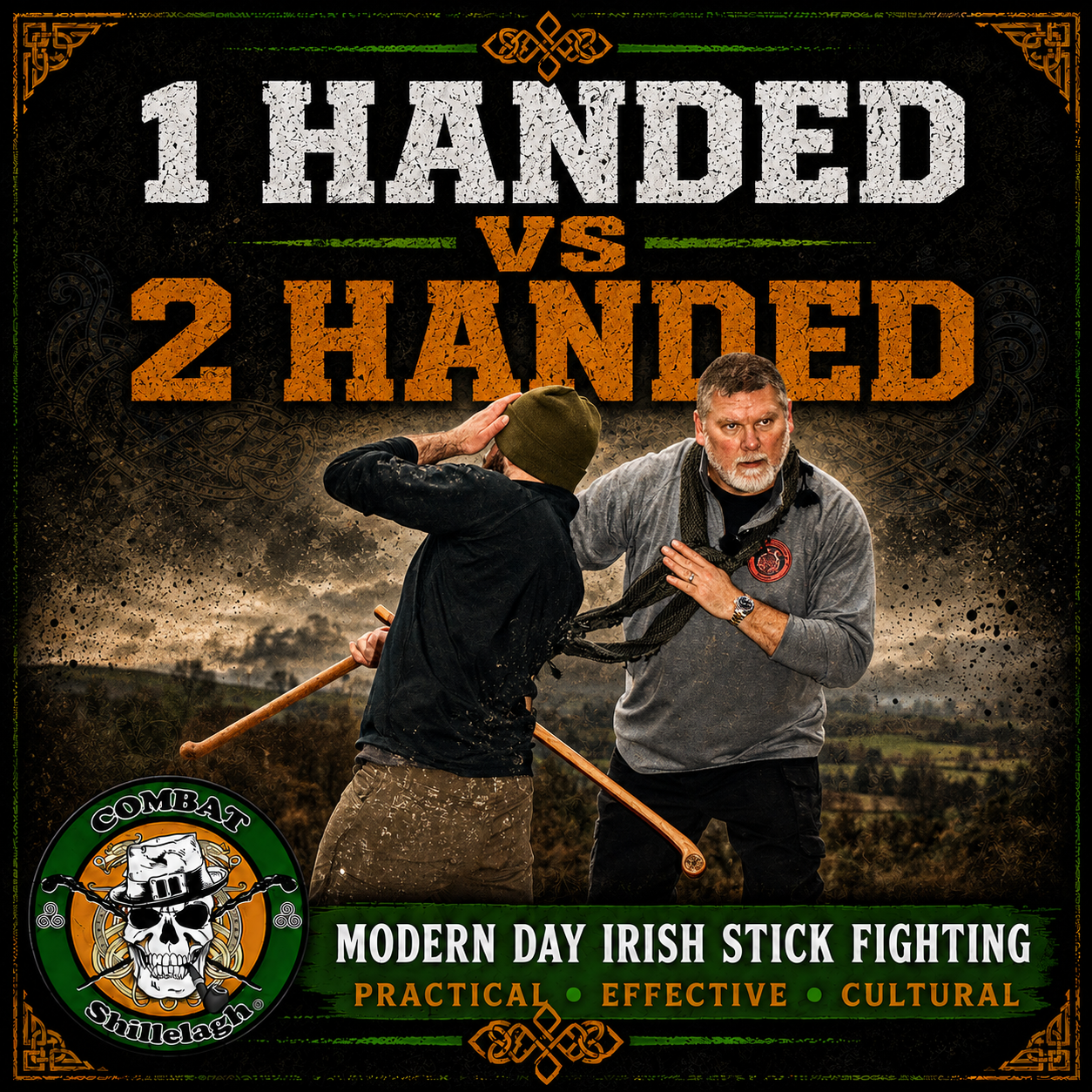
It is also a bit of a trick answer, because in most Irish stick fighting circles, you will see examples of both one handed and two handed use of the bata. That is because both grips have value. Both have strengths. Both have weaknesses.
The real question is not, “Which one is better?”
The better question is, “Which one is the right tool for the job at that exact moment?”
That is how I look at it.
In bataireacht, the bata can be used in different ways depending on distance, timing, pressure, the opponent’s movement, and what you are trying to accomplish. If we are being honest about practical self defense, we need to avoid getting trapped in the idea that one grip is always correct and the other one is somehow wrong.
A one handed grip is often seen at longer range. This makes sense because using the bata with one hand gives you more reach. That extra reach can be important when you are trying to keep an opponent away from you, strike from a safer distance, or create a barrier between yourself and the threat.
When you are using a one handed grip, the bata can move quickly. You can strike from different angles, recover, redirect, and use your free hand for checking, guarding, grabbing, balancing, or creating space. The free hand is not just hanging there doing nothing. It has a job.
That free hand can protect your head. It can monitor distance. It can help you frame against the opponent if they crash in. It can help you manage clothing, limbs, or pressure if the situation gets messy. In a practical context, that matters. In our system, we call the free hand the “Alive Hand”. Always in the mix and covering the high centerline in the middle of the chest, and always ready to be deployed for trapping, covering, manipulating etc.
The downside of a one handed grip is that you may have less control over the bata when compared to two hands. If the opponent grabs it, jams it, or crashes into you, the bata can become harder to manage. You also need good mechanics so you are not just swinging with your arm. If you rely only on arm strength, you will lose power, tire out quickly, and create openings.
This is why proper structure matters. Even with one hand, the power should still come from the body. Your feet, hips, shoulders, and alignment all have to work together.
A two handed grip changes the equation.
With two hands on the bata, you gain control, structure, and leverage. This can be extremely useful at closer range. If the opponent is inside your preferred striking distance, a two handed grip may help you manage the bata, keep possession of it, and use it for body manipulation.
At closer distance, the bata is not only a striking tool. It can become a frame, a lever, a wedge, a barrier, or a control tool. You can use it to jam movement, redirect pressure, create space, or affect the opponent’s posture.
Two hands can also help you protect the weapon. If someone grabs your bata, you may need that second hand to maintain control. If you are in a clinch-like range, or if the bata is being pulled, pushed, trapped, or tied up, two hands may give you the stability you need to keep from losing it.
The downside of a two handed grip is that you may sacrifice some reach and freedom of movement. Both hands are now committed to the bata, which means your hands are less available for checking, grabbing, posting, protecting, or managing other parts of the encounter. You may also shorten your striking range depending on how you are holding the bata.
So again, it comes back to the right tool at the right time.
One handed use may give you reach, speed, mobility, and flexibility. Two handed use may give you control, power, leverage, and structure. Neither one is magic. Neither one solves every problem. The grip has to match the situation.
This is one of the reasons I believe students should train both.
If you only train one handed use, you may struggle when the fight gets close and the bata gets tied up. If you only train two handed use, you may miss opportunities to use distance, angles, and the free hand more effectively. A complete student should understand both methods and know when to transition between them.
In a clean drill, it is easy to say, “I would use this grip.” Real movement is different. Distance changes. Balance changes. The other person does not always do what you expect. The bata may be extended one moment and jammed the next. You may be striking, then blocking, then framing, then fighting to keep control of the weapon.
That is why training has to go beyond memorizing positions.
You need to understand the purpose behind the grip.
Are you trying to keep the person away? Are you trying to strike before they close the gap? Are you trying to stop forward pressure? Are you trying to regain control of the bata? Are you trying to move their body? Are you trying to create space so you can escape?
The answer to those questions determines how you use the bata.
In the Combat Shillelagh system, we use both grips interchangeably and all the time. We are not locked into one way of holding the bata. We do not treat one grip as “the real way” and the other as secondary or less important.
The grip changes because the situation changes.
Sometimes we need reach. Sometimes we need control. Sometimes we need to strike. Sometimes we need to frame. Sometimes we need to keep someone away. Sometimes we need to manage close pressure and protect the weapon. In those moments, the ability to move naturally between one handed and two handed use becomes extremely important.
This is also where the Combat Shillelagh system looks at the bata as more than one isolated weapon.
We use these grips as analogs for other weapon types, including edged weapons, and we train accordingly. That does not mean we pretend every weapon is exactly the same. They are not. A bata, a blade, a club, and an improvised object all have different realities.
But there are transferable principles.
The way you manage distance, protect the hand, use the free hand, control the line, angle your body, retain the weapon, and move under pressure can all carry over into other combative contexts. A one handed bata grip may help a student understand certain edged weapon principles. A two handed bata grip may help a student understand stronger retention, leverage, and body manipulation concepts.
Again, context matters.
The Combat Shillelagh system approaches bataireacht from a modern day self defense and combatives perspective. We respect the Irish cultural roots of the art, but we are not trying to freeze it in the past. We are training a living method that has to make sense under pressure, against resistance, and in practical application.
That means we train the bata at longer range. We train it at closer range. We train striking, blocking, footwork, checking, pressure, weapon retention, body manipulation, and the transition between weapon use and empty hand combatives.
From our perspective, the grip is not a style statement.
It is a tactical choice.
Combat Shillelagh is built around practical application. Sometimes one hand gives you the answer. Sometimes two hands give you the answer. Sometimes you may transition between both in the same exchange without even thinking about it, because the training has made the decision natural.
The goal is not to win an argument about which grip is more traditional or more correct. The goal is to become functional, aware, and capable with the bata in your hand.
For me, that is the heart of bataireacht.
It is cultural. It is practical. It is rooted in history, but it can still be trained in a way that makes sense today.
So, one handed grip or two handed grip?
Yes.
Learn both. Understand both. Train both. Then use the right tool for the right job at the right time.