One of the most common misconceptions about the traditional Irish shillelagh is that it is simply a stick. From a martial arts perspective, that description misses many of the characteristics that make the blackthorn shillelagh such a distinctive weapon. Its shape, balance, construction, and natural irregularities all influence how it moves and how it can be used. Unlike a straight staff or evenly balanced baton, the shillelagh has several distinct working areas that give the practitioner different options for striking, blocking, controlling, hooking, trapping, and manipulating. Understanding those physical properties is an important part of learning how to use the weapon effectively rather than simply swinging it like an ordinary stick.
Understanding the Anatomy of the Shillelagh
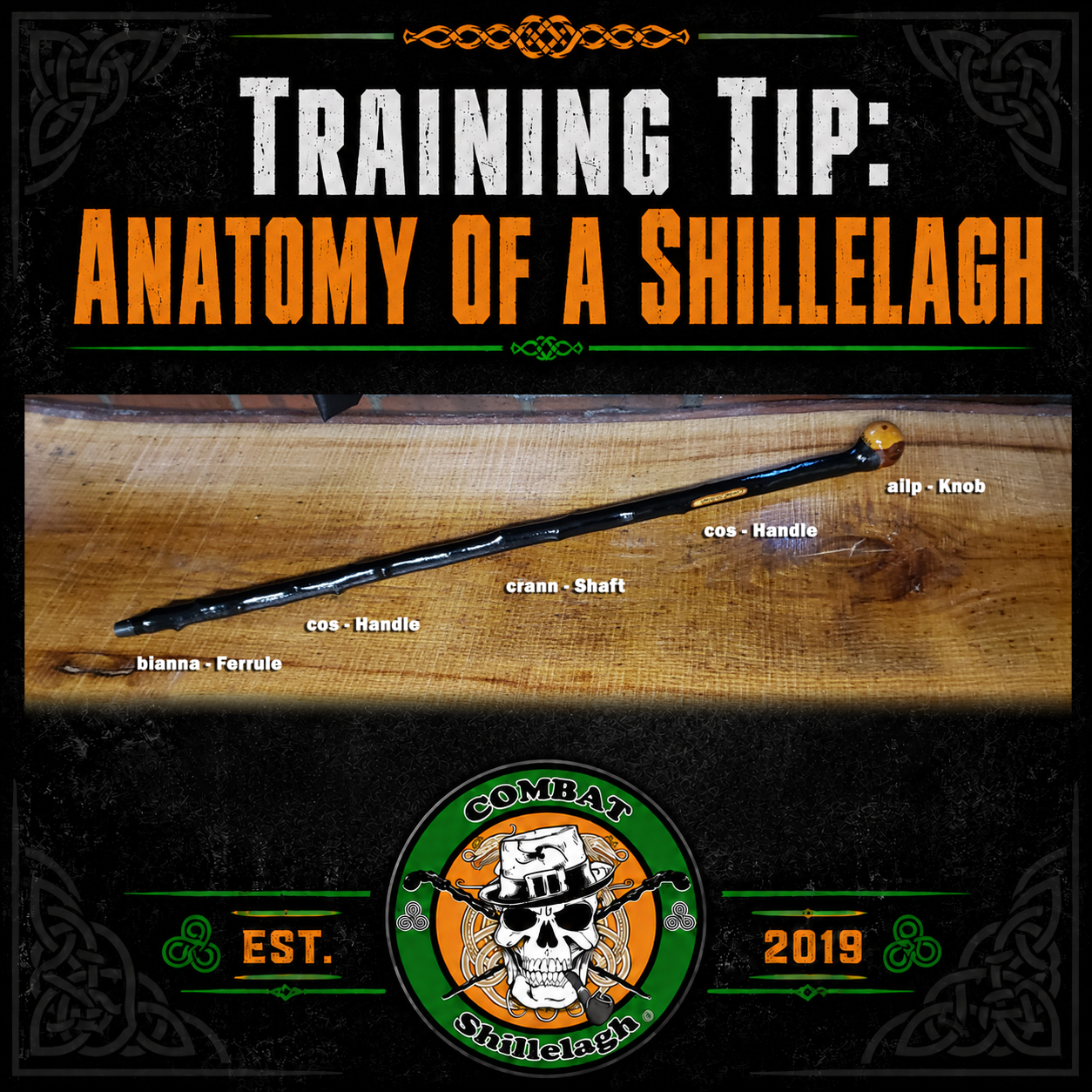
A useful place to begin is with the basic anatomy of the weapon. As illustrated in the accompanying training reference, the shillelagh can be broken down into several primary sections. The ailp, or knob, forms the distinctive head of the weapon. The cos, or handle, refers to the gripping area. The crann, or shaft, makes up the main length of the shillelagh, while the bianna, or ferrule, is located at the opposite end. Each of these areas contributes something different to the weapon’s overall function.
The most visually distinctive feature is the ailp, or knob. Unlike a conventional straight stick, the shillelagh typically has additional mass concentrated at one end. That weight changes the dynamics of the weapon considerably. When the shillelagh moves through an arc, the heavier head contributes additional momentum to the strike. Because of that, the practitioner must learn how to control the weapon’s balance and allow its weight to work with proper body mechanics rather than fighting against it.
Some of the custom blackthorn shillelaghs we have made in Ireland take this characteristic even further by incorporating lead loading into the head. That additional mass significantly magnifies the weight at the striking end. While this can increase the potential force generated by the weapon, it also makes proper alignment, grip, recovery, and overall control even more important. More weight does not automatically create better technique. In fact, poor mechanics become much more obvious when the weapon itself is less forgiving.
Grip, Balance, and Reach
Because the shillelagh has a weighted primary end, gripping position becomes extremely important. The cos, or handle, must provide a balance between control and usable reach. Holding too high on the shaft shortens the effective range of the weapon and sacrifices some of the mechanical advantage provided by its length. Holding too low, however, can make the weighted head more difficult to manage and can place unnecessary stress on the wrist during acceleration, impact, or recovery.
This is one of the reasons we emphasize learning the feel of the individual shillelagh in your hands. Traditional blackthorn weapons are not perfectly uniform. Differences in curvature, thickness, knots, head size, and overall weight mean that two authentic shillelaghs may behave somewhat differently. A practitioner should learn where the weapon naturally balances and where the grip provides the best compromise between speed, reach, leverage, and control.
The Ailp Is More Than a Striking Surface
While the ailp is an excellent striking surface, its shape also creates opportunities for weapon manipulation. The natural contour of the head can function almost like a compact hook. This can allow the practitioner to catch, redirect, clear, or sweep an incoming weapon or potentially manipulate portions of an opponent’s body.
The important difference is that the head generally does not project outward like a large artificial hook. A dramatically protruding hook could easily become caught on clothing, equipment, or another weapon. The relatively compact shape of the shillelagh head provides enough structure to assist with hooking and clearing while still allowing the weapon to move freely through transitions.
This is where understanding the weapon’s shape becomes especially important. Rather than trying to force techniques from another staff or stick system onto the shillelagh, we want to examine what the physical design of the weapon naturally allows us to do.
The Crann as a Blocking and Manipulation Tool
The crann, or shaft, forms the largest portion of the weapon and provides much more than simply the connection between the two ends. At the foundational level, the shaft is extremely useful for blocking, checking, framing, controlling space, and redirecting attacks.
As training progresses, the shaft can also become a powerful lever. With approximately three feet of material available between the practitioner’s hands and various contact points on an opponent, the shillelagh can generate considerable mechanical advantage during pushing, pulling, rotating, or body-manipulation movements. This ability to transition between striking and leverage is one of the characteristics that makes the weapon particularly interesting at closer ranges.
Do Not Forget the Bianna
At the opposite end is the bianna, or ferrule. Students can easily become so focused on the weighted head that they begin thinking of the shillelagh as having one useful end and one secondary end. In reality, both ends have important functions.
The ferrule end can be used for short-range striking, thrusting, raking, trapping, and other close-range manipulations. If an opponent closes inside the ideal striking distance of the ailp, the opposite end of the weapon may suddenly become the closest available tool. This is why we teach students to understand the entire length of the shillelagh rather than treating it as nothing more than a club with a heavy end.
At the foundational level, a simple way to think about the weapon is that the ailp is primarily associated with striking and hooking, the crann with blocking and manipulation, and the bianna with close-range striking, thrusting, trapping, and raking. These are not absolute limitations. At higher levels, each portion of the weapon can take on additional roles, and the practitioner begins transitioning fluidly from one part to another.
Learning to Use the Weapon You Actually Have
The traditional Irish blackthorn shillelagh rewards a practitioner who pays attention to its physical characteristics. Its weighted head, natural contours, uneven balance, long shaft, and functional opposite end all contribute to the way it should be handled. The goal is not to make the shillelagh behave like a perfectly straight staff. The goal is to understand what makes the shillelagh different and then build your movement around those differences.
For students, three concepts are particularly important. First, learn your grip and balance. Find the position that allows you to maintain reach without sacrificing control of the weighted head. Second, learn to use the entire weapon. Become comfortable with the ailp, cos, crann, and bianna and understand how each section contributes to the system. Third, embrace the unique shape of the shillelagh. Explore how the head can be used for hooking, sweeping, clearing, and redirecting rather than thinking of it only as the part that delivers a strike.
As experience increases, these ideas begin to blend together. You may strike with the ailp, redirect with the crann, hook with the head, manipulate with the shaft, and immediately transition to the bianna at close range. What initially appears to be several separate functions eventually becomes one continuous method of using the weapon.
That is one of the most important lessons in understanding the Irish blackthorn shillelagh as a martial arts weapon. It is not simply a stick with a knob on one end. Its anatomy directly influences its tactics, mechanics, and methods of application. Once you begin training around those characteristics, the question changes from “What techniques can I perform with this stick?” to “What does the design of this weapon naturally allow me to do?”
That distinction is where the shillelagh begins to reveal what makes it such a unique and versatile martial arts weapon.