
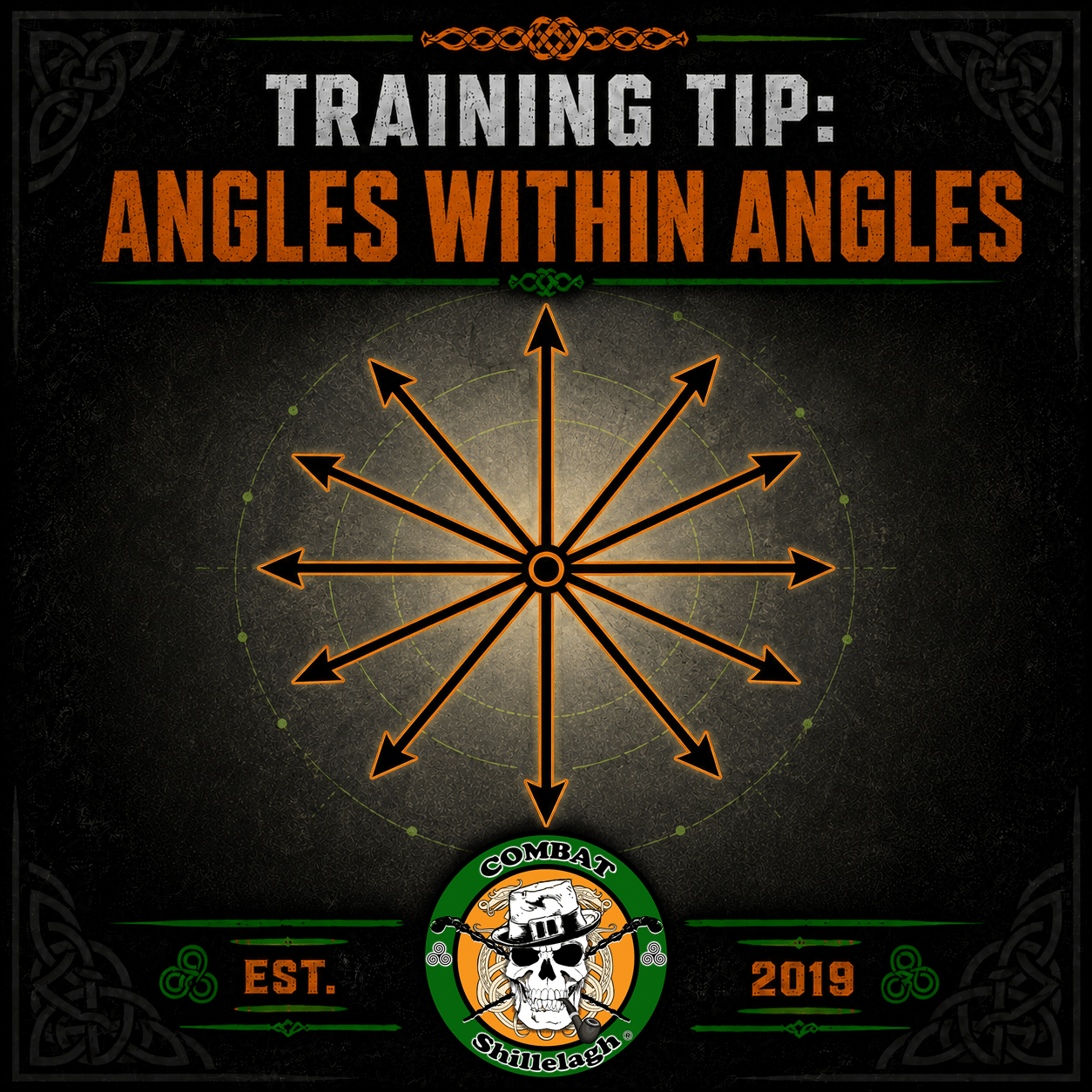
One of the core concepts in the Combat Shillelagh system is what we call the 9 Gates. At first glance, the 9 Gates are simply the major lines or angles through which we strike, block, move, and position ourselves. They provide a clear framework for learning how the body and the shillelagh should travel through space. As your training progresses, however, you begin to understand that the 9 Gates are not really nine fixed possibilities. They are major reference points within an almost unlimited number of possible angles.
Early in your training, precision and consistency matter. If a strike is supposed to travel along a particular diagonal, you should be able to reproduce that line repeatedly. If you are stepping off at a particular angle, your feet should learn to find that position without requiring much conscious thought. The same applies to blocks, parries, evasions, and other defensive movements. We initially work with relatively large, easily identifiable angles because they give the brain and body something concrete to learn. Think of the 9 Gates as the major roads on a map. Before you start looking for shortcuts, side streets, and alternate routes, you first need to know where the main roads go.
This is why we place so much emphasis on learning the major angles correctly before worrying about subtle variations. Repetition develops consistency, and consistency creates recognizable movement patterns. Eventually, those patterns become increasingly automatic. Instead of consciously thinking about moving your hand, weapon, or body along a specific line, your nervous system begins to recognize the movement and perform it naturally. Once that foundation exists, the concept becomes much more interesting.
Consider two major striking angles. One strike might descend diagonally at approximately 45 degrees, while another might travel more horizontally at approximately 90 degrees. During early training, we treat these as two distinct lines. Mathematically, however, there are countless possible angles between them. You could strike at 46 degrees, 47 degrees, 52 degrees, 63 degrees, or 78 degrees. Even those examples are unnecessarily restrictive because fractional angles exist between every whole number. From a purely mathematical perspective, there are essentially infinite angles between two established lines.
This leads us to the concept of angles within angles. The major Gates provide the framework, but they do not represent the limits of movement. Once you can reliably reproduce the major striking lines, you can begin making small and deliberate adjustments to them. A strike that normally travels along a familiar diagonal might arrive slightly flatter. Another might descend slightly more vertically. The difference may be visually small, but tactically it can be significant.
Human beings are extremely good at categorizing movement. When an opponent sees a strike approaching, the brain attempts to recognize the trajectory and generate an appropriate response. It does not necessarily calculate the exact geometry involved. Instead, it recognizes something approximately familiar: a diagonal strike, horizontal strike, vertical strike, and so forth. That recognition helps produce the defensive response. The problem for the defender begins when the incoming strike does not travel exactly where expected.
Imagine that an opponent recognizes what appears to be a familiar downward diagonal strike and begins positioning a block accordingly. Instead of delivering the strike along the exact training angle, you subtly alter its trajectory. The strike arrives several degrees above or below the expected line. To the observer, the two movements may initially look almost identical, but mechanically they are not. The defender may place the block in approximately the correct location and still fail to properly intersect the incoming weapon. The defensive angle may be slightly wrong, the stick may slide around the defense, or the contact point may occur somewhere unexpected. The defender recognized one line while the actual attack traveled along another.
This is where the simplicity of the 9 Gates begins developing into something much more sophisticated. The important lesson, however, is that subtlety should come after competency. Trying to manipulate tiny angular differences before you can reliably perform the major angles usually creates sloppy technique rather than advanced technique. You cannot deliberately deviate from a line that you cannot consistently reproduce in the first place. First learn the major roads. Then learn the alternate routes.
The same principle extends far beyond striking. Place the 9 Gates diagram on the floor and the concept becomes a framework for footwork. Forward, backward, lateral, and diagonal movement can all be understood through major directional lines. At first, you learn to step along those obvious paths. Later, you begin dividing the spaces between them into increasingly subtle angles. Instead of simply stepping diagonally away from an attack, perhaps you move a few degrees deeper. Perhaps you shift slightly more laterally. Perhaps you alter your angle so that you are simultaneously moving away from the incoming weapon while improving your position for a counterattack.
A few degrees can change distance, timing, position, and available opportunities. A slight change in angle can determine whether you remain directly in front of an opponent or begin moving toward their flank. This becomes particularly important when we talk about getting off the X. Escaping the immediate line of attack is not simply a matter of moving left or right. The direction you choose affects your distance, your weapon position, your opponent’s ability to track you, and the opportunities that appear immediately afterward.
As you begin dividing those movement angles into smaller and smaller pieces, the 9 Gates stop looking like nine individual lines. They begin to look more like a map of possibilities. The same principle can eventually be applied to striking, blocking, parrying, footwork, body positioning, weapon alignment, and combinations. Every major line contains countless smaller variations, and each variation can change how an opponent perceives your movement and how effectively they are able to respond.
That is why beginners should respect the structure of the 9 Gates rather than rushing past it. The Gates provide the foundation necessary to explore everything that exists between them. Learn the major angles, make them consistent, and make them automatic. Then begin slicing the space between them into increasingly subtle variations.
When you start discovering the angles within the angles, the system stops being a collection of predetermined movements and becomes something much more adaptable. Instead of simply reproducing techniques, you begin manipulating distance, position, trajectory, timing, and perception. That is one of the points where the art truly begins to come alive.