
When most people first think about the hands, wrists, elbows, knees, and other joints in Irish Stick Fighting, they tend to think of them primarily as potential striking targets. There is certainly a tactical reason for understanding those targets. If someone is holding a weapon, interfering with their ability to maintain that grip can potentially reduce part of the threat they present. But there is a much deeper subject underneath that discussion: understanding how joints move, how the human body is connected, and how the shillelagh can be used as a lever to influence another person’s structure. This is where Irish Stick Fighting begins moving beyond the simple idea of “hitting someone with a stick.” A shillelagh is not merely an impact weapon. It is also a rigid mechanical tool that can be used to frame, redirect, control, lever, and manipulate position. When we understand the anatomy underneath those applications, the weapon becomes considerably more versatile.
Not Every Joint Moves the Same Way
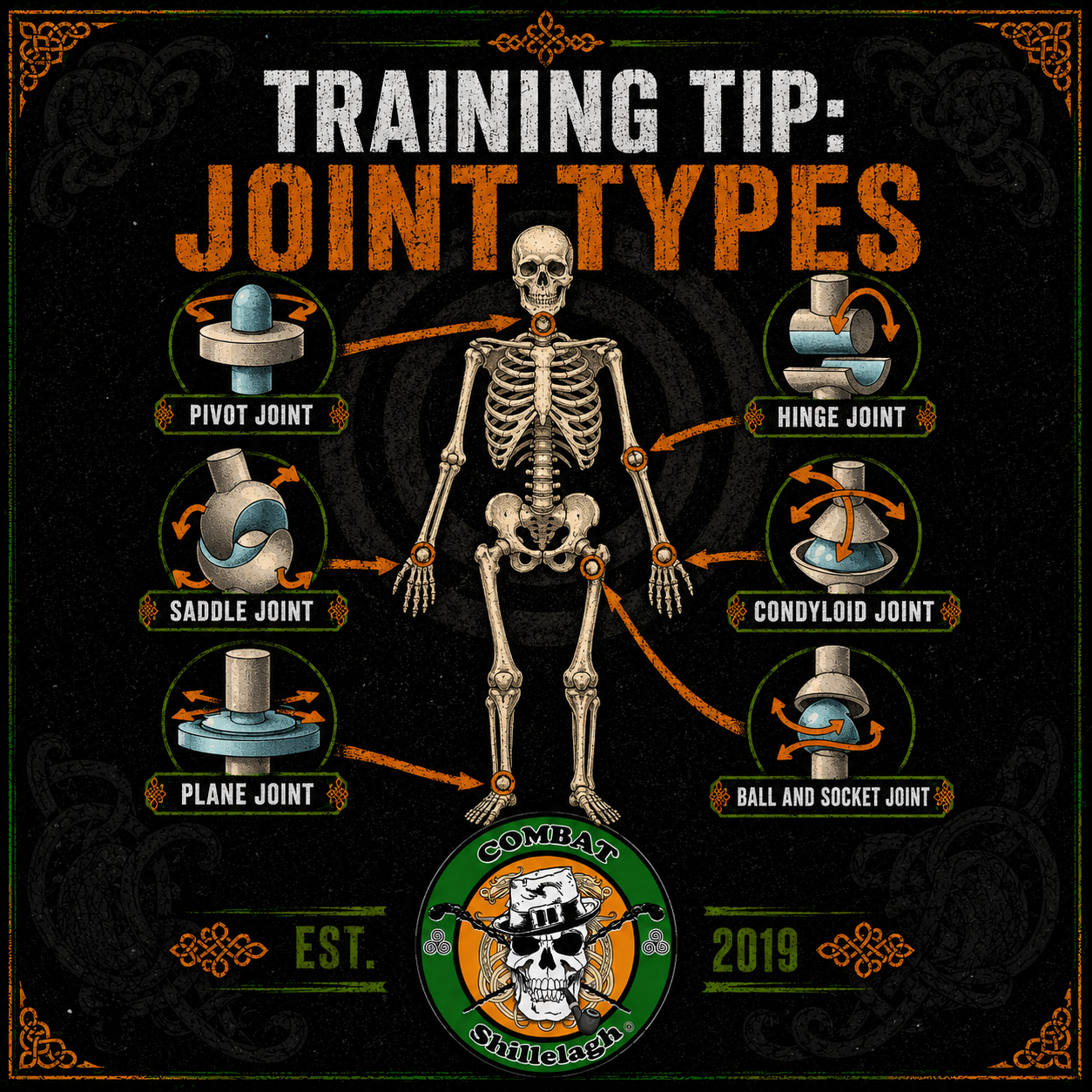
The human body contains several different types of joints, each designed to permit particular ranges and directions of movement. A hinge joint, such as the elbow or knee, primarily allows flexion and extension. A pivot joint permits rotational movement. Ball-and-socket joints, such as the shoulder and hip, allow movement through a much larger number of directions. Condyloid joints permit movement along two primary axes, while saddle joints provide considerable mobility in specific planes. Plane or gliding joints allow relatively small sliding movements between surfaces.
You do not need to become an orthopedic surgeon to practice Irish Stick Fighting, but having a basic understanding of these differences is extremely useful. Anatomy tells us what kinds of movement are normal for a particular joint and, equally importantly, where the limits of that movement begin. Joint manipulation generally works by controlling a limb and progressively influencing one or more joints toward the limits of their normal range while maintaining superior position and leverage. Done carefully in training, this can create enough pressure to influence posture, movement, grip, or balance without relying on a hard strike. That distinction matters. The objective during training is not to injure the joint. It is to understand the mechanics well enough that we can recognize how very little movement may be required once proper leverage and positioning are established.
The Shillelagh Is a Long Lever
This connects directly with our previous discussion of weaponized physics. The shillelagh is essentially a lever. When we place that lever against or around part of the body, relatively small movements at one end can create considerably greater mechanical influence somewhere else. That is one reason a trained practitioner does not necessarily need tremendous muscular strength to control another person’s arm. The weapon gives us another mechanical advantage. Rather than trying to overpower someone’s arm using only our hands and upper-body strength, the shillelagh can become part of the structure doing the work.
This is a recurring principle throughout Combat Shillelagh: use mechanics rather than strength whenever possible. The same physics we use when striking are still operating when we control. We are simply applying them differently. In a strike, the weapon’s length helps create speed, reach, and impact. During a control, the length of the weapon can provide leverage. The stick has not changed. The application has.
Control the Joint, Affect the Structure
The really important lesson is that joint manipulation is rarely just about the joint itself. The wrist connects to the elbow. The elbow connects mechanically to the shoulder. The shoulder influences the torso. The torso connects to the hips, and the hips ultimately influence the person’s base and balance. That means controlling one point can begin producing changes elsewhere.
Imagine someone whose arm and shoulder are suddenly being influenced by external pressure. Their natural reaction will often be to move their body in an attempt to relieve that pressure. They may rotate the torso, reposition the feet, bend the knees, turn the shoulders, or change their grip. Those movements can change their structure. And structure is one of the subjects we repeatedly return to in Irish Stick Fighting.
Our goal is to maintain our own structure while compromising theirs. This connects directly with our discussions about body alignment and the Body Envelope. If I have to lean dramatically, overextend my arms, or pull myself out of balance to create a control, then I may be sacrificing my own structure in the process. Good leverage should allow the weapon and body mechanics to do much of the work while we remain capable of moving, striking, disengaging, or transitioning if circumstances change.
One Joint Can Influence Another
As students progress through the system, they begin to recognize what we might call a chain reaction through the body. The wrist affects the elbow. The elbow affects the shoulder. The shoulder affects the spine. The spine affects the hips. The hips affect the knees and feet.
This is why a small movement at one joint can sometimes result in a much larger movement of the entire person. The objective is not necessarily to attack every joint individually. Instead, we begin learning how the body behaves as a connected mechanical structure. This is very similar to our study of the kinetic chain when generating strikes, except now we are looking at someone else’s kinetic chain.
When we strike, we try to connect our structure so force travels efficiently from the ground through the body and into the shillelagh. When controlling another person, we are often looking for opportunities to interfere with that connection. The principles are two sides of the same coin.
From Joint Control to Balance Disruption
One of the most useful outcomes of a properly applied control is not simply discomfort. It is movement. When someone moves to relieve pressure, their balance and posture may change. Their weight may shift onto one leg. Their shoulders may rotate away from their hips. Their feet may cross or become poorly positioned. Their upper body may begin traveling outside their base. That creates additional tactical possibilities.
This is where the joint-control material begins connecting with throws and takedowns found within our Stanza material. The joint itself becomes a way to influence the larger structure. Rather than trying to wrestle an entire person directly to the ground, we learn to affect particular parts of the structure and allow those changes to cascade through the body. Again, this is fundamentally an application of leverage, angles, body mechanics, and balance.
The Shillelagh as a Tool for Weapon Control
At higher levels, these same principles can also help us understand weapon control and disarming concepts. If another person is gripping an object, the problem is not simply the object. Their fingers, wrist, elbow, shoulder, posture, and balance all contribute to maintaining control of it. Trying to yank a weapon directly out of someone’s hand can quickly become a contest of strength. That is rarely the most intelligent mechanical solution.
A more sophisticated understanding looks at the entire structure supporting the grip. If position, leverage, and body alignment can be changed, the grip itself may become less effective. This is one reason learning basic anatomy is valuable: the weapon and the person holding it are not separate problems. They form one connected system.
This also reinforces an important point about real-world self-defense: a disarm should never be treated as a guaranteed technique. Armed encounters are chaotic and dangerous. In training, weapon-control exercises are tools for understanding leverage, position, timing, and structure—not promises that a particular movement will work perfectly against every person under every circumstance.
Pain Is Information, Not the Entire Strategy
Joint manipulation can create significant discomfort, and the body naturally attempts to move away from pain. That reaction can certainly be useful during training because it provides immediate feedback that leverage is being established. But we should not build our entire strategy around the assumption that another person will respond predictably to pain.
People respond differently under stress. Adrenaline, intoxication, injury, emotion, and individual pain tolerance can dramatically change someone’s reaction. The more dependable objective is therefore mechanical control of structure and position, with discomfort being a secondary consequence rather than the sole reason the technique works.
If the control only works because the training partner cooperatively moves when something hurts, we should examine it more carefully. If the position also compromises balance, limits movement, interferes with grip, and improves our own positioning, we have something much more mechanically useful.
Train Joint Manipulation Slowly
This is one of the areas where our discussion about training safely becomes especially important. Joint-control drills should be practiced slowly and progressively. Unlike a large muscle that may tolerate considerable pressure, ligaments and other joint structures can be injured quickly if a training partner suddenly forces a movement. Speed is therefore our primary safety valve.
Establish the position first. Apply pressure gradually. Give your partner time to respond. Release immediately when they signal that the limit has been reached. There is no training value in proving that a joint can be injured. We already know that. The purpose of training is to develop sensitivity: to recognize the mechanical position before excessive force becomes necessary.
In fact, students who need enormous amounts of strength to make a joint manipulation work should usually slow down and examine their leverage, angle, positioning, and body alignment. Better mechanics should reduce the amount of effort required.
Move Beyond “Just Hit Them With the Stick”
Striking remains an important part of Irish Stick Fighting, but the deeper we explore the shillelagh, the more possibilities begin to appear. It can strike and defend, certainly, but it can also frame, post, redirect, lever, control, influence balance, and help us manage another person’s structure. That is where familiarity with joint types becomes useful.
We begin seeing the body not simply as a collection of targets but as an interconnected mechanical system. The wrist relates to the elbow. The elbow relates to the shoulder. The shoulder relates to the torso. The torso relates to the hips and legs. Change one part of that system and other parts often have to compensate. The shillelagh gives us a lever through which we can explore those relationships.
As with so many concepts in Combat Shillelagh, the goal is not to memorize an endless list of isolated techniques. The goal is to understand the principles beneath them. Learn how the joints normally move. Understand leverage. Recognize angles. Maintain your Body Envelope. Preserve your alignment. Move your feet when necessary. Use the weapon as part of your structure rather than as something disconnected from it.
Practice the Stanzas slowly and diligently, paying attention to what happens throughout the entire body rather than focusing only on the joint being controlled. Notice how the shoulder changes when the wrist changes. Watch the hips and feet. Pay attention to where balance begins to disappear. That is where the real lesson resides.
A shillelagh may look like a simple piece of wood, but in the hands of someone who understands anatomy, leverage, angles, and structure, it becomes something considerably more sophisticated: a mechanical tool for controlling the larger system of the human body rather than simply striking it.