
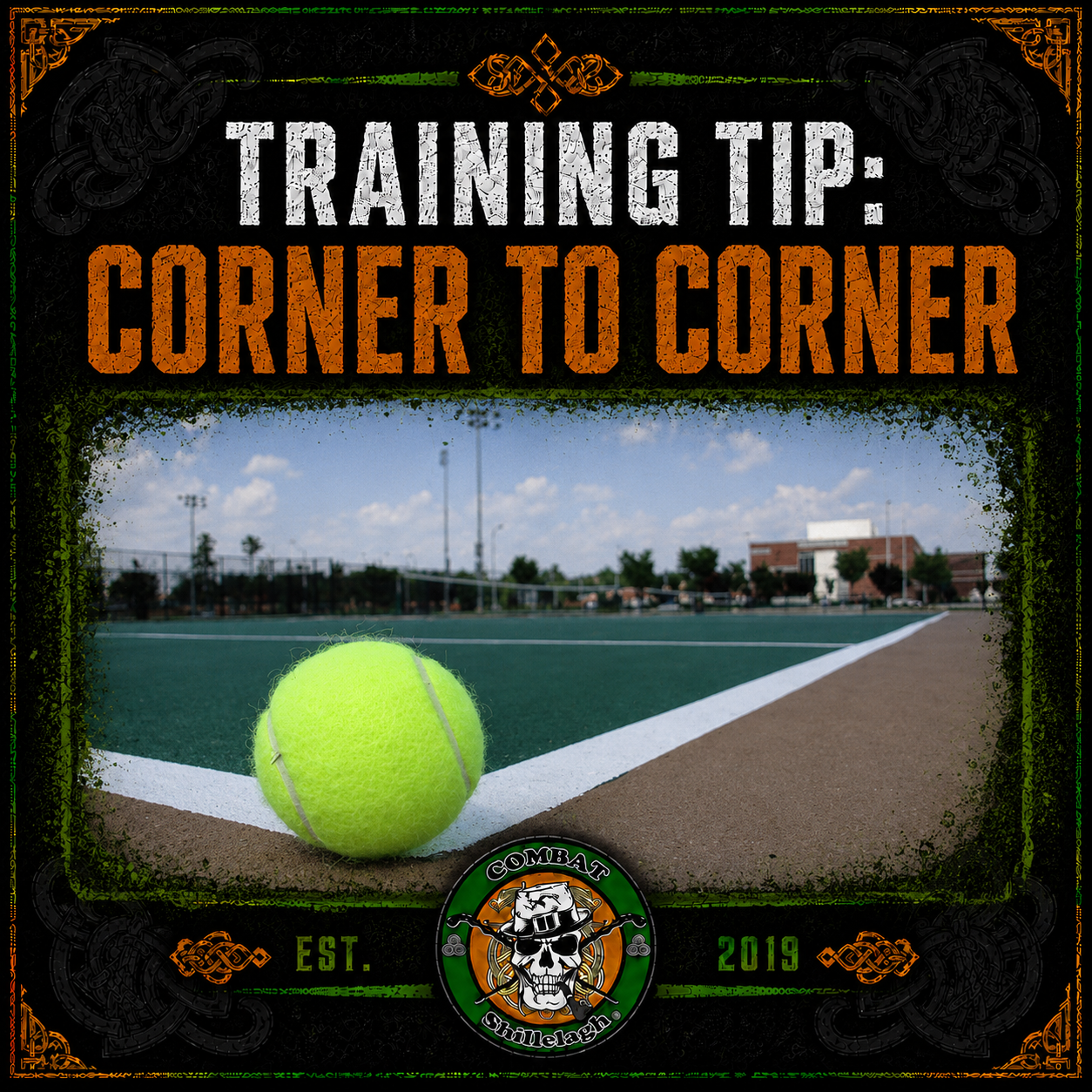
At first glance, a tennis court probably seems like a strange visual reference for Irish Stick Fighting. A tennis ball bouncing from one side of the court to the other does not immediately bring to mind a shillelagh, bata, or traditional stick-fighting exchange. But the comparison becomes useful once we start talking about striking patterns, angles, and the idea of moving an opponent from corner to corner.
As students progress through the levels of Combat Shillelagh, they become increasingly familiar with our 9 Gates concept and the different striking and defensive angles associated with those positions. Early in training, we often isolate individual movements so that students can understand the mechanics. You learn the angle, understand the target, develop the footwork, and practice delivering the strike with proper structure. Eventually, however, isolated strikes need to become combinations, and combinations need to become adaptable patterns rather than memorized sequences. This is where the idea of going corner to corner becomes valuable.
Think Like a Tennis Player
Watch a good tennis player when they have gained control of a rally. They do not continually hit the ball directly back to where their opponent is already standing. Instead, they make the other player move. A shot goes deep into one corner. The opponent rushes across the court to reach it. The next shot is sent toward the opposite corner, forcing them to reverse direction and cover as much distance as possible. The tennis player is not simply trying to hit the ball harder. They are manipulating position, distance, timing, and recovery.
The same basic idea can be applied to striking patterns in Irish Stick Fighting. Instead of repeatedly attacking targets that are close together, we can deliberately select targets that are separated by the largest practical distance. Think left temple to right ankle. Or right temple to left ankle. Or left side of the body to right side of the body. The specific targets can change. The underlying concept remains the same: the follow-up attack forces the defender to travel across their own structure in order to respond. You are making them move from one corner to the other.
Make the Defender Chase the Stick
A defender who is successfully dealing with an attack has to recognize the incoming movement, identify the likely target, position their body or weapon appropriately, and prepare for whatever comes next. If your strikes repeatedly arrive along similar lines, at similar heights, and with similar timing, the defender’s job becomes easier. They begin to recognize the pattern, and their defensive structure may only need to move a relatively short distance from one position to another.
Corner-to-corner striking changes that problem. Imagine that the first strike travels toward the left side of the head. The defender moves their shillelagh and body structure to deal with that attack. Your next strike immediately travels toward the opposite ankle. Now the defensive movement has to travel across the body while simultaneously changing height. The defender is no longer simply shifting a few inches. They are trying to reorganize their entire defensive structure before the next strike arrives. If the next attack then returns high to the opposite side, the problem becomes even more difficult.
This is not about swinging wildly from one extreme to another. The strikes still need proper mechanics, targeting, body alignment, and control. The advantage comes from making the defender’s recovery larger than your own.
Get Ahead of the Curve
An important concept in combination striking is that the first strike does not always have to finish the encounter. Sometimes its job is to create the conditions for the second or third strike. If the first attack forces the defender to commit strongly toward one side of their body, their defensive structure may momentarily become weaker somewhere else. A high attack may draw their attention and weapon upward. A low attack may force them to compress their structure or redirect their hands downward. The follow-up attack exploits the change you helped create.
Once you get ahead of that defensive cycle, you want to stay ahead of it. The defender begins chasing. They respond to the first strike, but the second is already developing. They move toward the second, but now the third is arriving somewhere else. Instead of making independent tactical decisions, they increasingly become reactive. That is the position we want to create. You are no longer simply trading techniques. You are forcing the other person to solve one problem after another faster than they can comfortably process them.
Eventually, something tends to break down. Their feet stop moving efficiently. Their posture begins collapsing. Their weapon gets out of position. Their elbows move outside their Body Envelope. Their balance shifts too far in one direction. Or a target simply becomes exposed. That opening is what the earlier strikes were helping to create.
Corner to Corner Is About More Than Targets
It is tempting to think of this concept only as choosing targets on opposite sides of the body, but there is more happening underneath the surface. A good corner-to-corner combination can manipulate height, angle, distance, rhythm, and direction at the same time. A high strike followed by a low strike changes elevation. A left-side strike followed by a right-side strike changes direction. Stepping off the line during the combination changes angle. Changing the timing between the strikes introduces broken rhythm. Adjusting hand position on the bata can subtly lengthen or shorten effective range. Now we are no longer simply throwing two strikes. We are combining multiple principles into one tactical problem.
This connects directly with many of the concepts we have discussed throughout Combat Shillelagh training. The 9 Gates give us a framework for understanding available angles. Broken rhythm helps prevent the combination from becoming predictable. Footwork allows us to maintain the correct range rather than reaching. Body alignment keeps our structure intact while changing direction. The Body Envelope helps prevent our arms from becoming disconnected from the rest of the body. The kinetic chain allows each strike to generate power without requiring excessive muscular effort. As students progress, these concepts should increasingly stop feeling like separate lessons. They begin interacting with one another.
Do Not Confuse Big Movement With Wild Movement
There is an important distinction to make. Going corner to corner does not mean making enormous, uncontrolled swings. We want the defender to have to make large corrections. We do not necessarily want to make large corrections ourselves.
Efficient striking should still come from organized body movement. The weapon should travel along useful paths, and the practitioner should maintain balance throughout the combination. If throwing a low follow-up strike causes you to bend dramatically at the waist, lose your footing, or overextend outside your structure, then you have traded one tactical advantage for another problem.
The goal is to stretch their defense without stretching your structure. This is where proper footwork becomes critical. If the next target is outside your effective range, move your feet. If the angle is poor, reposition yourself. Allow the entire body to support the weapon rather than forcing the arms to do all the work. Your shillelagh should move quickly between targets while your own structure remains capable of changing direction again.
Mix and Match the Gates
A useful way to explore this concept in training is to work through the 9 Gates and deliberately pair attacks that are far apart. Start slowly. Choose one high target and one low target on the opposite side. Practice moving between them while maintaining your alignment and balance. Once the mechanics feel comfortable, reverse the sequence. Then change the targets: high left to low right, low right to high left, mid-level right to mid-level left, high right to low left.
Once those movements become comfortable, begin adding footwork. Change the angle of entry. Change the hand position. Alter the rhythm between the first and second strike. Then stop deciding the entire combination in advance. Allow the first movement to create information. See how your partner responds and choose the second target based upon the opening their defensive reaction creates. That is where the drill starts becoming much more interesting.
Patterns Eventually Become Principles
Early in training, striking patterns give students something specific to practice. A sequence can help develop coordination, targeting, transitions, and familiarity with different angles. But we do not want students to become dependent upon memorized combinations. The larger objective is to understand why the combination works.
Corner-to-corner striking works because it creates a difficult recovery problem for the defender. It moves their attention and structure across large areas. It can change height and direction. It forces repeated adjustments. And when combined with good timing and broken rhythm, it can prevent the defender from ever becoming fully settled.
Once you understand that principle, the exact sequence becomes less important. You do not need to memorize “left temple, right ankle” as though it is a magic combination. You need to understand what happened when the defender committed to protecting the left temple and recognize what became available afterward. That is the transition from practicing patterns to understanding fighting.
Keep Them Moving
The tennis analogy ultimately gives us a simple way to remember the concept. If you have the opportunity to make your opponent run from one back corner of the court to the other, why keep hitting the ball directly back toward the center?
In Irish Stick Fighting, we can apply the same logic. Make them defend high, then low. Move them left, then right. Change the angle. Change the rhythm. Make their defensive structure travel farther than your attacking structure. Once you get ahead of the curve, keep them trying to catch up.
Eventually, the defender may be late, their structure may break, or an opening may appear that was not available when the exchange began. That is the real purpose of corner-to-corner striking. We are not simply learning how to hit multiple targets. We are learning how to use one attack to help create the next opportunity.
And when striking patterns begin working together with distance, angles, timing, footwork, structure, and broken rhythm, Irish Stick Fighting stops looking like a collection of individual techniques and starts becoming what it should be: a dynamic system for solving an ever-changing problem in real time.