
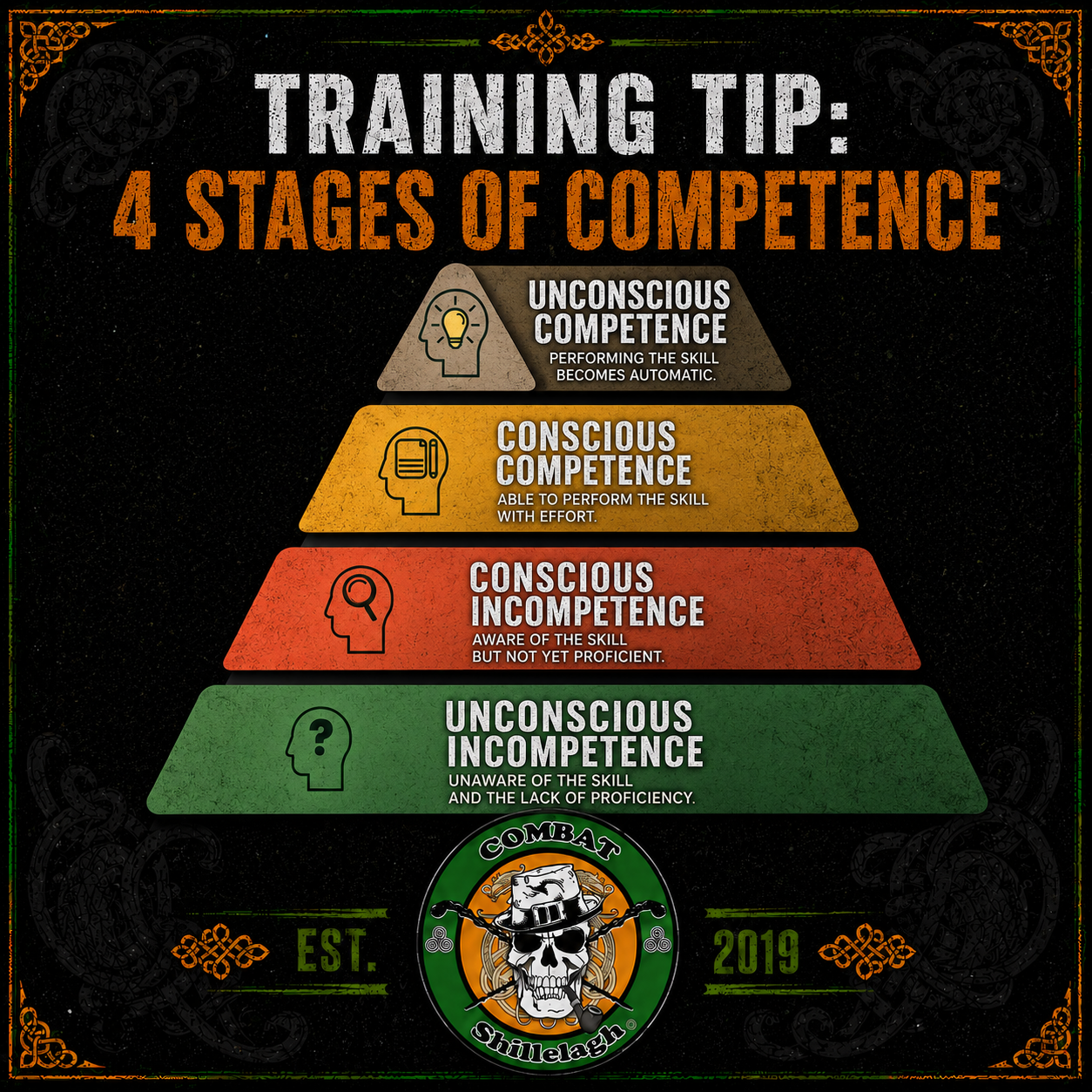
Learning Irish Stick Fighting is not simply a matter of collecting techniques. A student can watch a strike, imitate the movement, and even make contact with a target without necessarily understanding what makes that movement work. Real proficiency develops gradually as individual details become understood, practiced, refined, and eventually integrated into movement that no longer requires constant conscious thought. One useful way to understand that process is through the Four Stages of Competence: unconscious incompetence, conscious incompetence, conscious competence, and unconscious competence.
This model gives us a useful framework for understanding why martial arts training can sometimes feel frustrating, why attention to detail matters so much, and why simply repeating a movement is not the same thing as developing skill. In Combat Shillelagh, virtually every larger movement is built from numerous smaller components. How you stand, where your weight is located, how your hands are positioned on the bata, where your elbows are in relation to your Body Envelope, what your feet are doing, how your spine is aligned, where your eyes are looking, and when you choose to move are all pieces of what may appear from the outside to be a very simple action.
Stage One: Unconscious Incompetence
The first stage is unconscious incompetence. Put simply, you do not yet know what you do not know.
This is where almost everyone begins. A new student may look at a basic strike and think the movement appears straightforward. Raise the shillelagh, swing it toward the target, and recover. From the outside, that may appear to be the entire technique. What the beginner does not yet recognize are all of the smaller details happening underneath that visible movement.
Where is the target? What angle should the weapon travel through? Is the student reaching with the arm or generating power through the body? Are the feet moving with the strike? Is the body properly aligned? Is the student overextending outside the Body Envelope? What happens immediately after contact? Is the weapon still protecting the centerline? Can the student move again without first recovering their balance?
At this stage, mistakes often do not feel like mistakes because the student has not yet developed the knowledge necessary to identify them. This is not a negative stage of learning. It is simply the starting point. Good instruction begins revealing details that were previously invisible.
Stage Two: Conscious Incompetence
The second stage is conscious incompetence, and it can sometimes be the most frustrating part of martial arts training. Now you know enough to recognize what you are doing incorrectly, but you cannot consistently correct it yet.
A student might suddenly realize that they are lifting their shoulder every time they strike. They may notice that they lean forward when trying to reach. They might understand that their rear foot is pointing in the wrong direction or that their hand position on the shillelagh is limiting their range. They can see the problem, and perhaps even explain the correction, but the mistake continues appearing during practice.
This is actually progress.
Awareness must come before correction. You cannot intentionally change something you do not recognize. As students develop, they begin noticing details that they previously overlooked. That increasing awareness sometimes makes them feel as though they are getting worse when, in reality, their ability to evaluate themselves is improving.
This is one reason attention to detail is so important in Irish Stick Fighting. A student may understand a broad concept such as distance, but applying distance correctly requires many smaller skills working together. You need to recognize the space between yourself and another person. You need to understand your own reach and the effective reach of the shillelagh. Your stance and body position affect that distance. Your hand placement can lengthen or shorten the weapon’s usable range. Your footwork changes the equation again.
The large concept depends upon the details.
Stage Three: Conscious Competence
The third stage is conscious competence. At this point, you can perform the skill correctly, but doing so still requires attention and effort.
Consider a basic #1 strike. A student at this stage may consciously remind themselves to maintain their structure, move the feet, rotate the body, control the weapon’s angle, select the intended target, adjust the grip appropriately, maintain their Body Envelope, manage tension at impact, and recover into a useful position.
The strike works, but the student is still actively managing the components.
This stage is where a tremendous amount of productive training takes place. Repetition matters here, but correct repetition matters far more than repetition alone. Performing something incorrectly hundreds or thousands of times does not magically produce competence. It can simply make the error more deeply ingrained.
That is why we frequently emphasize slowing down during Combat Shillelagh training. Speed can hide mistakes. A student can sometimes use momentum, athleticism, or strength to force a movement to work. Slower practice makes those shortcuts much more difficult to hide. It gives the practitioner time to evaluate the details and make corrections.
This connects directly to our discussions about training safely as well. Slow, deliberate practice allows us to work on weapon contact, structural disruption, positioning, joint manipulation, takedowns, and other potentially dangerous material while maintaining control. At the same time, it gives the nervous system repeated exposure to the correct mechanics.
The goal is not to remain slow forever. The goal is to establish quality before adding speed.
Stage Four: Unconscious Competence
The fourth stage is unconscious competence. This is where the skill has been practiced and refined to the point that many of its components can happen without deliberate conscious management.
Think about something as ordinary as walking. You probably do not consciously tell yourself to shift your weight, move one foot, stabilize the pelvis, swing the opposite arm, place the foot, transfer weight, and repeat. The process has become automatic.
We eventually want many of our fundamental Irish Stick Fighting skills to operate in much the same way.
You should not have to conduct a mental checklist before every strike. You should not need to consciously remind yourself every second to maintain balance, keep the elbows connected, manage your centerline, or move your feet. Those principles should gradually become part of how you naturally move.
This becomes particularly important when we connect martial arts training to real-world violence. Under stress, your available cognitive bandwidth can become limited. Adrenaline, fear, uncertainty, movement, noise, and rapidly changing circumstances all compete for your attention. That is not the ideal moment to consciously remember twelve separate mechanical instructions for performing a basic movement.
The fundamentals need to be sufficiently ingrained that they require less conscious processing.
That does not mean an advanced practitioner stops thinking. Far from it. It means conscious attention can move toward larger tactical problems because the fundamentals require less mental effort.
Instead of thinking, Where should my elbow be?, you can think about what the other person is doing.
Instead of thinking, How do I make this strike?, you can recognize whether striking is appropriate at all.
Instead of thinking, Which foot moves first?, you can focus on distance, timing, position, environment, and changing threats.
Technical proficiency frees cognitive resources for problem solving.
Attention to Detail Builds the Foundation
The progression through the Four Stages of Competence depends heavily on attention to detail. Every large movement we perform is made up of smaller movements, positions, timings, and decisions.
Take something as apparently simple as standing at an appropriate distance from a training partner. Your feet need to be positioned correctly. Your weight needs to remain functional. Your shoulders and spine should be aligned. Your chin should be protected. Your hands and shillelagh should occupy useful positions. Your weapon should relate appropriately to your own reach and that of your partner. Your eyes should gather useful information without becoming fixated on a single point.
Now add movement.
Then add a strike.
Then add an opponent who is moving.
Then add combinations, defensive actions, changing ranges, resistance, uncertainty, and pressure.
Complexity grows quickly.
That is why we structure training around building fundamentals and then adding layers. The foundation has to support everything that follows. If the basic mechanics are poorly understood, increasing speed and complexity usually magnifies the problems rather than solving them.
A student who repeatedly overextends during a slow strike will probably overextend even more dramatically when moving quickly. A practitioner who loses balance during basic footwork is unlikely to become more stable simply because someone begins attacking them. A person who cannot intentionally identify a target during controlled practice will probably not suddenly develop precise targeting under pressure.
The details matter because the details become the skill.
Practice Correctly, Then Add Complexity
The Four Stages of Competence also remind us that progress in martial arts is not simply measured by how many techniques we know. Knowing more movements is not necessarily the same thing as becoming more capable.
Sometimes the most productive training involves returning to something very basic and examining it more closely. A strike you learned months ago may reveal new details once you understand body alignment. Footwork may take on new meaning once you understand range. The Body Envelope may change how you think about close-range weapon work. The kinetic chain may completely alter how you generate power.
You are performing the same movement, but you are no longer the same student performing it.
This is one of the reasons martial arts can remain interesting after decades of practice. Increased knowledge does not simply give us more things to practice; it gives us deeper ways to understand the things we already practice.
Our objective in Combat Shillelagh is to provide students with a framework in which they can recognize these details, understand why they matter, practice them safely, and gradually integrate them into increasingly complex situations. Each layer should rest on something that came before it.
Ultimately, the goal is not simply to perform Irish Stick Fighting techniques correctly while thinking carefully about every component. The goal is to practice those fundamentals correctly often enough that good structure, movement, positioning, and weapon mechanics become increasingly natural.
That is the journey from unconscious incompetence to unconscious competence. At first, you do not know what you are missing. Then you begin seeing the mistakes. Next, you learn to correct them deliberately. Eventually, the corrections become part of the way you move.
Build that foundation carefully. Pay attention to the small details. Practice them correctly and consistently. Everything we add later depends upon them.