One of the easiest mistakes to make in martial arts is to think about body alignment only when we are standing still. We check our posture, set our feet, position our hands, and make sure everything looks correct before beginning a technique. The problem is that fighting does not happen while we are posing. It happens while we are moving. That is what makes body alignment during transitions so important.
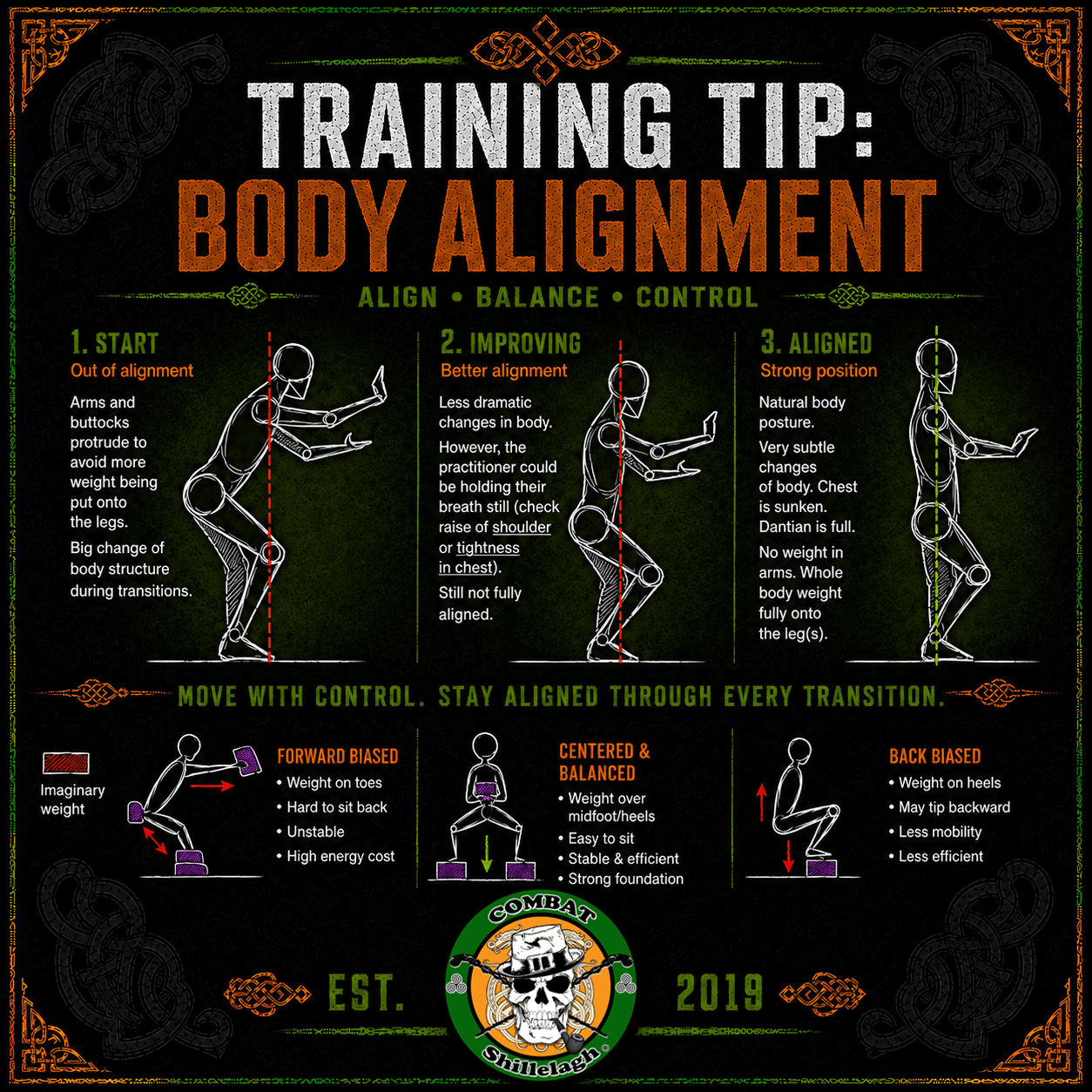
The accompanying illustration demonstrates how much unnecessary space the body can occupy when posture breaks down during movement. A beginning student may push the arms forward, send the hips backward, raise the shoulders, collapse the chest, or otherwise distort the body’s natural structure in an attempt to maintain balance. The student may still complete the movement, but they are doing so by physically compensating for instability. As alignment improves, those large compensations become smaller. Eventually, the goal is for the body to remain naturally stacked and balanced while the movement happens around that structure.
The Shillelagh Changes the Equation
For Irish Stick Fighting, this concept has enormous importance because we are not simply moving our bodies. We are moving our bodies while managing a weapon that extends beyond them. A shillelagh may not feel particularly heavy in the hand, but once it begins moving, its length creates leverage. The farther the weapon travels away from the body, the more influence it can have on your balance and structure.
This connects directly to several concepts we have discussed throughout our Combat Shillelagh training: body mechanics, the kinetic chain, footwork, power generation, striking structure, range, and recovery. Imagine throwing a strike while reaching excessively with the arm. Your shoulder moves ahead of your hips. Your chest begins leaning forward. Your rear heel may lift unnecessarily. Your hips move backward to compensate for the weight moving forward. You may still hit the target, but you have sacrificed structure to do it.
A better approach is to allow the strike to emerge from coordinated movement of the entire body. The feet establish the base. The legs and hips move the body. The torso rotates. The shoulder and arm transmit that movement into the stick. The shillelagh becomes the final link in the kinetic chain rather than something you are trying to throw independently with your arm.
Transitions Reveal Problems
Many alignment problems are difficult to see when someone is standing in a guard position. A student can often create a technically correct-looking posture when nothing is happening. The real test begins when they move: step forward, change direction, strike, recover, transition from one angle of attack to another, or move from offense back into a defensive structure.
This is where excessive movement begins appearing. A student may strike and leave the weapon hanging far away from the body. They may lean dramatically toward the target. They may straighten the legs and raise their center of gravity. They may pull their hips backward while their upper body moves forward. They may tense the shoulders in an attempt to control the stick. Each of these actions makes the body occupy more space than necessary and forces other parts of the body to compensate.
Good movement becomes increasingly economical. Instead of different sections of the body fighting against one another for balance, the entire structure works together.
Think About Your Center, Not Just Your Stick
Irish Stick Fighting naturally draws our attention toward the weapon. Students understandably watch the shillelagh, think about the striking surface, and concentrate on where the stick is traveling. But sometimes the better training question is: What is your body doing underneath the stick?
If the weapon suddenly disappeared from your hand during the movement, would your posture still make sense? Would you still be balanced? Could you immediately move in another direction? Could you strike again? Could you defend? If the answer is no, there is a good chance the weapon is pulling your structure out of alignment.
This is also why our discussions about moving your feet are so closely connected to alignment. When the body needs to travel farther, the solution should usually be to reposition the base rather than stretch the upper body farther away from it. Move the body to the weapon. Do not continually sacrifice the body in order to make the weapon reach something.
Natural Posture Does Not Mean Rigid Posture
There is another important distinction here. Good alignment does not mean standing perfectly upright like a statue. Irish Stick Fighting requires rotation, level changes, directional movement, acceleration, deceleration, and changes in range. Your body will naturally lean, turn, compress, extend, and reposition itself. The goal is not rigidity. The goal is organized movement.
Think of the head, spine, hips, knees, and feet as parts of a connected structure. Movement can occur throughout that structure without any one section becoming unnecessarily disconnected from the rest. The shoulders should not have to tense dramatically to control the weapon. The hips should not have to shoot backward every time the hands move forward. The head should not consistently travel beyond the base of support simply because you are trying to reach farther. The more efficient the structure becomes, the less compensation the body needs.
Alignment Improves More Than Balance
Good alignment has benefits far beyond simply preventing someone from falling over. It improves power because force can travel through a connected kinetic chain. It improves speed because unnecessary movements are eliminated. It improves recovery because the body finishes a strike in a position from which another movement can immediately begin. It improves range management because footwork replaces excessive reaching. It improves endurance because the muscles are not constantly fighting to stabilize poor positions. And perhaps most importantly, it improves adaptability.
Combat Shillelagh is not about memorizing a collection of isolated poses. It is about learning principles that allow us to move, strike, defend, adjust, and solve problems while maintaining control of ourselves and our weapon. That means we should pay particular attention to what happens between techniques. The transition from guard to strike matters. The transition from strike to recovery matters. The transition from forward movement to lateral movement matters. The transition from one angle to another matters. Those moments often reveal more about the quality of someone’s body mechanics than the technique itself.
Train the Space Your Body Occupies
A useful way to evaluate your movement is to consider how much unnecessary space your body occupies during a technique. Are your hips suddenly moving backward while your hands move forward? Are your shoulders rising? Are you reaching instead of stepping? Is your chest collapsing? Are you leaning farther than the situation requires? Are you finishing strikes in positions that require an additional movement just to regain your balance?
Record yourself performing basic movements slowly and watch what happens to your posture throughout the entire action, not just at the beginning and end. The goal is not to make movement smaller simply for the sake of making it smaller. The goal is to remove movement that exists only because your body is compensating for poor structure.
In Irish Stick Fighting, efficiency matters. A shillelagh should move because the body moves well, not because the body is desperately trying to keep up with the stick. As skill develops, the dramatic adjustments begin disappearing. The hips, spine, shoulders, arms, legs, and weapon become increasingly coordinated. Balance becomes less something you consciously recover and more something that remains present throughout the movement.
That is ultimately what good body alignment gives us: the ability to move aggressively without losing ourselves in the movement. The strike may be powerful. The footwork may be fast. The direction may change suddenly. But underneath all of it, the structure remains ready for whatever comes next.