
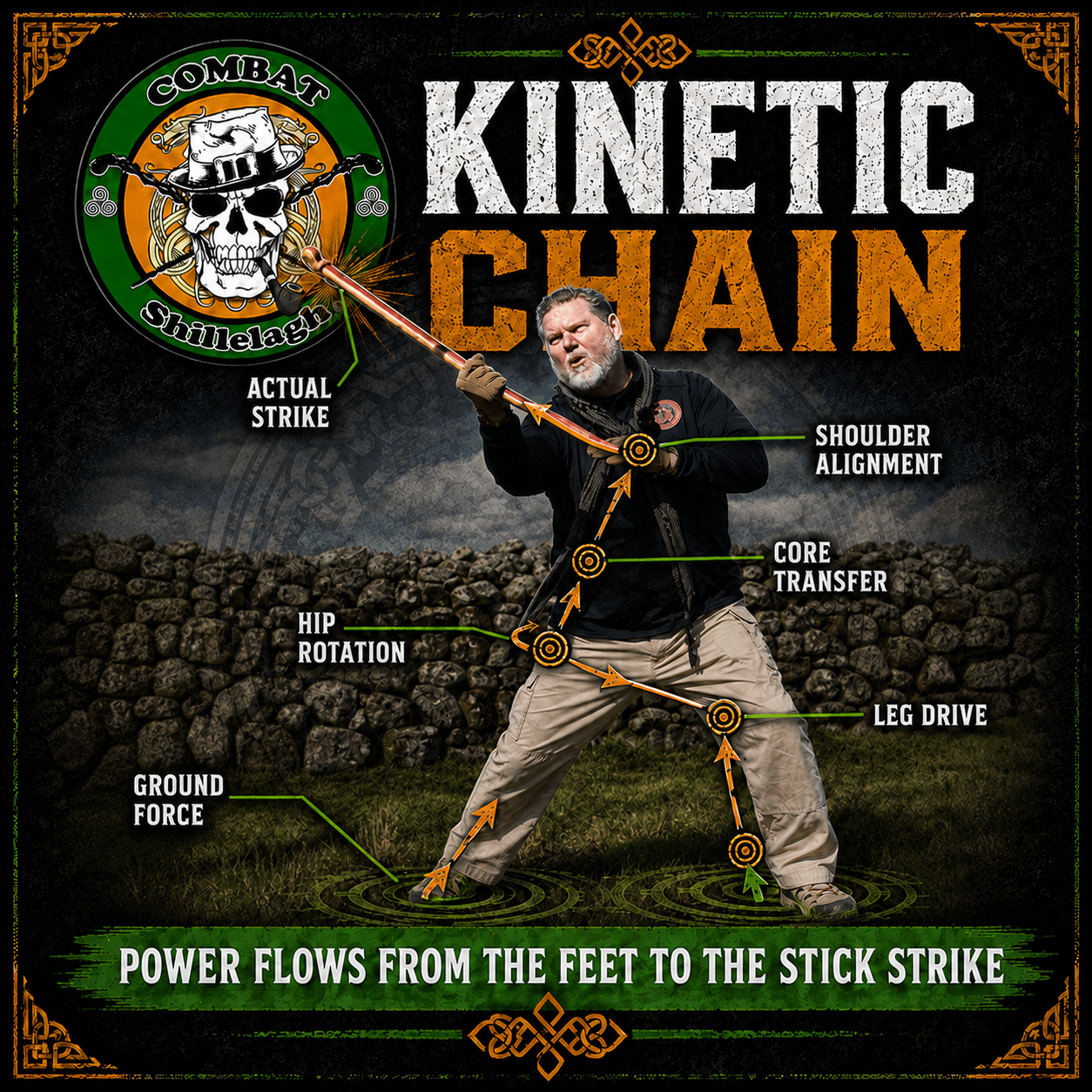
The kinetic chain is one of the most important ideas in martial arts, even if many students do not hear the term right away. In simple terms, the kinetic chain is the way power moves through the body. A strong strike does not come only from the hand, arm, or shoulder. Real power begins at the ground, travels through the feet and legs, moves through the hips and core, and then releases through the striking tool, whether that is a fist, elbow, foot, stick, or shillelagh.
This is why smaller martial artists can still hit very hard. They are not relying only on muscle. They are using structure, timing, body alignment, and efficient movement. When the kinetic chain works properly, the whole body contributes to the strike. When it breaks down, power leaks away.
Everything starts with the feet. Your feet connect you to the ground, and the ground gives you something to push against. If your stance is weak, off balance, or poorly rooted, then the strike loses force before it even begins. Good striking starts with solid contact with the ground and proper leg drive. We emphasize the concept that BOTH feet should be flat on the ground to give you this proper foundation.
From there, the legs help transfer force upward. The knees and hips should not be stiff or frozen. They should be engaged and able to move dynamically. The hips are especially important because they act like a major engine for rotational power. In many martial arts, the hips AND the spine help turn the body into the strike. That spinal rotation adds weight, speed, and intent.
Next comes the core. Your core links the lower body to the upper body. If the core is loose or disconnected, the power generated by the legs and hips never fully reaches the strike. A strong core does not mean flexing like a bodybuilder. It means creating connected movement so the body works as one unit.
Finally, the shoulders, arms, and hands deliver the force. The upper body should guide and release the power, not create it all by itself. This is a common mistake in martial arts. Many beginners try to strike using only their arms, which often leads to weaker hits and more fatigue.
This becomes especially important when striking with a stick or a shillelagh. A stick is not just an extension of the hand. It is a force multiplier. If the kinetic chain is working well, the stick carries the power of the whole body into the target. If it is not, the strike becomes little more than an arm swing.
When using a shillelagh, the practitioner should think about the strike flowing from the ground up. The feet root and drive. The legs support and move. The hips and spine rotate. The core transfers energy. The shoulder aligns the motion. The arm and hand guide the weapon. Then the striking end of the shillelagh delivers the impact. The weapon becomes the final link in the chain.
This is one reason why Irish Stick Fighting is so effective. The shillelagh allows the body’s natural mechanics to express power in a focused and efficient way. When trained properly, it teaches students not to rely on brute force, but on timing, alignment, and body unity. IN the Combat Shillelagh system, it is this modern day understanding of power generation that makes our system stand apart from others. We use modern concepts explained in modern day terms to help the student not only understand WHAT to learn, but HOW to learn.
In the end, the kinetic chain reminds us that power is a full-body event. Whether empty hand or armed with a shillelagh, the best strikes do not come from isolated movement. They come from the whole body working together with unified body movement.