
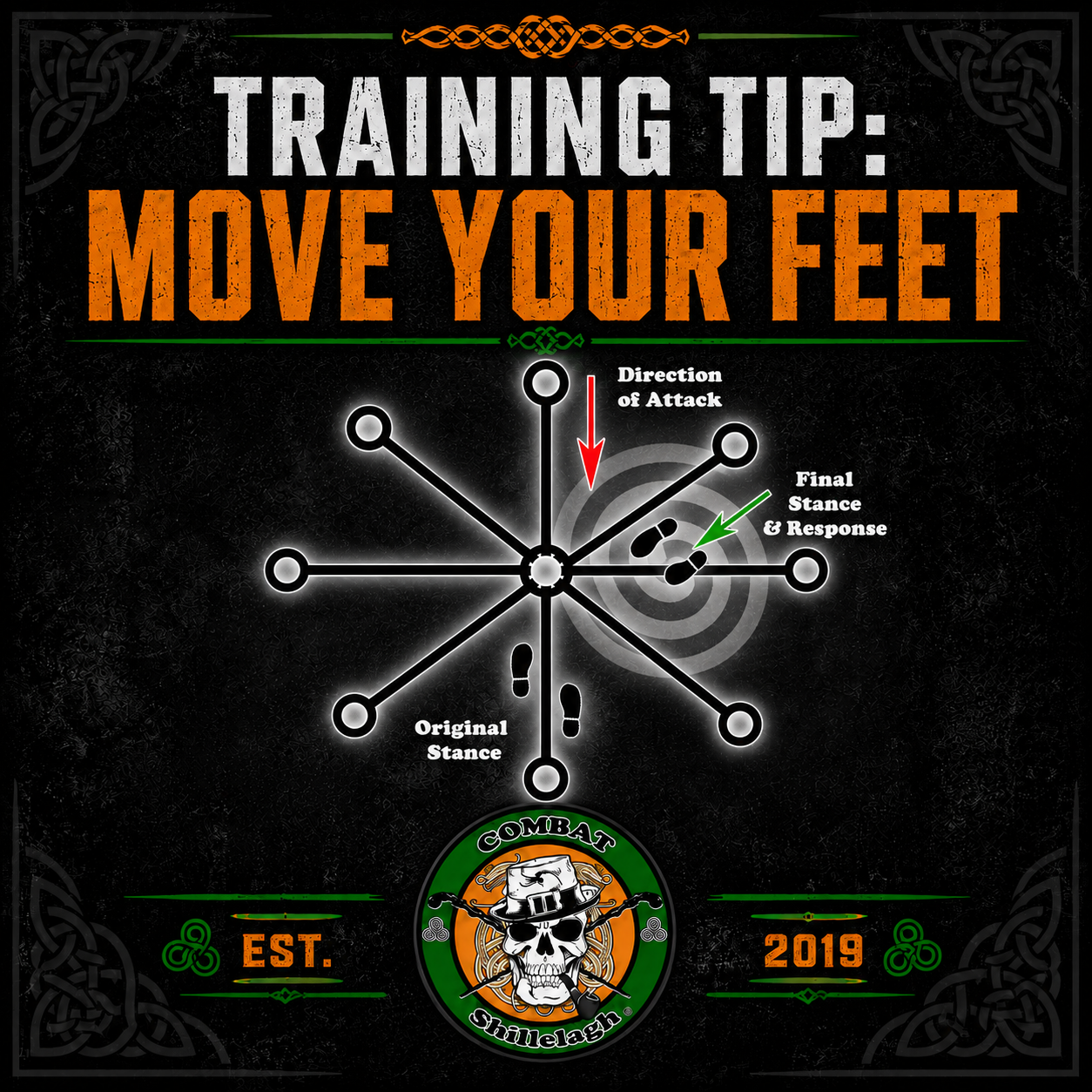
In Irish Stick Fighting, one of the most important habits you can develop is also one of the simplest to understand: move your feet. We stress this constantly in classes, seminars, and lessons because footwork is not merely something that supports your stick techniques. Footwork is what allows those techniques to function under pressure. Your strikes, blocks, counters, angles, and range management all depend on where your feet place your body. A technically perfect block becomes much less useful if you remain standing directly in the path of an incoming attack. A powerful strike does little good if you are too far away to connect. A fast counter may fail if your angle places you directly in front of your opponent’s strongest response. Your feet solve many of those problems before your hands ever have to.
Getting Off the X
At the foundational level, one of the most important concepts we teach is Getting Off the X. The “X” represents the location where the incoming attack is intended to land. If an opponent is striking toward your current position and you remain standing there, you are relying almost entirely on your defensive technique, timing, or ability to absorb the impact if something goes wrong. Moving your feet changes that equation. Instead of asking your block to do all of the work, you move your body away from the incoming line while simultaneously defending. This creates redundancy in your defense. If your block is slightly late or imperfect, your body may no longer be where the strike was originally directed.
At the early stages of training, this frequently means moving back left or back right at approximately a 45-degree angle while defending against the incoming attack. Lateral movement to the left or right can also remove you from the direct line of the strike. As your timing and confidence improve, you can begin working forward angles as well. Moving forward left or forward right can close the distance while taking you away from the center of the attack and placing you in a more advantageous position for the counter.
The concepts themselves are straightforward. Developing the ability to use them automatically is not. Good footwork requires repetition. You should practice these basic movements every time you train until your body recognizes the angle without requiring conscious thought. When something is moving quickly toward you, that is not the ideal moment to stop and calculate which foot should move first. The movement should already be part of your training.
Footwork Controls Distance
Changing angle is only one job of footwork. The other major function is controlling distance.
At the earlier levels of training, we often work within a relatively consistent engagement distance. You may step to one of the primary angles, but the overall relationship between you and your training partner remains fairly predictable. This allows you to concentrate on learning the mechanics of your strikes, blocks, counters, and movement without introducing too many variables at once.
As your experience increases, however, footwork becomes increasingly dynamic. Now you are not simply changing the angle. You are changing angle and distance at the same time.
A short step forward may allow you to remain near the edge of your preferred striking range. A larger retreating step may cause an opponent’s attack to fall short completely. A lateral step can move you outside the line of attack while maintaining approximately the same distance. You might close rapidly into very short range so that the opponent no longer has enough space to use the weapon in the way they intended.
This is where footwork changes from basic movement into tactical decision-making.
Create Distance, Maintain Distance, or Destroy Distance
An important way to think about footwork is that it allows you to do three things: create distance, maintain distance, or destroy distance.
Creating distance means moving beyond the opponent’s effective range. Instead of automatically blocking every strike, sometimes the simplest answer is to make the attack miss. If the opponent cannot reach you, the strike has already failed. From there, you may be able to move back into range as they recover.
Maintaining distance means keeping the engagement within a range that favors your current strategy. If you are comfortable at the end of your shillelagh’s striking range, your footwork can help preserve that distance while you change angles and continue moving.
Destroying distance means rapidly closing the gap. There are situations where moving farther away may be the correct answer, but there are also situations where moving closer changes the problem entirely. Closing into a tighter range can limit the opponent’s ability to generate large swinging motions and may transition the engagement toward trapping, checking, controlling, or collar-and-elbow range.
The important lesson is that distance should not simply happen to you. Whenever possible, you should be actively managing it.
Do Not Become a Stationary Target
One of the most common mistakes we see, particularly among newer practitioners, is static footwork. The student plants their feet and begins exchanging attacks and defenses from the same position. One person strikes. The other blocks. Then they strike back. The exchange starts to resemble two people taking turns rather than an actual dynamic engagement.
Avoid developing this habit.
Real movement creates different problems for both people. Step outside the attacking line. Let the opponent’s weapon fall short. Move back in as they recover. Change sides. Circle. Close the distance. Open the distance again. Force the other person to continually adjust where they are facing and how far their weapon needs to travel.
A moving target is harder to attack than a stationary one. More importantly, movement allows you to continually improve your own position.
Wherever Your Feet Go, Your Body Follows
One of the simplest principles we use is: wherever your feet go, your body follows.
If you want your body out of the path of an incoming attack, your feet have to take it there. If you want to place your body weight behind a powerful strike, the feet help move that weight into position. If you want to reach the opponent, your feet establish the distance. If you want to escape the engagement, the feet create the separation.
This sounds obvious, but it is easy to forget when you have a weapon in your hands. Students naturally focus on the bata or shillelagh because that is where the visible action is happening. They watch the opponent’s weapon and become preoccupied with what their own hands are doing.
Meanwhile, their feet stop moving. When in doubt, move your feet.
Good Movement Must Preserve Balance
Movement for its own sake is not enough. Effective footwork must preserve your structure and balance.
Taking the largest possible step is not necessarily better than taking a small one. If you overreach, your stance may become weak and your weight may become difficult to recover. An oversized step can delay your next movement and make changing direction more difficult. It may also compromise your ability to strike effectively because your upper body is now trying to compensate for poor lower-body positioning.
Your step should be large enough to accomplish the tactical objective and no larger than necessary.
Sometimes that means moving only a few inches. Sometimes it means taking a significant retreating step. Sometimes you may need several steps linked together. The goal is to arrive in a position where you are balanced, capable of defending, and ready to move again immediately.
Good footwork does not simply get you somewhere. It prepares you for what happens next.
Weapon Length Changes the Footwork Problem
As practitioners advance, weapon length makes distance management even more important. In the higher levels of the Combat Shillelagh system, students work with longer staffs and wattles as well as shorter cudgels. Each creates different range considerations.
A longer weapon may allow you to control a greater amount of space and engage from farther away. A shorter weapon may require you to close the gap more aggressively before it becomes effective. The footwork that works perfectly with one weapon may need to be adjusted when your weapon length changes.
You do not need to wait until advanced training to begin exploring these principles. Experiment with short steps and long steps. Practice moving laterally, diagonally, forward, and backward. Combine several movements together. Deliver the same strike from different distances and pay attention to how your timing, power, and positioning change.
Footwork Turns Techniques Into Fighting
Perhaps the most important reason to move your feet is that footwork connects everything else you are learning.
Without movement, Irish Stick Fighting can easily become a collection of individual techniques: strike, block, counter, reset. Good footwork removes the reset. The engagement begins to flow. You change the angle while defending, adjust the distance while striking, move outside the opponent’s line, enter again, and continue adapting as the situation changes.
That is when the art begins to feel alive.
Use your feet to get off the X. Use them to manage the Nine Gates. Use them to change angle, create distance, maintain distance, or destroy distance. Keep your balance, avoid becoming a stationary target, and develop the habit of moving every time you train.
Your hands may be holding the shillelagh, but your feet determine where the fight happens.
When in doubt, move your feet.