
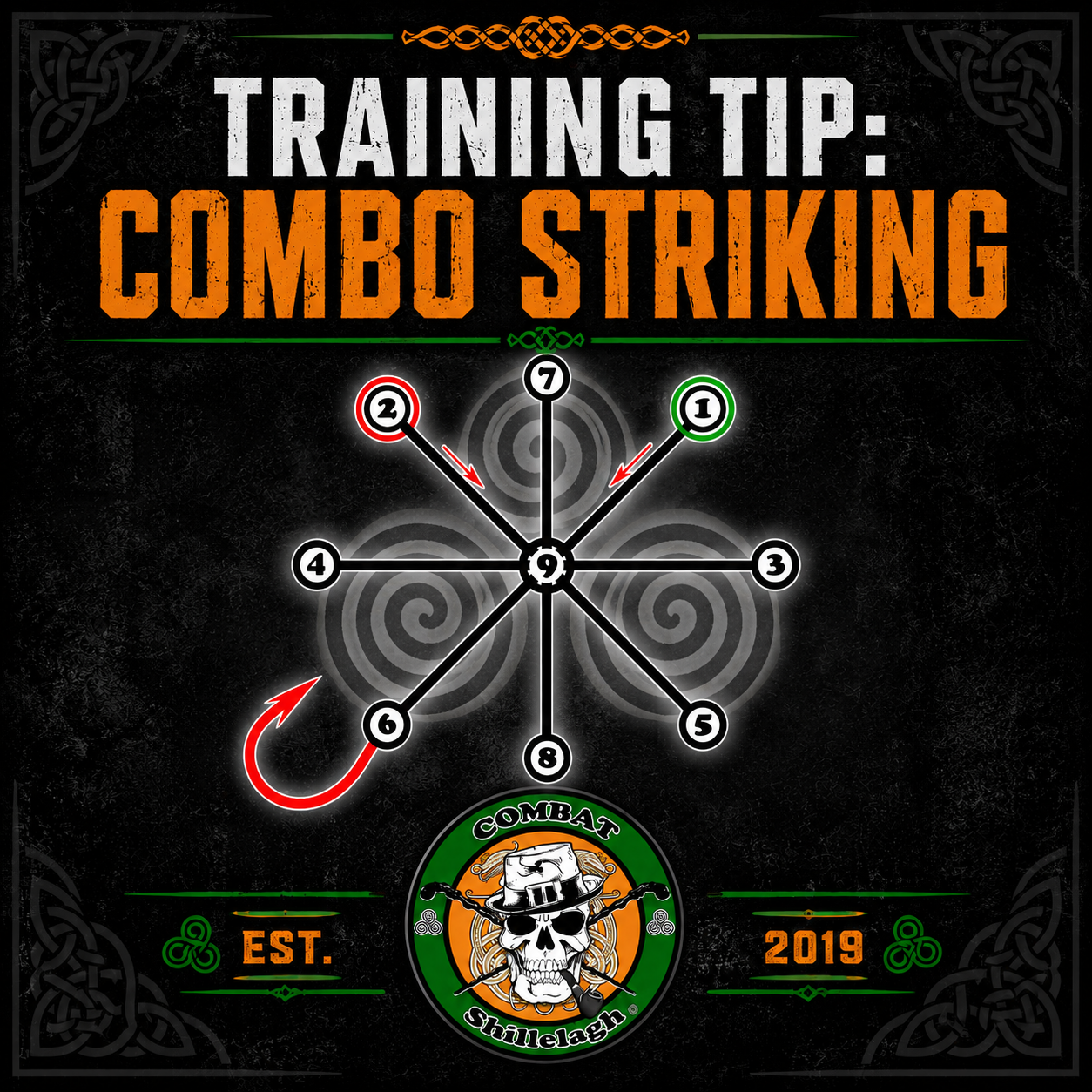
One of the major transitions that occurs as you progress through the Combat Shillelagh system is moving from practicing individual strikes to learning how to connect those strikes together. Early training is intentionally focused on fundamentals. You learn the core striking angles represented by the 9 Gates, develop proper body mechanics, understand distance and positioning, and become familiar with some of the specialty striking methods found throughout the system. Eventually, however, those individual movements need to become part of something larger. That is where combination striking begins.
During the first two Levels of the Combat Shillelagh curriculum, students are introduced to the core 9 Gates strikes and their corresponding angles. You also begin working with additional striking methods, including thrusting actions with the ferrule end, extended overtop strikes, feints, rotational or “helicopter” strikes, downward crushing movements, and other variations. Each of these techniques initially needs to be practiced individually so that the mechanics become familiar and repeatable. Think of these individual strikes as tools being added to your toolbox. The more familiar you become with each tool, the easier it becomes to select and combine them when the situation requires it.
A simple way to begin combination striking is by connecting movements that naturally flow together. For example, a downward strike on one angle can reverse direction and transition into an upward strike along a complementary angle. Several of the basic Gates naturally pair together in this way. Practicing these combinations begins to create a flowing, almost figure-eight or infinity-loop pattern in the movement of the Shillelagh. Instead of completing one strike, stopping, resetting, and beginning another, the ending position of one movement becomes the starting position of the next.
This concept is extremely important because efficient combination striking is not simply about throwing more strikes. It is about creating continuity of movement. Whenever possible, the energy and positioning created by one movement should help establish the next. Rather than constantly stopping and restarting the Shillelagh, you begin learning how to redirect its momentum and allow strikes to flow naturally from one angle into another.
Once those basic combinations become comfortable, students can begin integrating some of the specialty strikes found within the curriculum. A standard Gate strike might transition into a feint. A horizontal movement may develop into a rotational strike. A vertical movement may change into a different type of downward action. The possibilities begin multiplying quickly once the student understands that the individual strikes are not isolated techniques but components that can be mixed and matched.
This is where combination striking begins to become much more interesting. The purpose is not to memorize hundreds of fixed combinations. Instead, combinations are training exercises designed to teach you how movements connect. Initially, you may practice a specific two-strike or three-strike sequence exactly as it is shown. Once that movement becomes comfortable, however, you should begin understanding why those strikes connect and what other options are available from each position.
Every interaction has its own rhythm. Distance changes. Angles change. Position changes. Your opponent moves, reacts, withdraws, advances, or attempts to interrupt what you are doing. Because of that, the combination you imagined before an engagement may not be the combination that ultimately makes sense during it. The deeper objective is developing enough familiarity with your fundamental movements that you can select and connect them according to what is happening in the moment.
There is another layer to combination striking that we frequently discuss during Combat Shillelagh classes and seminars. Sometimes the most effective combination is not the most obvious continuation of the original movement. You can begin one action in a way that encourages your opponent to expect a particular follow-up and then transition into something entirely different.
We sometimes describe this as placing the opponent into a “logic void.” Human beings naturally attempt to recognize patterns and predict what is about to happen. If your movement appears to establish a recognizable pattern, the opponent may begin reacting according to that expectation. Changing the rhythm, angle, direction, or type of movement can interrupt that prediction. The opponent begins responding to the problem they thought you were creating while you are already creating a different one.
This is closely related to the concepts of feinting, broken rhythm, and changing angles. A combination does not always need to follow a predictable one-two-three sequence. Sometimes you establish a pattern and then deliberately break it. Sometimes you repeat a familiar movement before changing direction. Sometimes you begin one action and convert it into another. As students become more advanced, combination striking becomes less about memorized sequences and more about manipulating movement, timing, expectations, and positioning.
The key to developing this skill is patience. There is no benefit to rushing through combinations simply because they look faster or more impressive. Speed should be the result of efficient movement, not the objective of the drill.
Start by practicing each individual strike carefully. Make sure your angles, structure, grip, body mechanics, and recovery positions are consistent. Once those movements are comfortable, connect two strikes together. Practice them slowly. Pay attention to the transition between the movements rather than simply focusing on the beginning and ending positions. Look for unnecessary pauses, excessive tension, or awkward resets. Your goal is to make the transition smooth and efficient.
Then begin adding additional strikes and variations. Reverse combinations. Change starting positions. Mix standard Gate strikes with specialty movements. Change the rhythm. Insert a feint. Break an expected pattern. Over time, the combinations should become less rigid and increasingly adaptable.
Combination striking represents an important step in the evolution of your Combat Shillelagh training. Individual strikes provide the vocabulary, but combinations allow you to begin forming sentences. Eventually, the objective is not to recite memorized combinations at all. It is to develop enough fluency with the fundamental movements that you can assemble the appropriate response when you need it.
Build the fundamentals first. Connect them slowly. Smooth out the transitions. Then gradually introduce speed, variation, rhythm, and unpredictability.
Put the tools in your toolbox one at a time. Learn how each one works. Then learn how to combine them.