
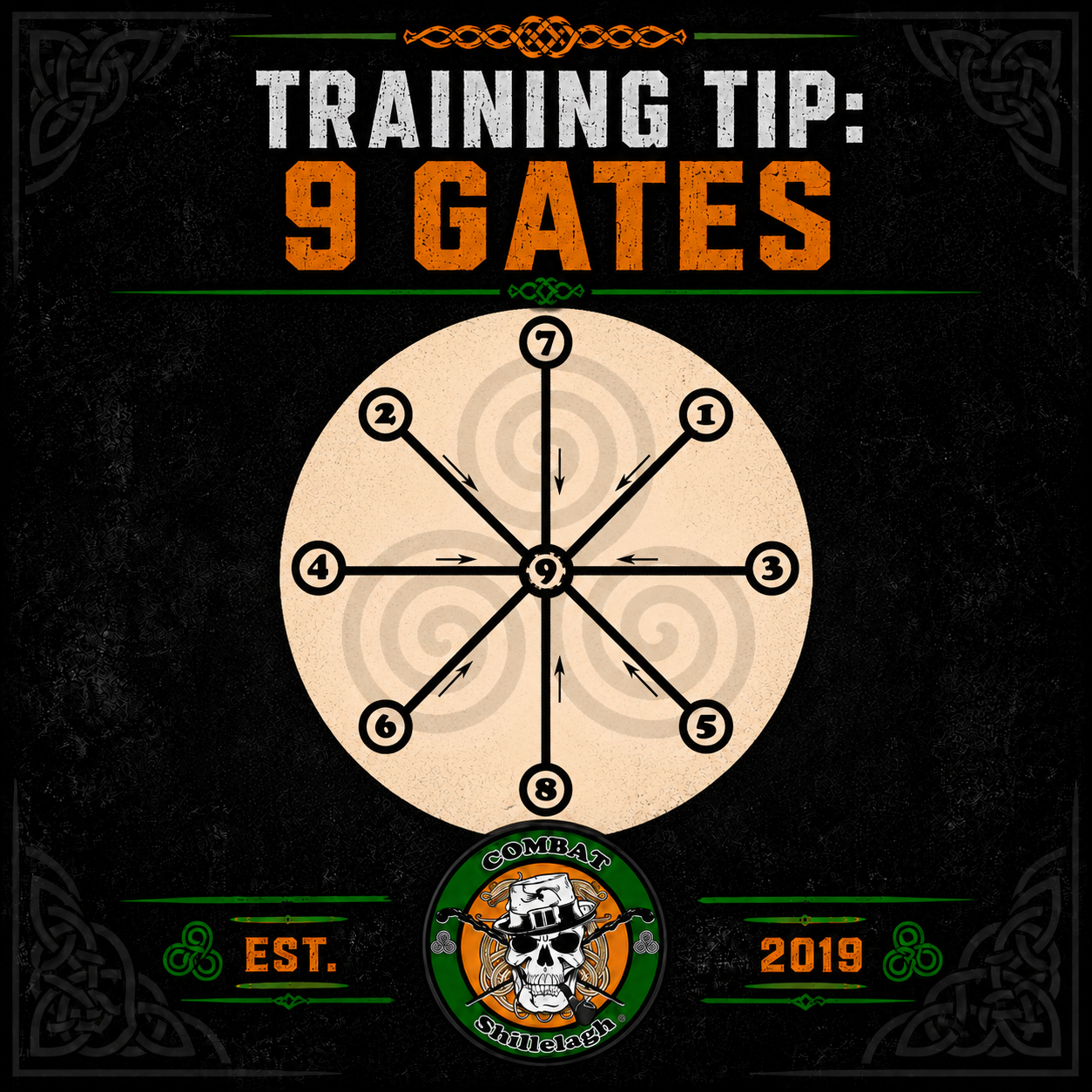
One of the foundational concepts within the Combat Shillelagh Irish Stick Fighting System is what we call the 9 Gates of Attack and Defense. The 9 Gates provide a framework for understanding the major angles through which attacks and defenses occur. They help organize striking, blocking, movement, and eventually more advanced applications into a system that is easier to learn, practice, and apply under pressure.
At first glance, the 9 Gates may appear to simply be nine striking angles, but the concept goes much deeper. One of the most important ideas for students to understand is that every Gate is a strike, and every Gate is a block. There is not necessarily one set of angles that belongs exclusively to offense and another set reserved for defense. The same fundamental lines of movement can perform either function depending on the situation. A particular angle might be used to deliver a strike against an opponent, while that same movement pattern might be used moments later to intercept, redirect, or disrupt an incoming attack.
This creates tremendous efficiency within the system. Rather than attempting to memorize dozens of unrelated movements, the student develops proficiency with a smaller number of fundamental movement patterns. Those patterns can then be adapted according to distance, timing, positioning, and the actions of the opponent.
Another useful way to understand the 9 Gates is to think of each Gate as a general quadrant or pathway of movement, rather than an absolutely fixed line that must always be reproduced at exactly the same angle. When students first begin training, we want the major angles to be very consistent. Practicing the same lines repeatedly teaches the body where those movements belong and begins building reliable motor patterns. However, real encounters are rarely geometrically perfect. An opponent will not conveniently place an arm, weapon, head, or body exactly along the angle you practiced during a drill. Their position may be slightly higher, lower, farther inside, or farther outside.
This is where understanding the Gates as quadrants becomes important. Imagine dividing an angle into increasingly smaller slices. You could continue dividing that space almost indefinitely. There may be countless individual angles inside a particular Gate, but they all belong to the same general family of movement. Once the student has properly conditioned the major Gate, the body can begin making small adjustments within that quadrant. The gross movement remains familiar while the fine angle changes according to the situation.
This is one of the primary reasons drilling the 9 Gates is so important. Repetition is not simply about memorizing a numbered sequence. It is about developing what might be described as operant conditioning of the fundamental striking and blocking pathways. You are teaching your nervous system to recognize and reproduce these movements without having to consciously calculate every step.
Early in training, a student may be thinking about which Gate is being used, what angle the Shillelagh should travel, or where the hands should finish. As familiarity develops, that conscious processing begins to decrease. The student sees movement entering a particular area and begins responding through the appropriate Gate more naturally. This is especially important in any system concerned with practical fighting skills. Under pressure, there may not be enough time to intellectually analyze every possible option. Fundamental movements need to become familiar enough that they can emerge quickly and efficiently.
This is also why we emphasize practicing the 9 Gates regularly rather than treating them as something learned once and then forgotten. They are not merely introductory techniques. They are part of the underlying architecture of the entire Combat Shillelagh system.
As students become more experienced, the distinction between striking and blocking can also become less rigid. A defensive movement does not necessarily have to be passive. If someone attacks through one Gate and you move your Shillelagh through another Gate to intercept that attack, your defensive movement can carry structure, intent, and force of its own. In some circumstances, the interception itself may function much like a strike against the attacking limb or weapon. Likewise, a strike may simultaneously occupy a line that prevents another attack from reaching you.
This reinforces one of the broader principles within Combat Shillelagh: movement should solve multiple problems whenever possible. You are not simply memorizing nine strikes and nine blocks. You are developing nine major pathways through which you can interact with incoming and outgoing force.
The 9 Gate concept also connects directly to another major component of the Combat Shillelagh system: footwork. Students who have trained using the 9 Gate pattern on the floor have already seen how the same general geometry can help organize stepping and positioning. The lines that describe striking and blocking can also help you understand how you move your body through space.
This relationship becomes increasingly important as training progresses. The diagrams associated with the 9 Gates also incorporate the Irish Tri-Spiral, or Triskelion, which hints at some of the more advanced footwork concepts found later in the system. At higher levels, linear angles, rotational movement, body positioning, and weapon movement increasingly begin working together rather than being treated as separate skills. That development, however, begins with mastering the fundamentals.
The 9 Gates should remain a regular part of your training regardless of your experience level. Practice the individual strikes, the corresponding blocks, the combinations contained within the curriculum, and the footwork that connects them. As your skills improve, begin experimenting with subtle variations inside each quadrant and learn how to adjust the major angles according to what is actually happening in front of you.
The goal is not to become trapped by the numbered pattern. The purpose of the pattern is to build a reliable physical vocabulary that eventually gives you greater freedom. Learn the major angles first, condition them through repetition, and then develop the ability to make increasingly subtle adjustments as the situation requires.
That is where the 9 Gates move beyond being a training diagram and become a functional framework for attack, defense, movement, and problem solving within the Combat Shillelagh system. Every Gate is a strike. Every Gate is a block. Every Gate is a pathway through which you can attack, defend, move, and adapt.