
A serious martial arts student should do more than memorize techniques. If you are going to invest years of your life studying an art, you should also invest the time to understand where that art came from, why it developed, who used it, what problems it was designed to solve, and what kind of violence surrounded its creation. That broader context matters because martial arts do not exist in a vacuum. They are products of culture, history, necessity, conflict, and human behavior.
At its core, Combat Shillelagh is an Irish Stick Fighting art centered on the shillelagh and bata. But the system includes much more than simply learning how to swing a stick. We work with striking, blocking, footwork, leverage, joint manipulation, trapping, throws, takedowns, close-range combatives, and principles that can transfer to walking sticks, cudgels, longer staffs, blades, and empty-hand applications. It is a well-rounded martial art, but underneath all of those methods is something even more important: an understanding of what martial arts were originally created to address.
They were created around violence.
Understand the History Behind the Art
If you want to understand Irish Stick Fighting, you should learn the history that surrounds it. The shillelagh is not simply an interesting piece of Irish folklore, nor is it merely a decorative walking stick. It has a real place in Irish social history, fighting traditions, cultural identity, and personal defense.
Understanding that history gives meaning to the techniques you practice. It helps explain why certain weapon lengths were common, why particular grips and tactics developed, how sticks were carried, and how fighting traditions evolved around the realities of the time.
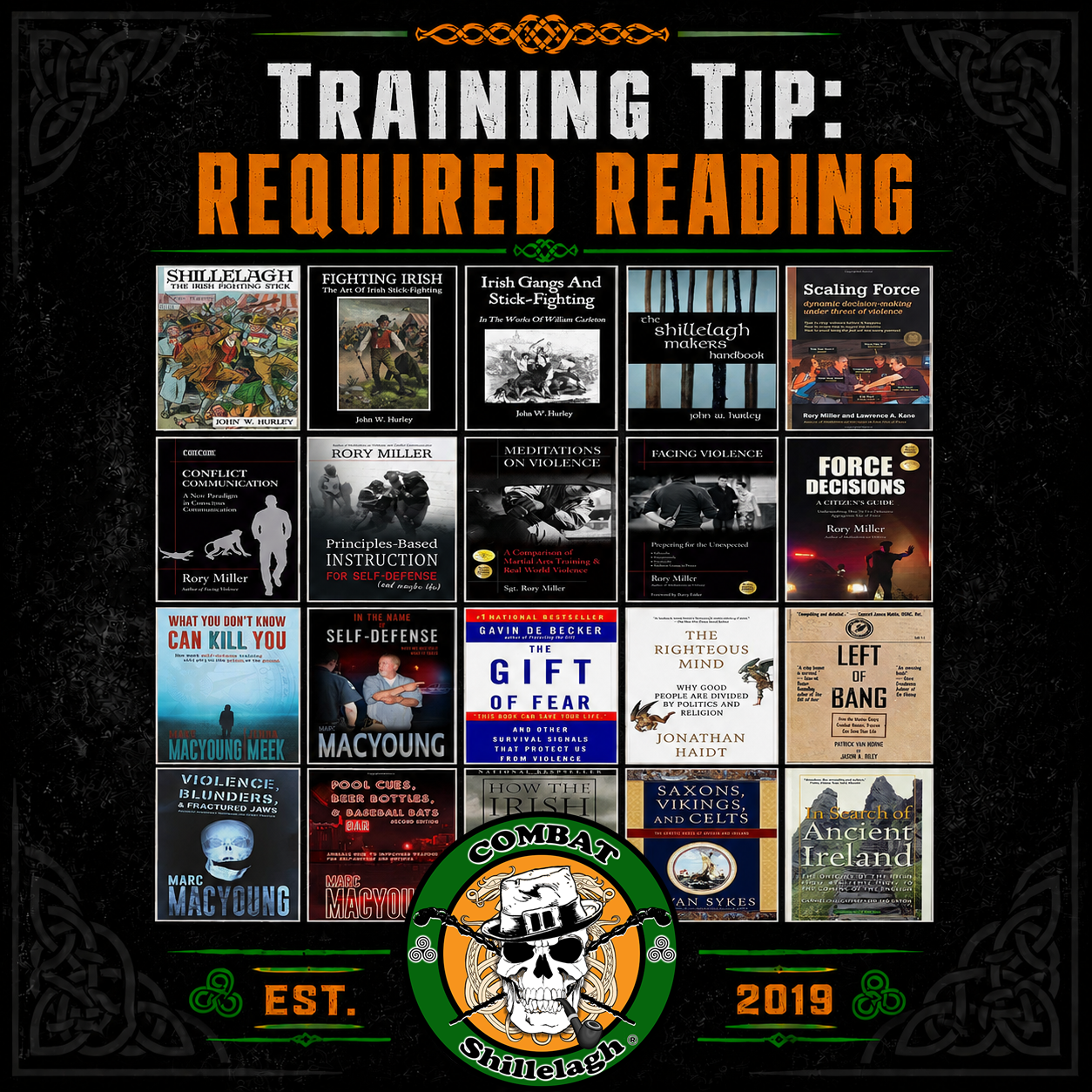
For students who want to go deeper into the history of the shillelagh and Irish Stick Fighting, the work of John Hurley is an excellent place to begin. His books explore the historical context surrounding the shillelagh and provide students with a much broader understanding of the traditions they are studying. For us, that kind of reading is not an optional curiosity. It should be part of the education of anyone who wants to become a serious student of the art.
Techniques become more meaningful when you understand the world that produced them.
Martial Arts Are the Study of Violence
One of the easiest things to forget in a modern training environment is the simple reality that martial arts are, by their nature, connected to violence. In the training hall, we work cooperatively. We use protective equipment. We slow movements down. We practice with training weapons. We give our partners time to learn. We stop when someone taps or when an instructor calls the drill.
Those safety measures are essential, but they can also create an artificial environment. The movements themselves are not artificial.
A powerful strike, joint lock, throw, takedown, thrust, or weapon manipulation has the potential to cause serious injury when applied with full intent. That reality should make us more thoughtful students, not more aggressive ones.
If you study martial arts for self-defense, then learning physical techniques is only part of the education. You also need to understand violence itself. Why do violent confrontations begin? Where are they most likely to happen? What kinds of people initiate violence? What warning signs appear before an encounter becomes physical? What is the difference between intimidation, social conflict, and predatory violence? When can de-escalation work? When should you leave? What behaviors increase or reduce your risk?
These questions may ultimately be more important than knowing another dozen techniques.
The Best Fight Is the One You Never Enter
There is a phrase repeated throughout martial arts and self-defense circles: the best way to win a fight is to never be in one in the first place. That may sound simple, but putting it into practice requires knowledge.
Avoidance begins with awareness. Awareness requires understanding the environments and behaviors associated with violence. De-escalation requires understanding what the other person may want and recognizing whether you are dealing with anger, ego, fear, status, intimidation, or predatory intent.
Sometimes the correct answer is to leave before the situation develops. Sometimes it is to create distance. Sometimes it is to set a clear boundary. Sometimes it is to recognize that the other person is looking for an excuse to escalate and refuse to participate.
Physical skill should be the last layer of a much larger personal safety strategy. That is why we believe real-world violence should be studied alongside the physical curriculum rather than treated as a completely separate subject.
Learn From People Who Study Violence Professionally
Over decades of martial arts training, one of the most important lessons I have learned is that martial artists should seek knowledge from people who have spent significant time studying real violence, not simply martial arts.
Two authors whose work has had a major influence on our approach are Rory Miller and Marc MacYoung. Their writing forces martial artists to examine assumptions about self-defense, violence, criminal behavior, escalation, and what actually happens when an encounter moves outside the controlled environment of a dojo or training hall.
I have personally trained with both Rory and Marc, and their perspectives caused major shifts in the way I think about martial arts and self-defense. That is exactly what good education should do. It should challenge assumptions, expose gaps in your knowledge, and force you to look at familiar subjects from a new perspective.
Their books are not replacements for physical martial arts training. They provide something different: context.
That context can help you understand when physical skills might be necessary, when they might make a situation worse, and what you might be able to do long before the encounter ever becomes physical.
Start With Module Zero
Within Combat Shillelagh, we refer to this part of the education as Module Zero for a reason. Before you become overly focused on strikes, blocks, combinations, rank material, and techniques, you need to understand the larger problem the training is supposed to address.
Module Zero introduces students to the realities of real-world violence, including the circumstances surrounding violent encounters, warning signs, escalation, avoidance, de-escalation, and the mindset required to think about self-defense responsibly.
We encourage every student to watch the Module Zero presentation available through our YouTube content and training resources. But that presentation should be viewed as the beginning of the conversation, not the end of it. If you want to go much deeper into these subjects, we also strongly recommend getting a copy of our Real World Self Defense book. The book expands on many of the concepts introduced in Module Zero and goes into much greater depth on understanding violence, recognizing warning signs, managing risk, de-escalation, decision-making, and the realities that exist before an encounter ever goes “hands on.” It is designed to give students a broader framework for understanding self-defense beyond just physical techniques.
Then continue your education through the recommended reading.
Read Rory Miller. Read Marc MacYoung. Read John Hurley.
Then, as your experience grows, go back and read them again.
Just as a basic strike reveals new layers after several years of physical training, books about violence and martial history often reveal new insights when you return to them with greater experience.
Become a Student of the Entire Subject
A lifelong martial artist should never stop being a student. Learning the physical curriculum is important, but serious study should extend far beyond the movements themselves.
Learn the history of your art. Understand the culture that produced it. Study how and why the weapon was used. Learn about the realities of violence. Understand escalation, avoidance, de-escalation, and aftermath. Study the legal and ethical responsibilities surrounding self-defense. Then take that knowledge back into your physical training and allow it to influence how you think about what you are practicing.
The more context you gain, the more the techniques begin to make sense.
Ultimately, being a serious martial artist is not about collecting techniques or accumulating ranks. It is about developing a deeper understanding of the subject you have chosen to study.
Invest in your physical training, but invest just as seriously in your knowledge. Study the art. Study its history. Study violence. Ask better questions. Keep reading, keep training, and keep expanding your understanding of what martial arts are really about.