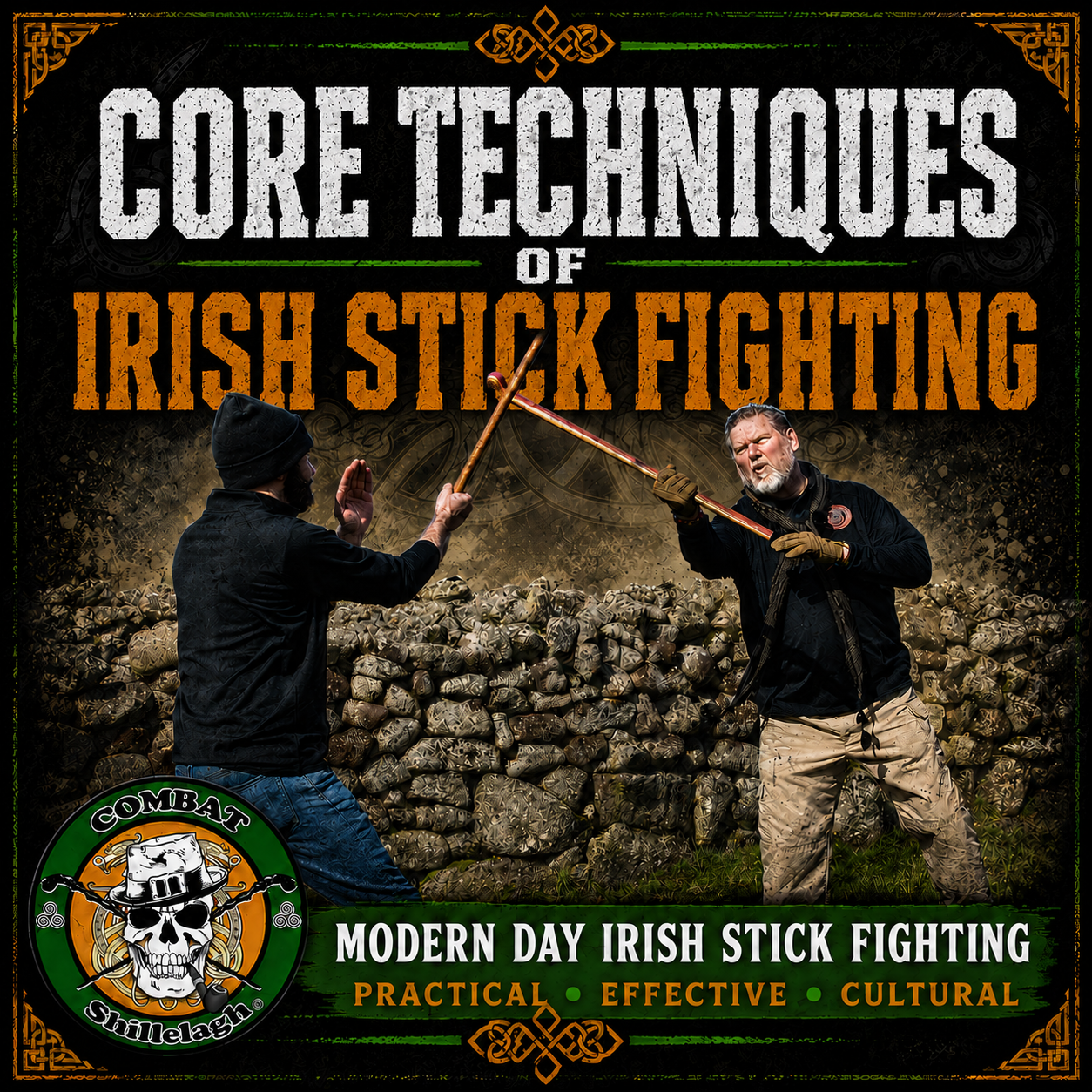
When most people first hear about Irish Stick Fighting, or bataireacht, they picture two people standing toe to toe swinging heavy blackthorn sticks at each other.
And honestly, I get it.
The shillelagh is the thing people recognize first. It is iconic. It connects directly to Irish culture, Irish history, old faction fights, family stories, walking sticks, and the image of the Irishman who was never quite as harmless as he looked.
But Irish Stick Fighting is much more than just swinging a stick.
At Combat Shillelagh, we teach a modern day system of Irish Stick Fighting. That means we respect the cultural roots and historical traditions of bataireacht, but we are not trying to recreate a museum piece. We are training a living, functional system built for real people, real movement, and real pressure.
One of the things that makes Combat Shillelagh different is our combatives perspective. We are not only looking at Irish Stick Fighting as a historical art, cultural exercise, or recreational weapon system. We are looking at it through the lens of practical self defense, pressure, chaos, timing, distance, and decision making.
That combatives approach influences everything we do.
Like any real martial art, Irish Stick Fighting has structure. It has principles. It has categories of movement and technique that all work together. When trained correctly, the shillelagh becomes more than a stick. It becomes a tool for learning distance, timing, footwork, body mechanics, self protection, and personal discipline.
For new students, it helps to understand the main categories of techniques that make up the Combat Shillelagh system.
The first major category is striking.
This is the part most people expect. Irish Stick Fighting uses a wide range of strikes delivered with the shillelagh. Some are powerful committed blows. Others are quick snapping shots designed to create openings, disrupt rhythm, or stop forward pressure.
Strikes can come from different angles, levels, and positions. You may strike high, low, to the outside line, inside line, or directly through the center. The key is not just learning how to hit hard. It is learning how to hit with control, proper structure, and purpose.
In Combat Shillelagh, we look at striking from a combatives point of view. A strike is not just a technique you perform in the air. It has to make sense under stress. It has to work with your footwork. It has to fit the distance you are in. It has to help you solve the problem in front of you.
A good strike is not just arm strength. It comes from the feet, hips, body alignment, timing, and intent. If all you do is swing with your arms, you will get tired quickly, telegraph your movement, and lose power. One of the big lessons in our system is learning how to make the whole body work together behind the shillelagh.
The second major category is blocking and defense.
If someone is swinging a stick at you, you need to know how to protect yourself. That means learning how to cover vital targets, intercept incoming strikes, and use the stick as a shield, barrier, and counter attacking tool.
Defense in Irish Stick Fighting is not passive. We are not just hiding behind the stick and hoping for the best. A proper defense should put you in position to respond immediately. You block so you can counter. You cover so you can move. You receive the attack in a way that helps you take back initiative.
This is where students start to understand that Irish Stick Fighting is not just about toughness. It is about awareness, angles, timing, and decision making under pressure.
The third category is footwork.
In my opinion, footwork is one of the most overlooked parts of stick fighting by beginners. Everyone wants to learn the cool strikes first, but your feet are what put you in the right place to use those strikes.
Footwork controls distance. It helps you get out of danger. It lets you close the gap when needed. It allows you to change angles instead of standing directly in front of an attack.
In practical self defense, being able to move your feet matters. You may need to create space, escape, reposition, or drive forward. The stick gives you reach, but the feet give you opportunity.
This is another area where our Combat Shillelagh approach is different from many traditional or purely historical interpretations of Irish Stick Fighting. We are always asking, “How does this hold up when the other person is not cooperating?” That question forces us to pay serious attention to footwork, balance, recovery, and pressure.
The fourth category is gripping, checking, and control.
Irish Stick Fighting is not only long range striking. At closer distances, the stick can be used to check the opponent’s weapon, jam their movement, control their limbs, create barriers, and open space for follow up techniques.
This is where the shillelagh becomes very versatile. It can strike, press, hook, trap, frame, and redirect. A student begins to see that the stick is not just something you swing. It is something you use to manage the opponent’s structure and movement.
This category is especially important in our system because real encounters are messy. Distance changes quickly. You may start at long range and suddenly find yourself chest to chest. You need tools for those closer ranges.
The fifth category is counter fighting.
Counter fighting is the ability to respond to an attack in a way that turns the situation back in your favor. A counter may happen after a block, during an opponent’s movement, or as you recognize an opening.
This is where timing becomes critical. You learn not only what technique to use, but when to use it. A good counter is not random. It is built on reading pressure, recognizing lines of attack, and responding with the right tool at the right moment.
For many students, this is where the art starts to feel alive. They stop thinking of techniques as isolated moves and start seeing them as part of a conversation.
The sixth category is close quarter combatives and empty hand integration.
This is one of the most important differences in Combat Shillelagh.
We do not train as if you will always have perfect distance, perfect footing, and a clean duel-like exchange. That may be useful for certain drills, but it does not reflect the chaos of real conflict.
Sometimes the opponent crashes in. Sometimes the stick gets tied up. Sometimes you have to manage pressure at close range. Sometimes you need to use your body, elbows, knees, hands, shoulders, simple positional control, or direct combative movement to create space and regain advantage.
A well rounded approach to Irish Stick Fighting should include understanding how the stick connects to empty hand self defense. The weapon teaches principles that carry over into the body. Lines of attack, footwork, angling, pressure, structure, and timing all remain important whether you have a shillelagh in your hand or not.
That is why our system is not limited to stick swinging. Combat Shillelagh is a weapon based system, but it is taught through a practical combatives lens. The stick is the center of the training, but the principles reach much farther.
The seventh category is practical application and pressure testing.
Techniques can look great in a clean demonstration. They can look great in a video. They can look great when both people know exactly what is supposed to happen next.
But training has to go beyond that.
In Combat Shillelagh, we care about whether the material can survive resistance, movement, stress, and pressure. That does not mean every training session has to become a fight. It does mean students need progressive drills that help them move from simple mechanics to more realistic application.
This includes partner drills, timing drills, movement drills, controlled resistance, and eventually more open training where the student has to make decisions in real time.
That is a big part of what separates a combatives approach from a purely technical approach. We are not just collecting techniques. We are learning how to use them.
The final category is strategy and mindset.
Techniques are important, but they are not enough on their own. A student also needs to understand when to engage, when to create distance, when to escape, and how to avoid making a bad situation worse.
Our approach to Irish Stick Fighting includes the reality that self defense is not a game. It is not about ego. It is not about looking tough. It is about protecting yourself, protecting others if needed, and making better decisions when things become stressful.
This is where the combatives perspective really matters.
Combat Shillelagh is not just about preserving Irish martial culture, although that is important to us. It is also about making the material useful, relevant, and practical for modern students.
At the end of the day, Irish Stick Fighting is a serious martial study.
It includes striking, defense, footwork, control, counters, close quarter work, pressure testing, and mindset. It connects us to Irish culture, but it also gives us practical lessons that apply right now in the modern world.
For me, that is what makes Combat Shillelagh so valuable.
It is historical, but not stuck in the past. It is cultural, but not just a novelty. It is practical, but not mindless. It is a modern day system of Irish Stick Fighting that challenges you physically, mentally, and personally.
And for anyone who has ever felt drawn to Irish heritage, martial arts, or practical self defense, picking up the shillelagh may be the beginning of a much deeper journey than you expected.