Yes, Irish Stick Fighting is absolutely a legitimate martial art.
The confusion usually comes from the fact that Irish Stick Fighting is not as widely known today as systems like Karate, Judo, Boxing, Muay Thai, or Brazilian Jiu-Jitsu. It also does not have one single worldwide governing body, one universal ranking structure, or one standardized curriculum used by every school.
But legitimacy in martial arts is not based on popularity alone. A martial art is legitimate when it has history, method, training principles, practical application, and a body of knowledge that can be taught, practiced, tested, and passed on.
Irish Stick Fighting has all of those elements.
At its center is the shillelagh, one of the most recognizable symbols of Irish martial culture. The shillelagh was not merely a walking stick or decorative souvenir. Historically, it could serve as a practical tool, a travel companion, a symbol of identity, and, when needed, a serious defensive weapon.
Modern systems such as Combat Shillelagh continue that tradition by organizing shillelagh-based training into a practical, reality-based self-defense system built around proven combative concepts.
What Makes a Martial Art Legitimate?
A legitimate martial art does not need to look like every other martial art.
Some martial arts use fists. Some use kicks. Some use throws. Some use swords, staffs, knives, sticks, canes, or blades. Some are battlefield arts. Some are dueling arts. Some are sport arts. Some are self-defense systems.
What matters is whether the system has a coherent method of training and a practical logic behind what it teaches.
Irish Stick Fighting is legitimate because it includes:
- Striking mechanics
- Footwork and body movement
- Guarding and defensive structure
- Distance management
- Timing and targeting
- Weapon control
- Pressure and response training
- Practical self-defense concepts
- Historical and cultural roots
In other words, Irish Stick Fighting is not just “swinging a stick.” A serious Irish Stick Fighting system teaches how to move, how to generate power, how to protect yourself, how to control space, and how to use the shillelagh intelligently.
That makes it a martial art.
The Historical Use of the Shillelagh
The shillelagh has a long association with Irish life and Irish fighting culture.
Traditionally, a shillelagh or walking stick could be carried in everyday life. It might be used for walking, travel, work, personal protection, or as a mark of identity. Unlike a sword or firearm, a stick was common and practical. It could be carried openly without always appearing threatening.
But in skilled hands, it could become a powerful defensive tool.
The shillelagh offered several practical advantages:
- It extended the user’s reach
- It increased striking power
- It helped create distance
- It could be used to guard and deflect
- It could target arms, legs, hands, head, or body
- It gave a smaller person a better chance against a larger attacker
That is one of the reasons stick-based fighting arts appear in cultures around the world. The stick is one of humanity’s oldest and most practical defensive tools. Irish Stick Fighting is the Irish expression of that larger truth.
Faction Fights and Irish Stick Fighting Culture
Irish Stick Fighting is also connected to the history of Irish faction fighting.
Faction fights were organized or semi-organized group conflicts that occurred in Ireland, especially in earlier centuries, often involving rival families, communities, local groups, or factions. These fights could happen at fairs, markets, gatherings, festivals, or other public events.
The shillelagh and other sticks were commonly associated with these clashes.
While faction fighting should not be romanticized, it is an important part of the historical context. It shows that Irish stick methods were not simply theoretical. They came from a culture where sticks were actually used in violence, defense, rivalry, and group conflict.
That history does not mean modern students are training to recreate faction fights. They are not.
Instead, modern Irish Stick Fighting systems can study and preserve the combative lessons of the past while applying them responsibly in a modern self-defense context.
Combat Shillelagh does exactly that. It honors the Irish martial tradition while focusing on practical, disciplined, and reality-based training for today’s world.
Irish Stick Fighting Is More Than Historical Reenactment
Some people mistakenly assume Irish Stick Fighting is only folklore, performance, or historical reenactment.
That can be true in some settings, just as sword arts, archery, fencing, or traditional martial arts can sometimes be practiced for cultural display or historical interest.
But that is not the whole picture.
Irish Stick Fighting can also be trained as a serious martial art and self-defense system. The key is the quality and purpose of the training.
A legitimate system should not rely only on costumes, stories, or demonstrations. It should teach usable principles. It should explain why techniques work. It should have progressive instruction. It should develop skill over time. It should address distance, timing, power, movement, control, and safety.
The Combat Shillelagh system is built around that kind of practical training.
Combat Shillelagh as a Modern Martial System
Combat Shillelagh is a structured system of Irish Stick Fighting centered around the use of the Irish shillelagh.
The system is based on practical, proven, and robust self-defense concepts. It is not limited to one narrow idea of stick fighting. Instead, it organizes multiple combative areas around the shillelagh as the central tool.
Combat Shillelagh includes concepts from:
- Single stick
- Two stick
- Stick and blade
- Empty hand
- Close-range body manipulation
- Joint control
- Posture and spine disruption
- Footwork and distance management
- Practical self-defense response
The important point is that all of this is centered around the use of the Irish shillelagh. The shillelagh is not treated as a prop. It is treated as a functional defensive tool that can be used at multiple ranges and in multiple ways.
Single Stick Concepts
The foundation of Irish Stick Fighting is the single stick.
This is where students learn how to use the shillelagh for striking, guarding, controlling space, and defending themselves. The single stick teaches the practitioner how to generate power, recover after movement, maintain structure, and keep the weapon between themselves and the threat.
In Combat Shillelagh, single stick training helps students understand the core mechanics of the system.
Students learn how to use the shillelagh for:
- Direct striking
- Defensive guarding
- Checking and covering
- Maintaining distance
- Moving off the line
- Creating openings
- Escaping danger
This is the core of practical shillelagh self-defense.
Two Stick Concepts
Combat Shillelagh also includes two stick concepts, but this should not be misunderstood as simply using two identical sticks for display or coordination drills.
In practical terms, two stick training can involve different stick lengths and roles. One stick may be closer to cudgel length, shorter, more compact, and useful for closer-range striking, checking, trapping, or control. The other may be closer to a longer walking stick length, offering greater reach, distance management, and defensive structure.
This gives the student a better understanding of how different tools behave in the hands. A shorter cudgel-length stick moves differently than a longer walking stick. It changes the range, timing, leverage, and tactical choices. Training both together helps students understand asymmetry, coordination, angle control, and how to manage different weapon lengths at the same time.
Two stick training also develops:
- Ambidexterity
- Coordination between both hands
- Awareness of multiple lines of attack
- Offensive and defensive flow
- Transition between ranges
- Control of both close and longer-range space
This is not just flashy martial arts movement. It is a method of teaching the body how to manage multiple tools, multiple angles, and changing distances.
Sticks as Analogs for Blades
At higher levels in the Combat Shillelagh system, students are also shown how sticks can function as analogs for blades.
This is an important training concept.
A stick and a blade are not the same thing. They do different kinds of damage and require different levels of caution, awareness, and respect. However, many movement principles can overlap. Angles, lines of attack, range control, targeting, hand positioning, body movement, and defensive responsibility all become extremely important when blade concepts are introduced.
By using sticks as training analogs, students can safely explore concepts that help them understand how a blade changes the nature of a confrontation. The goal is not fantasy knife fighting. The goal is awareness, structure, and responsibility.
At higher levels, Combat Shillelagh shows the transition from stick methods into blade-aware movement. Students begin to see how certain angles, grips, entries, checks, and defensive structures relate to edged weapon concepts. The shillelagh remains the center of the system, but the practitioner gains a deeper understanding of how weapon principles connect.
This also strengthens the student’s stick work. Once a student understands that a stick may represent a blade in training, their movement becomes more disciplined. They become more aware of lines, openings, exposure, and consequences.
Stick and Blade Concepts
A serious self-defense system must recognize that threats may involve weapons.
Combat Shillelagh includes stick and blade concepts as part of its broader training approach. This does not mean reckless or unrealistic knife fighting. It means students are exposed to the reality that edged weapons change the danger level of an encounter.
The shillelagh gives the defender reach, structure, and impact against a close-range threat. When training includes blade awareness, the student learns to respect distance, protect vital areas, control lines of attack, and understand why movement and positioning matter.
The stick may be used as a training analog for blade mechanics, while the shillelagh itself remains the primary defensive tool. This allows students to understand the relationship between impact weapons and edged weapon principles in a safer, structured, and progressive way.
Stick and blade concepts help students recognize that self-defense is not always clean or predictable. A practical system must prepare students for changing circumstances, different ranges, and serious threats.
Empty Hand Concepts
Combat Shillelagh also includes empty hand concepts.
This is important because a defender may not always have the perfect tool in hand. A confrontation may begin before the shillelagh is ready. The attacker may grab, clinch, crowd, or close distance. The defender may need to strike, frame, control, move, or escape without immediately relying on the stick.
Empty hand training supports the overall system by teaching body mechanics, structure, balance, movement, and close-range self-defense principles.
In Combat Shillelagh, empty hand concepts are not separate from the weapon work. They support it. The same principles of distance, leverage, posture, alignment, and movement apply whether the practitioner is using the shillelagh or working empty handed.
Close-Range Control and Body Manipulation
One of the important strengths of Combat Shillelagh is that it does not treat the shillelagh only as a long-range striking weapon.
Real self-defense situations can collapse quickly. An attacker may rush, grab, push, clinch, or crowd the defender’s space. If a system only works at long range, it may fail when the distance closes.
Combat Shillelagh addresses this through close-range body manipulation.
At close range, the shillelagh can be used as a lever for joint manipulation, posture control, and disruption of the attacker’s structure. The stick can help influence the attacker’s arms, shoulders, neck, spine, balance, and movement.
This gives the defender more options.
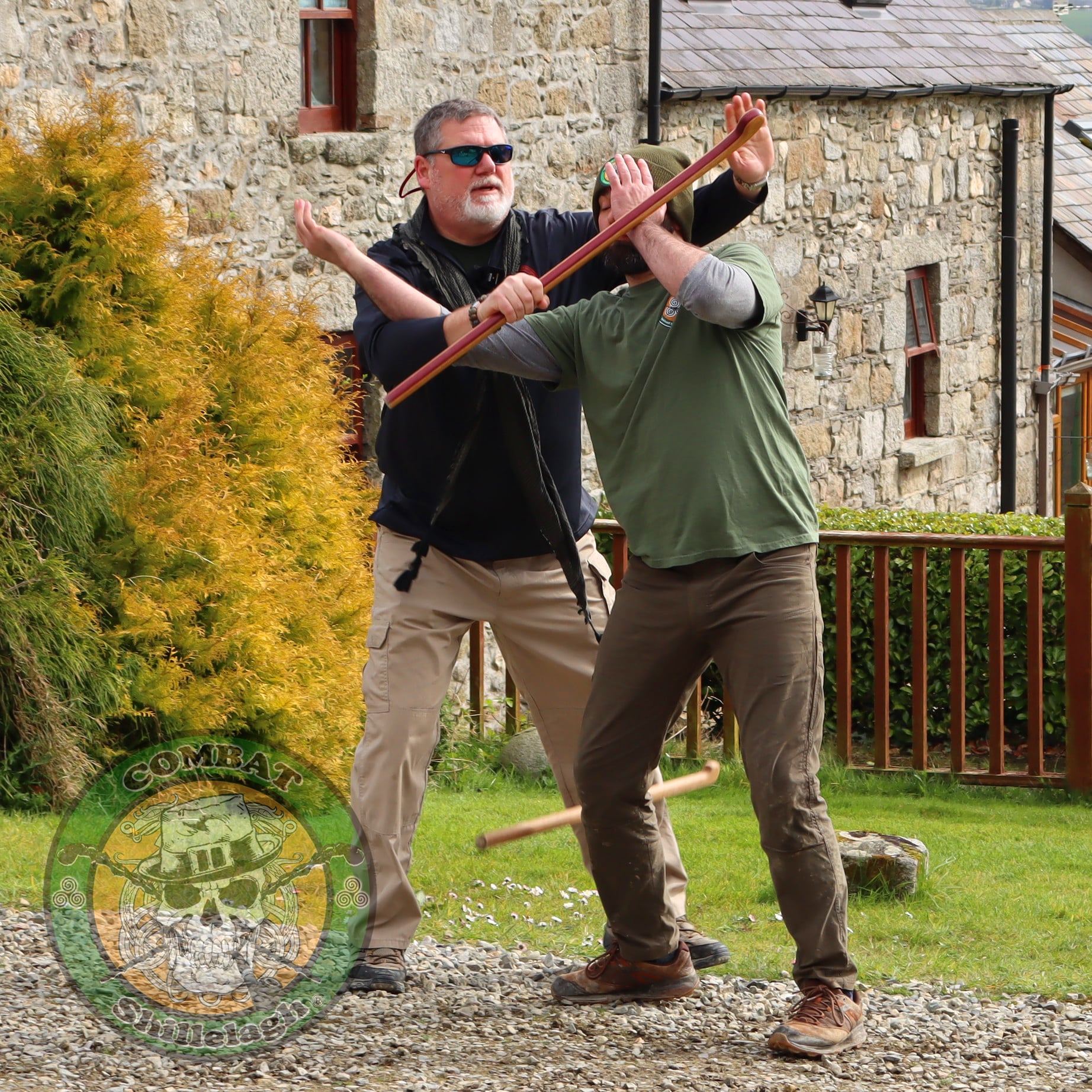
The shillelagh can be used to strike, but it can also be used to frame, wedge, press, redirect, control, and create space. This makes the system more complete and more practical for real-world self-defense situations.
Why Combat Shillelagh Is Built Around Proven Self-Defense Principles
The legitimacy of Combat Shillelagh does not come only from Irish history. It also comes from practical function.
A martial art must work with the realities of the human body. It must account for fear, pressure, movement, resistance, distance, timing, and the fact that real confrontations are unpredictable.
Combat Shillelagh is based around proven self-defense concepts such as:
- Using reach to improve safety
- Creating distance from the attacker
- Moving off the line of attack
- Protecting vital targets
- Using leverage instead of strength
- Disrupting balance and posture
- Maintaining weapon awareness
- Controlling space
- Escaping when possible
- Using appropriate force responsibly
These are not fantasy concepts. They are practical self-defense principles found across many effective martial systems.
Combat Shillelagh applies them through the lens of the Irish shillelagh.
Legitimacy Does Not Require Being Mainstream
Some people assume a martial art is only legitimate if it is famous, widely commercialized, or part of a major sport organization.
That is not true.
Many legitimate martial arts are niche, regional, traditional, family-based, or culturally specific. Some are preserved by small groups. Some are reconstructed or modernized from historical sources and living traditions. Some are taught quietly and practically without becoming mainstream.
Irish Stick Fighting belongs in that category.
It may not be as widely known as other martial arts, but it has real history, real cultural roots, real combative logic, and real practical value when taught correctly.
Combat Shillelagh gives modern students a structured way to access that tradition while training in a practical and organized system.
A Responsible Martial Art for Modern Students
A legitimate martial art should also teach responsibility.
The shillelagh can cause serious injury. Blades, even when introduced conceptually or through training analogs, require even greater seriousness. That means training must be disciplined, controlled, and used only in a lawful and morally justified self-defense context.
Serious training should never encourage reckless violence, intimidation, or ego-driven behavior.
The purpose of Combat Shillelagh is not to start fights. It is to help students develop skill, confidence, control, awareness, and the ability to defend themselves if no safe alternative exists.
That responsible mindset is part of what makes the system legitimate.
A real martial art should make people more disciplined, not more reckless.
So, Is Irish Stick Fighting a Legitimate Martial Art?
Yes. Irish Stick Fighting is a legitimate martial art because it has historical roots, practical purpose, defined methods, weapon-based skill development, cultural significance, and real self-defense applications.
The shillelagh was historically more than a walking stick. It was a practical tool that could be used for protection. Irish faction fights show that stick fighting had a real place in Irish combative culture.
Modern systems such as Combat Shillelagh continue that legacy by organizing the material into a practical, structured, reality-based self-defense system.
Combat Shillelagh is centered around the Irish shillelagh but draws from a broad range of proven combative concepts, including single stick, two stick, stick and blade, empty hand, close-range control, joint manipulation, posture disruption, and practical defensive movement.
The two stick material may include differences between cudgel-length and longer walking-stick-length tools, giving students a deeper understanding of range, timing, and weapon behavior. At higher levels, the system also shows how sticks can serve as analogs for blades and how those principles transition into blade-aware movement.
That combination of history, structure, practicality, and self-defense relevance makes Irish Stick Fighting not only legitimate, but also one of the most unique martial arts available today.
Final Answer
Irish Stick Fighting is considered a legitimate martial art when it is taught as a serious system of training rather than as performance or folklore.
The shillelagh has historical and practical roots as an Irish defensive tool. Its use in personal protection and faction fighting gives Irish Stick Fighting a real combative background. Combat Shillelagh builds on that heritage with a modern, structured system based on proven self-defense concepts involving stick, two stick, stick and blade, and empty hand methods.
In Combat Shillelagh, two stick training can include one stick of cudgel length and another of longer walking stick length, helping students understand different ranges, angles, and weapon roles. At higher levels, sticks are also used as analogs for blades, and students are shown how those principles transition into blade-aware movement and application.
All of this remains centered around the practical use of the Irish shillelagh.
For students looking for a martial art that combines Irish heritage, practical self-defense, weapon training, and structured skill development, Irish Stick Fighting through the Combat Shillelagh system is absolutely legitimate.
When you are ready to start learning Irish Stick Fighting, you can sign up for one of our training packages here: Distance Learning Courses