One of the most common questions people ask when they first discover Irish Stick Fighting is whether it has a belt system or formal ranking structure.
The answer is: it depends on the school, lineage, or system being taught.
Irish Stick Fighting, sometimes referred to broadly by the Gaelic term bataireacht, is not one single standardized martial art controlled by one governing body. It is a broad term for Irish methods of stick fighting, often using the shillelagh, walking stick, cudgel, or bata. Because of that, there is no universal ranking system that applies to every Irish Stick Fighting school.
Most established lineages and modern schools have developed their own way of measuring student progress. Some use formal ranks. Some use instructor certifications. Some use levels of curriculum. Some may have no belt structure at all and instead rely on direct teacher-to-student progression.
The Combat Shillelagh system, however, uses a very structured and linear rank and belt advancement framework. This helps students clearly understand where they are in their training, what material they are working toward, and how their growth is recognized over time.
Irish Stick Fighting Does Not Have One Universal Ranking System
Unlike martial arts such as Brazilian Jiu-Jitsu, Judo, or Taekwondo, Irish Stick Fighting does not have one widely accepted global belt structure.
That does not make it less serious or less effective. It simply reflects the history of the art.
Irish Stick Fighting developed through families, regions, factions, communities, and later through different teachers and preservation efforts. Over time, different approaches to training emerged. Each method may emphasize different grips, footwork, tactics, weapon lengths, historical interpretations, sparring methods, self-defense concepts, or curriculum organization.
Because of this, ranking in Irish Stick Fighting can vary widely.
One lineage may use named levels. Another may use sashes, belts, patches, or certificates. Another may focus only on whether a student is ready to teach. Another may place less emphasis on rank and more emphasis on practical ability.
So, when someone asks, “What belt do you earn in Irish Stick Fighting?” the most accurate answer is:
That depends on the specific system you are training in.
Most Established Lineages Have Their Own Approach
Many established Irish Stick Fighting lineages and schools have their own method of recognizing progress.
This is normal in traditional and weapon-based martial arts. A ranking structure usually reflects the goals of that particular system.
Some systems may be primarily historical. Others may be family-based. Others may focus on cultural preservation. Some may be combative and self-defense oriented. Some may include sparring, while others may emphasize forms, drills, partner work, or instructor transmission.
Because the training goals differ, the ranking systems also differ.
A rank in one Irish Stick Fighting system may not mean the exact same thing as a rank in another. A “Level 1” student in one system and a “Level 1” student in another system may have learned different material, trained different tactics, and been tested according to different standards.
That is why students should not look only at the name of the rank. They should look at what the rank represents.
A good ranking system should answer important questions:
What skills has the student learned?
What level of understanding has the student demonstrated?
Can the student apply the material under pressure?
Does the student understand safety, structure, control, and responsible use?
Is the student ready for the next stage of training?
In Combat Shillelagh, the ranking framework is designed to help answer those questions in a clear and organized way.
Combat Shillelagh Uses a Structured Rank Advancement Framework
The Combat Shillelagh system has a very structured and linear approach to rank and advancement.
This is intentional.
Combat Shillelagh contains a robust body of material. Students are not simply learning how to swing a stick. They are learning a complete system of shillelagh-based self-defense that includes striking, guarding, footwork, distance management, in-close body manipulation, joint control, posture disruption, training drills, principles, tactics, and practical application.
Because the material is deep, students need a clear pathway.
The Combat Shillelagh ranking framework gives students that pathway. It breaks the system into progressive levels so students can build skill step by step rather than feeling overwhelmed.
Each rank is meant to support growth, achievement, and continued development.
Why Ranking Matters in a Distance Learning System
A structured ranking system is especially important in a distance learning program.
When students are training remotely, they need clarity. They need to know what to practice, what standards to work toward, and how the material fits together.
Without structure, a student can easily jump around, train randomly, or focus only on the techniques they enjoy. That can create gaps in skill.
A strong ranking framework prevents that.
In Combat Shillelagh, rank advancement helps students move through the curriculum in a logical order. Each level builds on the previous level. Beginner material creates the foundation. Intermediate material expands the student’s technical ability. Advanced material deepens understanding, pressure response, teaching ability, and system fluency.
This linear approach helps students stay motivated because progress is visible. It also helps students stay accountable because advancement is tied to learning and demonstrating material.
The Combat Shillelagh Student Rank Path
The Combat Shillelagh system includes a clear progression for students.
At the beginning, a new student starts with the foundational material. From there, the student can progress through the primary levels of the system.
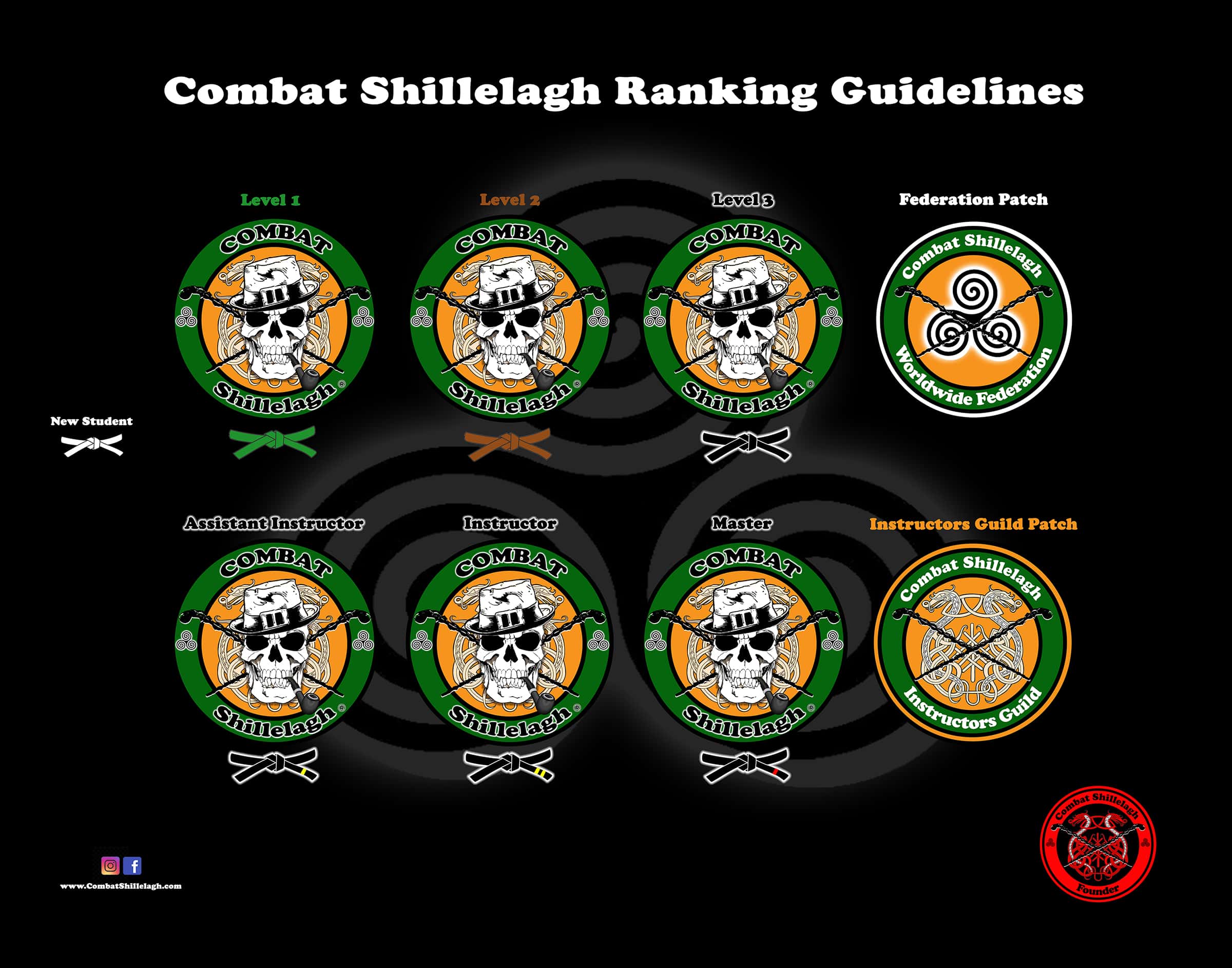
The rank structure includes:
New Student
This is the starting point. The student is entering the system, learning the basic expectations, beginning their training, and preparing to build a foundation.
Level 1
Level 1 represents the first major stage of development. Students begin building core skills with the shillelagh, including basic movement, basic striking mechanics, guard positions, safety, and fundamental self-defense concepts.
Level 2
Level 2 builds on the foundation. Students begin adding more depth, control, and technical understanding. The material becomes more connected, and students develop a stronger grasp of how the system works as a whole.
Level 3
Level 3 represents a more advanced stage of student development. At this level, the practitioner should have a much stronger understanding of the Combat Shillelagh curriculum and be able to demonstrate greater skill, control, and practical application.
These levels give students a clear sense of direction. They are not just collecting techniques. They are moving through a structured path of growth.
Instructor-Level Advancement
Combat Shillelagh also recognizes advancement beyond the basic student ranks.
As students grow, some may choose to pursue teaching, leadership, and deeper responsibility within the system. This is where instructor-level ranks become important.
The Combat Shillelagh framework includes:
Assistant Instructor
An Assistant Instructor has moved beyond basic student development and is beginning to take on a greater role in helping others learn. This rank reflects both technical progress and the beginning of leadership responsibility.
Instructor
An Instructor has achieved a higher level of understanding and is qualified to teach the system more fully. This level requires more than personal skill. It requires communication ability, safety awareness, curriculum understanding, and the ability to guide students through the material.
Master
The Master level represents a very high level of achievement and responsibility within the system. This rank reflects deep knowledge, long-term commitment, technical ability, and the ability to preserve and transmit the system.
In a serious martial arts system, instructor ranks should never be treated as titles only. They should represent responsibility.
A person who teaches must understand not only how to perform the material, but how to develop students safely and effectively.
Patches, Belts, and Recognition
The Combat Shillelagh system also uses visual recognition through belts, patches, and ranking markers.
This matters because martial arts training is a journey. Students benefit from seeing milestones along the way. A belt or patch is not the skill itself, but it can represent effort, consistency, progress, and achievement.
In the Combat Shillelagh rank structure, the visual markers help students and instructors identify where someone is in the system. They also create a sense of belonging and shared identity.
This is especially valuable in a worldwide distance learning community. Students may be training from different states, countries, or time zones, but the ranking framework gives everyone a shared structure.
It helps create a common language.
Ranking Should Support Skill, Not Replace It
A rank is useful only if it reflects real progress. The purpose of ranking should never be ego. It should never be about collecting titles, rushing through curriculum, or comparing yourself to other students.
The purpose of rank is to support learning.
A good rank system helps students:
Understand where they are
Know what to study next
Stay motivated
Measure progress
Build confidence
Develop discipline
Prepare for higher levels of responsibility
Recognize achievement
In Combat Shillelagh, ranking is meant to support the student’s growth through a robust and practical curriculum. The belt framework gives structure to the training, but the real goal is skill, understanding, and effectiveness.
Why Combat Shillelagh Uses a Linear Structure
The Combat Shillelagh system is practical, reality-based, and designed around effective use of the shillelagh for self-defense.
That kind of training requires progression.
Students must learn the basics before advanced material makes sense. They need to understand how to stand, move, grip, strike, guard, recover, and maintain balance before they can fully understand more advanced concepts such as close-range control, leverage, joint manipulation, and posture disruption.
The linear rank structure helps organize that process.
Each stage prepares the student for the next stage. The student does not just learn more techniques. They gain deeper understanding of the principles behind the techniques.
That is where real martial skill develops.
Is Rank Required to Learn Irish Stick Fighting?
Rank is not required to appreciate or begin Irish Stick Fighting.
A person can train for fitness, culture, self-defense, history, or personal interest without caring much about rank. That is perfectly valid.
However, for many students, rank gives the training direction. It creates goals. It encourages consistency. It gives the student a reason to keep practicing even when progress feels slow.
In a structured system like Combat Shillelagh, rank is not just decoration. It is a roadmap.
It tells the student: here is where you begin, here is what you are learning now, and here is where you are going next.
So, Is There a Belt System in Irish Stick Fighting?
There is no single universal belt system across all Irish Stick Fighting.
Most established lineages and schools have their own approach to ranking, advancement, and instructor recognition.
The Combat Shillelagh system, however, does have a clear, structured, and linear rank advancement framework. This framework supports student growth, recognizes achievement, and helps organize the robust material within the system.
For students who want a defined path from beginner to advanced practitioner, Combat Shillelagh offers a clear progression. The structure helps students stay focused, stay motivated, and continue developing real skill with the shillelagh.
Final Answer
Irish Stick Fighting does not have one universal belt or ranking system. Because bataireacht and Irish Stick Fighting refer broadly to Irish stick fighting traditions, each established lineage or school may use its own method of ranking and advancement.
Combat Shillelagh has a structured and linear rank framework that guides students from new student through Level 1, Level 2, Level 3, Assistant Instructor, Instructor, and Master levels. This structure is designed to support student growth, recognize achievement, and help students understand the robust material in the Combat Shillelagh system.
In short, ranking in Irish Stick Fighting depends on the system. In Combat Shillelagh, ranking is clear, organized, progressive, and built to help students grow in skill, confidence, and understanding of practical shillelagh-based self-defense.
When you are ready to start learning Irish Stick Fighting, you can sign up for one of our training packages here: Distance Learning Courses