
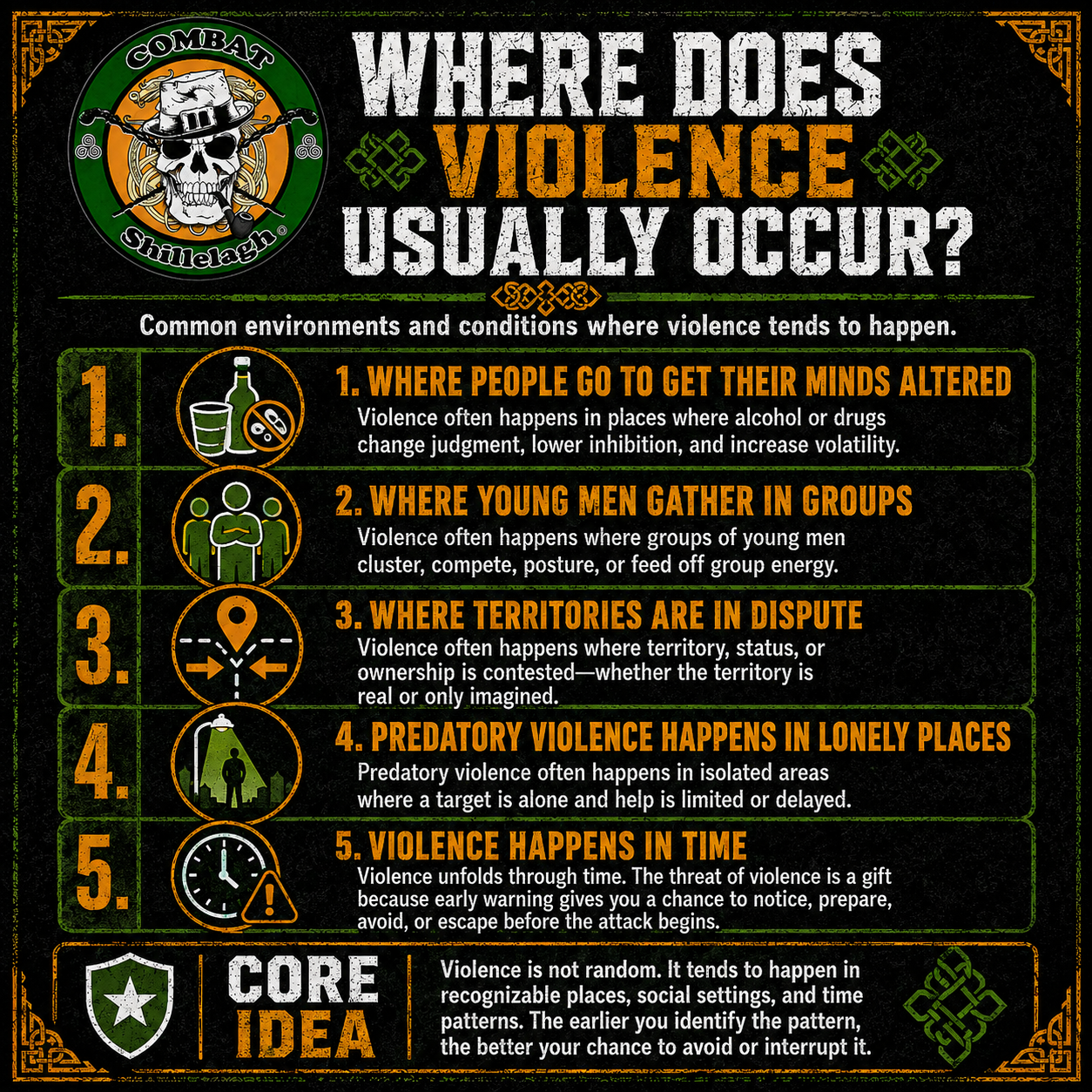
Violence is not as random as most people think.
That does not mean every violent encounter can be predicted perfectly. Real life is messy. People are complicated. Circumstances change quickly. But when you study violence long enough, certain patterns start to appear. Violence tends to happen in recognizable environments, social settings, and timeframes.
Understanding those patterns helps you make better decisions before things ever go hands-on.
The first place violence often occurs is where people go to get their minds altered. Alcohol and drugs change judgment, lower inhibition, increase emotional volatility, and make small conflicts feel much bigger than they are. That is why bars, clubs, parties, and late-night social scenes can become dangerous quickly.
The old saying is true: nothing good happens at a bar at 2:00 in the morning. That does not mean every bar is dangerous or every person drinking is a threat. It means the combination of altered judgment, crowding, ego, noise, attraction, rejection, and competition can create a higher-risk environment.
The second place violence often appears is where young men gather in groups. This is not an insult. It is an observation about patterns of social violence. Young men, especially in the late teens through mid-twenties, are often still sorting out status, identity, dominance, and hierarchy. Add alcohol, an audience, peer pressure, and competing groups, and the risk increases.
That connects directly to the third environment: where territories are in dispute.
Sometimes the territory is real. A neighborhood, a parking spot, a seat, a line, a bar stool, or someone’s personal space. Other times, the territory is symbolic. My team versus your team. My group versus your group. My status versus your status. A sports rivalry, a nightclub scene, or even a loud argument in a parking lot can become a contest over imagined territory.
This is where social violence can erupt. It is often about pride, face, reputation, or belonging. Someone feels disrespected. Someone feels challenged. Someone believes their group has to prove something. Then suddenly, a situation that could have been avoided becomes a fight.
The fourth place violence occurs is very different: predatory violence happens in lonely places.
This is the asocial side of violence. The predator is not trying to win status in front of a crowd. They are looking for privacy, access, control, and opportunity. Parking garages, alleys, poorly lit streets, stairwells, isolated lots, and transition areas between safe places are common danger zones.
You leave the restaurant, the bar, the gym, or the store, and now you are walking alone to your car. That transition matters. Crowds provide witnesses. Lonely places reduce help, delay intervention, and give predators more control.
The fifth point is that violence happens in time.
Violence usually unfolds. There are cues, stages, changes in distance, changes in tone, and opportunities to take an off-ramp. A threat can actually be a gift because it gives you information. It tells you the situation is changing. It gives you a chance to leave, de-escalate, create distance, get help, or prepare.
In Combat Shillelagh, we train self-defense through the use of the shillelagh. But real self-defense is not only about what happens after the attack begins. It is also about understanding where violence tends to happen, why it happens there, and how to remove yourself before the situation becomes physical.
The goal is not paranoia. The goal is pattern recognition.
When you understand the environments where violence is more likely, you can make smarter choices. You can avoid unnecessary exposure, manage distance, stay out of ego contests, pay attention in transition areas, and recognize when it is time to leave.
The best fight is not the one you win.
The best fight is the one you saw coming early enough to avoid.