
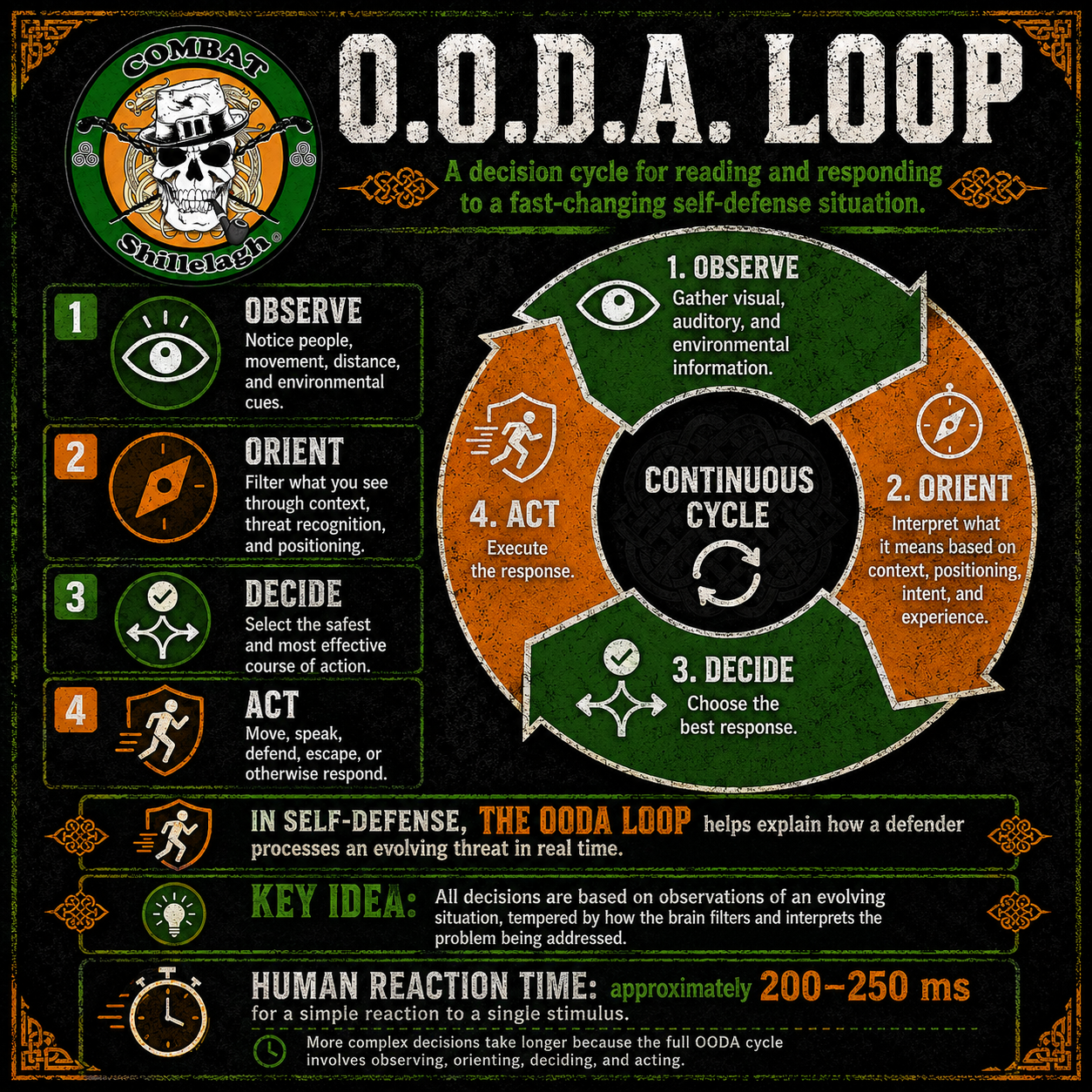
In a fast-changing self-defense situation, your brain has to process information quickly. You see something, interpret it, choose a response, and act. That process is often described as the O.O.D.A. Loop, which stands for Observe, Orient, Decide, and Act.
It is a simple model, but it explains a lot about how people respond under stress.
The first step is Observe. This is where you notice information coming in through your senses. You see someone closing distance. You hear a change in tone. You notice hands moving toward the waistband. You see someone angle their body or look around for witnesses. Observation is the intake of information.
The second step is Orient. This is where your brain tries to make sense of what you observed. Is this normal for the setting? Is the person just animated, or are they preparing to attack? Are they leaving, or are they coiling to strike? Are they asking a harmless question, or are they interviewing you as a potential victim?
Orientation is where context matters. The same behavior can mean different things in different places. A stranger standing close in a crowded concert is not the same as a stranger standing close in an empty parking garage. A hand near the waist may mean nothing in one context and danger in another.
The third step is Decide. Once your brain has interpreted the situation, you must choose what to do. That decision may be to leave, speak, create distance, set a boundary, move toward people, prepare to defend, or do nothing because the situation does not require action.
The fourth step is Act. This is where the decision becomes behavior. You move. You speak. You block. You strike. You escape. You draw attention. You protect someone. Or, in some cases, you intentionally choose not to engage.
Then the loop begins again.
That is important because the O.O.D.A. Loop is not a one-time event. It is continuous. Every action changes the situation. The other person reacts. The distance changes. The environment changes. Your options change. You must keep observing, orienting, deciding, and acting as the situation evolves.
A simple human reaction to a single stimulus is often discussed in the range of roughly 200 to 250 milliseconds. That may sound fast, but real self-defense is rarely a single clean stimulus. It is usually messy. There may be multiple people, conflicting signals, fear, noise, movement, surprise, and uncertainty. The more complex the problem, the longer it can take to process.
The good news is that the O.O.D.A. Loop is a process.
The bad news is that the O.O.D.A. Loop is a process.
You cannot magically skip it. But training can help you move through it more effectively. When you have already studied common patterns, such as pre-incident indicators, pre-attack cues, boundary testing, and positioning, your brain has better filters. You recognize danger sooner because it is no longer completely unfamiliar.
That is where training matters.
In Combat Shillelagh, we train self-defense through the use of the shillelagh. The stick helps us understand distance, timing, movement, structure, and response. But the larger goal is not simply to react after an attack begins. The larger goal is to read the situation early enough to make better decisions before the attack is underway.
If you observe sooner, orient more accurately, decide more clearly, and act more decisively, you gain time.
And in self-defense, time is life.
The goal is not to become paranoid. The goal is to become better prepared. The O.O.D.A. Loop gives us a useful way to understand how the mind processes danger, how quickly situations can change, and why early recognition matters so much.
The earlier you see the pattern, the more options you have.
And the more options you have, the better your chance of getting home safe.