
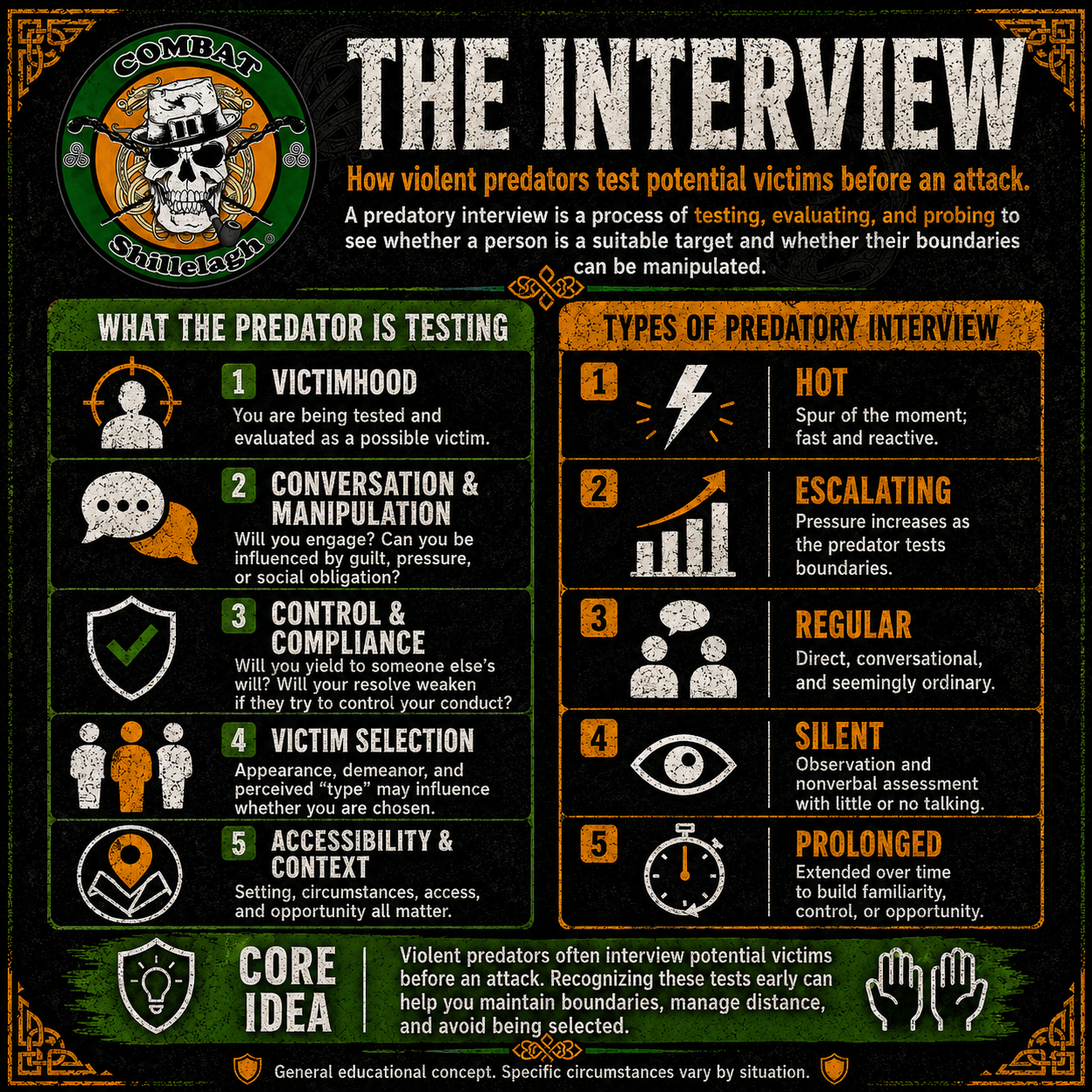
In real-world violence, the attack is often not the first move. Before a predator commits to physical violence, there is frequently a testing process. That process is called the interview.
The interview is not always obvious. It may look like a harmless question, a casual conversation, a request for help, a pushy sales pitch, a panhandler asking for money, or someone trying to get just a little too close. The point is not always what they are asking for. The point is what they are learning about you.
A predatory interview is a test.
The predator is asking, “Can this person be controlled?” “Can they be pressured?” “Will they freeze?” “Will they apologize for having boundaries?” “Can I use guilt, fear, confusion, or social pressure to make them comply?”
That is why small boundary violations matter. A person who ignores your first “no” may be testing whether your boundary is real. They want to know if you will maintain it when challenged, or if it is only a false front they can push through.
For example, someone asks you for money. You say, “No, thank you,” and keep walking. That should be the end of it. But then they escalate.
“What’s the matter with you?”
“You look like you can afford it.”
“You can’t help a brother out?”
Now the request is no longer about a dollar. It is about pressure. They are testing whether guilt can make you stop, turn back, engage, explain, or comply. The longer they keep you engaged, the more opportunity they have to close distance, position you, distract you, or assess whether you are a suitable target.
This is why no is a complete sentence.
You do not owe a stranger an explanation for your boundaries. You do not have to justify why you will not give money, answer a question, accept help, shake hands, step closer, move to another location, or continue a conversation.
“No, thank you,” followed by movement, is often enough.
The interview may also be silent. Someone may watch you, track your movement, study your awareness, or look for signs of distraction. It may be regular and conversational. It may be hot and fast, designed to overwhelm you. It may escalate gradually as the person tests one boundary after another. Or it may be prolonged over time, especially in situations where familiarity and trust are being manipulated.
The common thread is this: the predator is evaluating access, control, compliance, and opportunity.
In Combat Shillelagh training, we are learning self-defense through the use of the shillelagh. That gives us a practical method for understanding distance, structure, movement, and protection. But real self-defense cannot begin only when things go hands-on.
If we only train for the physical attack, we are starting too late.
The goal is to recognize the pattern earlier. When you understand the interview, you can manage distance, avoid being socially trapped, maintain your boundaries, and remove yourself before the situation becomes physical.
That is not paranoia. That is preparation.
The best self-defense outcome is not winning a fight. The best outcome is recognizing the danger early enough that you never have to fight at all.