
The 5 Stages of Violent Crime: Why Self-Defense Starts Before the Attack
Most self-defense training begins too late.
It starts when the punch is thrown, when the grab happens, when the weapon appears, or when the attacker is already inside your personal space. But in real violence, the physical attack is usually not the beginning of the event. It is the fourth stage of a process that has already been unfolding.
Understanding that process gives you time. And time gives you options.
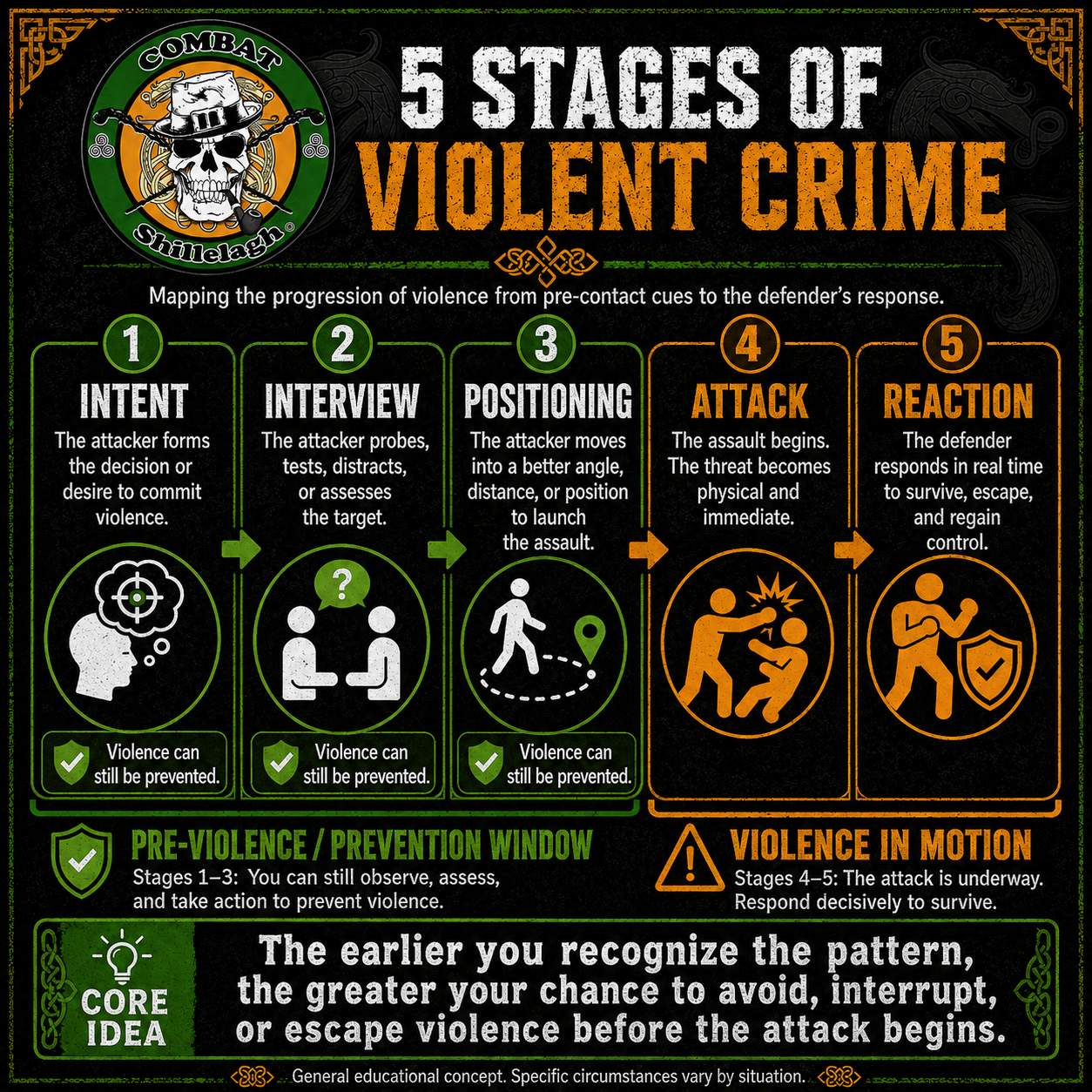
Violent crime often follows a predictable pattern: intent, interview, positioning, attack, and reaction. The earlier you recognize where you are in that pattern, the better your chance of avoiding violence altogether.
The first stage is intent. This is when the attacker has already made a decision, or is moving toward a decision, to harm someone. You may not know exactly what they are thinking, but you may notice behaviors that do not fit the environment. Maybe someone is watching too intently. Maybe they are moving with purpose while trying not to look obvious. Maybe they are scanning for isolation, distraction, weakness, or opportunity.
At this stage, there may be no interaction yet. That is important. Because if there is no interaction, there is often still a clean exit. You can leave, change direction, move toward people, increase distance, or acknowledge that something feels wrong and act on it.
The second stage is the interview. This is where the predator tests the potential victim. They may ask for the time, request help, offer a distraction, invade space, ignore boundaries, or attempt to create social pressure. The purpose is not always the question being asked. The purpose is to see how you respond.
Do you freeze? Do you apologize for having boundaries? Do you let them close distance? Do you explain yourself? Do you comply with small unreasonable requests?
This is an interview you want to fail.
A violent predator usually wants an easy target. They want someone who can be controlled quickly, quietly, and with minimal risk. Confident body language, clear verbal boundaries, movement toward safety, and a refusal to be socially managed can all communicate that you are not the easy option they are looking for.
The third stage is positioning. This is where danger becomes much more immediate. The person may try to get closer, angle off to your blind side, herd you toward a wall, separate you from a group, block your exit, or move you toward isolation. Positioning is about creating advantage before the attack begins.
This is still part of the prevention window, but it is closing fast.
Once you recognize positioning, you need to act decisively. Move. Create distance. Put obstacles between you and the threat. Get your back off the wall. Do not allow yourself to be guided to a secondary location. Use your voice. Draw attention. Leave immediately if you can.
The fourth stage is the attack. At this point, the assault is underway. The threat has become physical and immediate. Your options are now narrower, faster, and more urgent.
The fifth stage is your reaction. This is where physical self-defense lives: protecting yourself, escaping, fighting if necessary, and regaining control long enough to survive.
The mistake is believing self-defense only exists in stages four and five.
Real self-defense begins in stages one through three. It begins with awareness, recognition, boundaries, movement, and prevention. The goal is not to win a fight. The goal is to avoid needing one.
The earlier you recognize the pattern, the more choices you have.
By the time violence is in motion, you may still survive, but you are now solving the problem at its most dangerous point. When you learn to see intent, resist the interview, and disrupt positioning, you give yourself the greatest advantage possible: the chance to escape violence before it begins.
Why This Matters in Combat Shillelagh Training
In the Combat Shillelagh system, we are learning self-defense through the use of the shillelagh. The stick gives us structure, range, leverage, and a practical training method for protecting ourselves. But the weapon is only one part of the larger self-defense picture.
Real self-defense is not just about what you do once things go hands-on. It is also about understanding how violence actually develops in the real world. If you can recognize predatory intent, identify the interview process, and disrupt dangerous positioning, you may be able to avoid the physical encounter entirely.
That matters because the best defensive outcome is not winning a fight. The best outcome is never having to fight in the first place.
So while we train the shillelagh seriously, we also want students to understand the behavior, timing, and warning signs that often come before violence. The more clearly you understand the pattern, the better prepared you are to mitigate risk, create distance, set boundaries, escape, and make better decisions before the situation ever becomes physical.