
In a real self-defense encounter, simple is good.
But simple does not mean shallow.
A strong defensive response should not be a collection of disconnected movements. It should be efficient, layered, and purposeful. That is the idea behind a stacked response. Instead of doing one thing at a time, you combine several useful actions into the same movement.
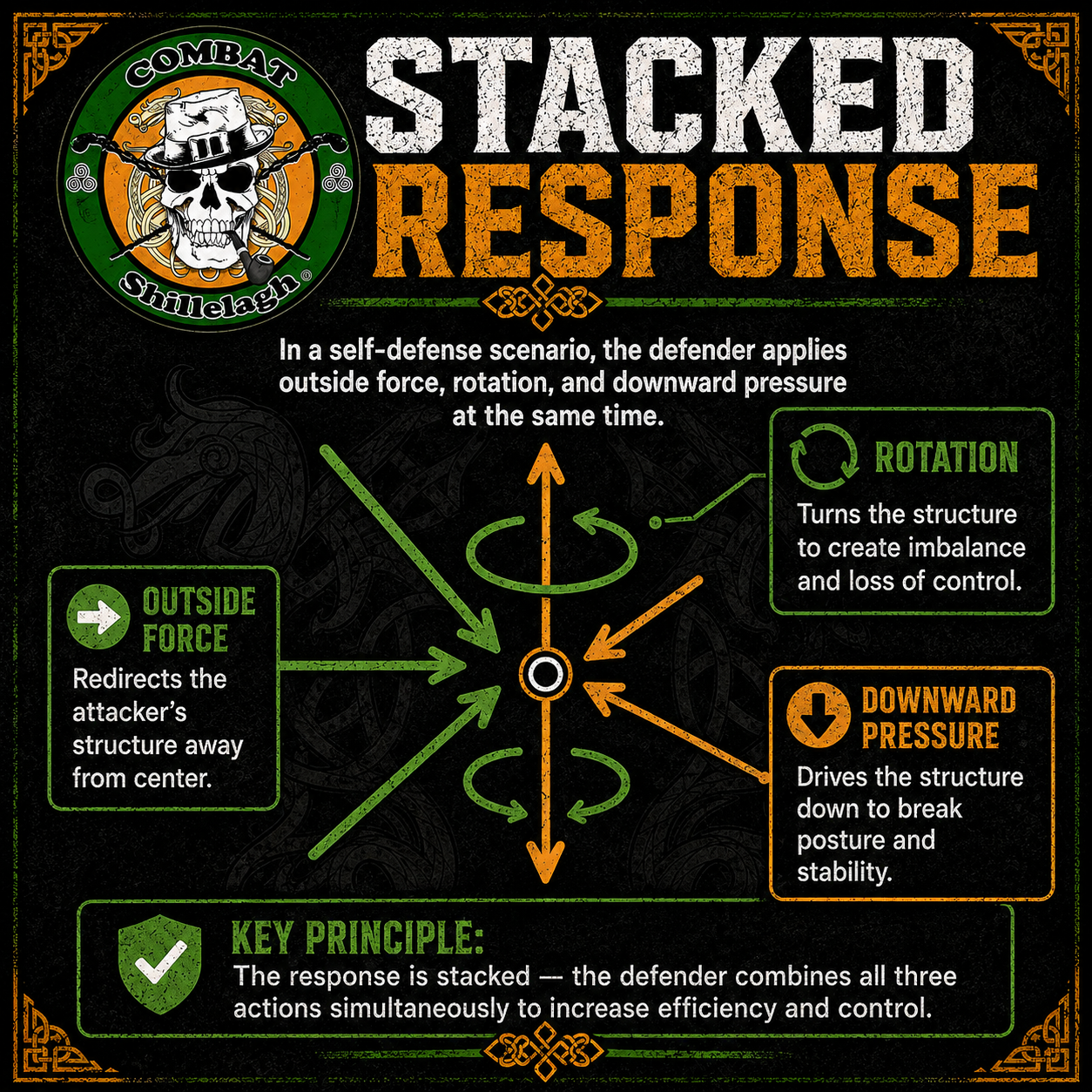
In the Combat Shillelagh system, one way to understand this is through three simultaneous forces: outside force, rotation, and downward pressure.
Each piece does a different job. Together, they create a stronger response than any single piece would by itself.
The first part is outside force.
Outside force redirects the attacker’s structure away from your center. In practical terms, this means you are not trying to meet force head-on if you do not have to. You are taking the attack, the grab, the pressure, or the incoming line and moving it off your centerline.
That matters because your centerline is where you are vulnerable. If the attacker can drive directly into your structure, they can overwhelm you, control you, strike you, or keep advancing. Outside force changes that relationship. It moves their pressure away from your strongest line and begins to break their ability to continue cleanly.
The second part is rotation.
Rotation turns the attacker’s structure. It creates imbalance, misalignment, and loss of control. When you rotate someone’s structure, you are not just pushing them away. You are changing their relationship to the ground, to you, and to their own balance.
People are strongest when their body is aligned behind their force. They are weaker when their shoulders, hips, knees, feet, and head are no longer working together. Rotation attacks that alignment. It makes the attacker adjust, reorient, and recover.
That recovery time is important.
In self-defense, you do not need to dominate forever. You need enough time and space to stop the immediate threat, escape, access a better position, or continue with the next necessary action.
The third part is downward pressure.
Downward pressure drives the attacker’s structure down. It can break posture, disrupt balance, and make it harder for the attacker to continue moving freely. A person whose structure is collapsing downward has a harder time striking effectively, advancing, grabbing, or regaining initiative.
Downward pressure also helps you create control without relying only on strength. When combined with outside force and rotation, it attacks the attacker’s structure in multiple directions at the same time.
That is why the response is “stacked.”
You are not redirecting first, rotating second, and applying downward pressure third as three separate steps. You are blending them together. One action creates multiple effects.
This connects directly to the Iron Rule of 3. A good self-defense movement should secure your perimeter, disrupt the attack, and set up your next move. A stacked response does exactly that. It protects your space, breaks the attacker’s structure, and puts you in a better position for what comes next.
It also connects to the O.O.D.A. Loop. If your movement forces the attacker to lose balance, turn, drop, or reorient, you have interrupted their decision cycle. Now they have to process a new problem while you are already moving toward your next solution.
In Combat Shillelagh training, this principle is especially valuable because the stick gives us leverage, range, and structure. But the principle is not only about the weapon. It is about how the body moves, how force is redirected, and how we create advantage under pressure.
The goal is not to use more effort.
The goal is to use better structure.
A stacked response makes one movement do several jobs at once. Outside force moves the threat off center. Rotation breaks alignment. Downward pressure damages posture and stability.
Together, they help you protect yourself, disrupt the attacker, and regain control in a moment where every second matters.