
Real self-defense is not a clean, choreographed exchange.
It is not a movie scene. It is not a drill where everyone knows the attack ahead of time. It is a fast, chaotic, high-pressure problem where you may have only seconds, or fractions of seconds, to make decisions that can change your life.
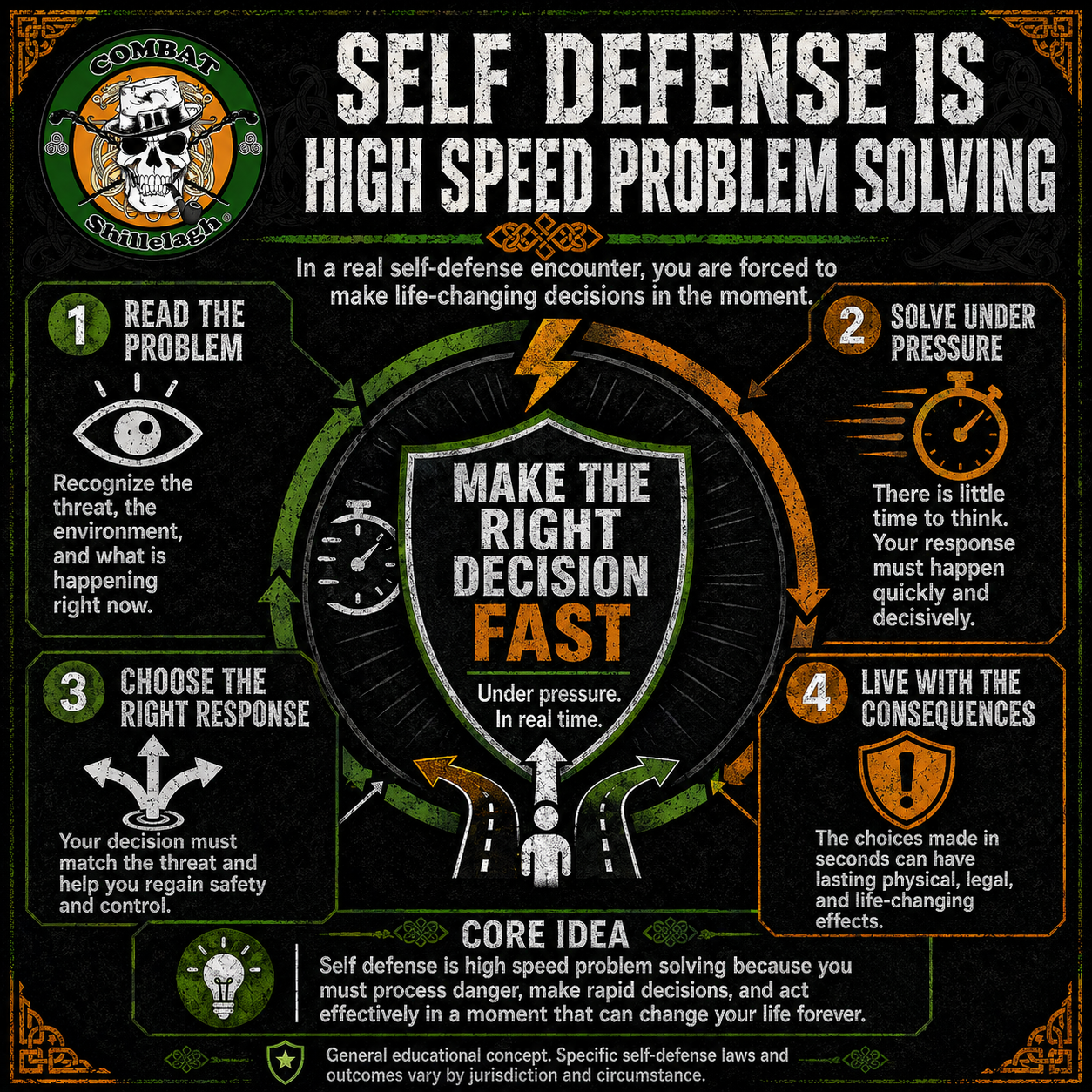
That is why self-defense is really high-speed problem solving.
You are forced to read the problem, solve it under pressure, choose the right response, and then live with the consequences of that decision. That is a heavy responsibility, which is why understanding violence matters just as much as learning physical technique.
The first step is to read the problem.
What is happening right now? Is this social posturing, or is it predatory behavior? Is the person angry, drunk, confused, manipulative, or actively preparing to hurt you? Are they alone, or are there others with them? Are you in a crowded area, a transition space, a parking lot, a stairwell, or somewhere isolated? Where are their hands? Are they closing distance? Are they blocking your exit?
You cannot solve the problem correctly if you misread what kind of problem it is.
The second step is to solve under pressure.
In a real encounter, you may not have time for a perfect plan. Your heart rate spikes. Your vision may narrow. Your breathing changes. Your hands may shake. Your thinking may speed up or slow down. You may feel fear, anger, disbelief, or hesitation.
That pressure is part of the problem.
This is why training matters. You are not just training techniques. You are training your ability to recognize patterns, manage distance, set boundaries, move, speak, and act while under stress. You are trying to build a decision-making process that still functions when things become ugly.
The third step is to choose the right response.
The right response is not always physical. Sometimes the right response is leaving. Sometimes it is creating distance. Sometimes it is using your voice. Sometimes it is giving someone a face-saving exit. Sometimes it is moving toward witnesses. Sometimes it is protecting someone else. And sometimes, when there are no safer options left, the right response is decisive physical defense.
The response must match the threat.
Too little response may leave you vulnerable. Too much response may create legal, moral, and practical consequences. The goal is not to punish the other person. The goal is to regain safety and control.
The fourth step is to live with the consequences.
This is the part many people ignore. A self-defense encounter does not end when the physical danger stops. There may be injuries. There may be police. There may be witnesses, cameras, courtrooms, job consequences, family consequences, and emotional consequences.
That does not mean you should hesitate when action is truly necessary. It means you should understand the seriousness of the decisions being made.
In Combat Shillelagh training, we study self-defense through the use of the shillelagh. The stick gives us structure, range, leverage, and a practical method for defending ourselves. But the larger goal is not simply learning how to swing a weapon.
The larger goal is learning how to solve the problem.
Can you recognize danger early? Can you avoid unnecessary conflict? Can you manage distance? Can you make a decision under pressure? Can you act decisively without losing control? Can you stop when the danger stops?
Self-defense is high-speed problem solving because the situation is moving, the threat is evolving, and the stakes are real.
The better you understand violence before it happens, the better prepared you are to make the right decision when it matters most.