
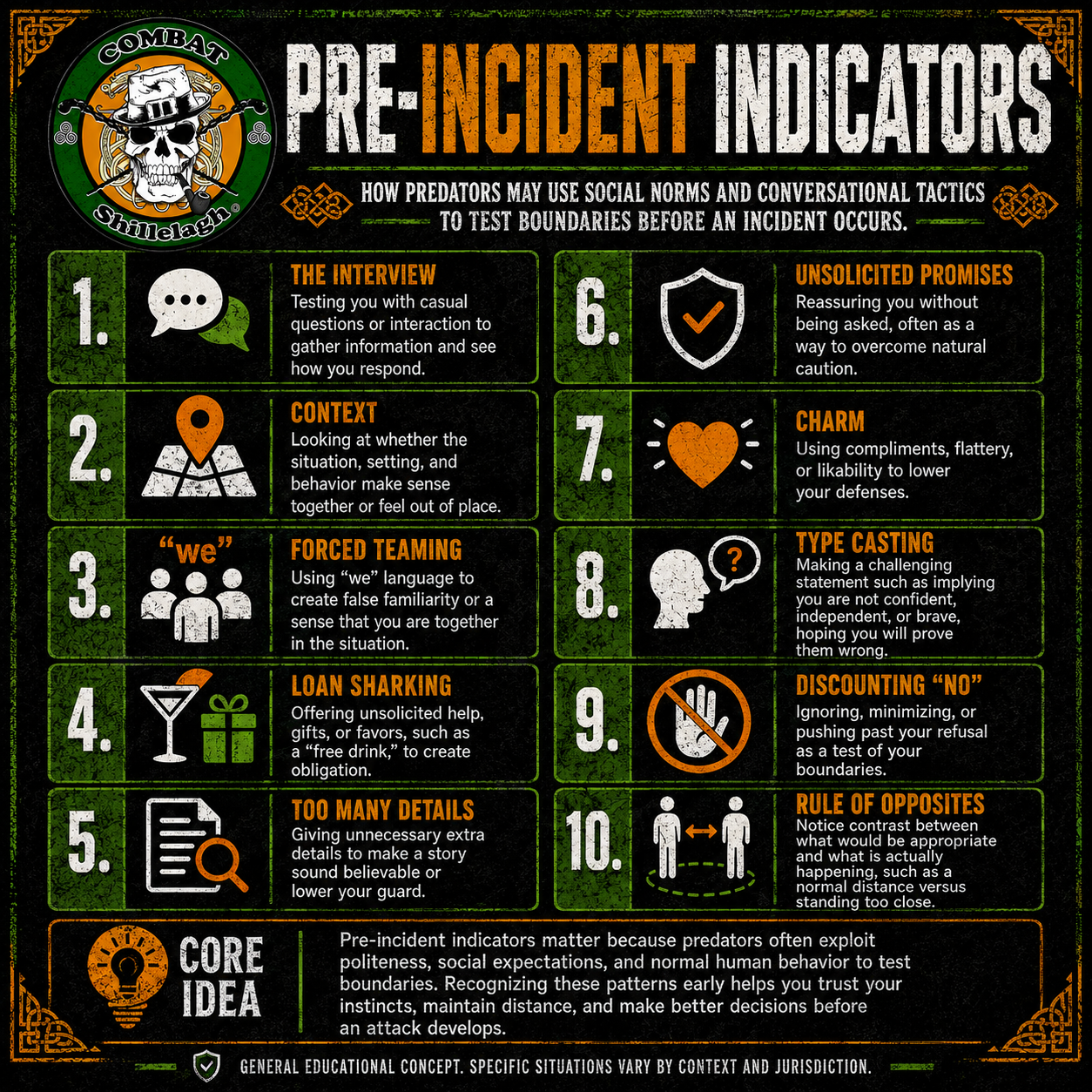
Intuition is not magic. Most of the time, intuition is your brain noticing small details before your conscious mind has fully organized them.
Something feels off. The person is too close. The story has too many details. The offer feels unnecessary. The charm feels forced. The situation does not match the setting.
That is where pre-incident indicators matter.
Pre-incident indicators are the social, verbal, and behavioral warning signs that may appear before a violent encounter. They are not guarantees. One indicator by itself does not mean someone is definitely dangerous. But several indicators together, in the wrong context, should get your attention.
One of the biggest indicators is the interview. This is when a potential predator tests you to see how you respond. They may ask casual questions, create unnecessary interaction, or try to pull you into a conversation you did not ask for. The real question underneath the question is simple: “Are you a good target?”
This is the interview you want to fail.
A predator may be looking to see whether you are distracted, overly polite, easily pressured, or unwilling to set boundaries. They may test whether you will stop moving, answer personal questions, allow them to close distance, or explain yourself when you have already said no.
Another indicator is forced teaming. This is when someone uses “we” language when no real relationship exists.
“We need to get out of here.”
“We should go over there.”
“We’re in this together.”
That kind of language can create false familiarity. It can make you feel socially connected to someone you do not know and do not owe anything to.
Loan sharking is another common tactic. This is when someone offers unsolicited help, gifts, favors, or attention in order to create a sense of obligation. A free drink, help carrying something, or an unwanted favor may be harmless in many contexts. But when it feels pushy, unnecessary, or tied to pressure, pay attention.
The same goes for too many details. When someone overexplains a simple situation, they may be trying to make a story sound believable or lower your guard. Excessive charm, compliments, and unsolicited promises can serve the same purpose. They can be used to make you feel safe, liked, rude for resisting, or obligated to continue the interaction.
One of the most important indicators is discounting “no.”
No is a complete sentence. You do not need to explain it, soften it, or apologize for it. If someone ignores your no, minimizes it, laughs it off, pressures you, or keeps pushing, they are testing whether your boundary is real.
If you establish a boundary and immediately allow it to be violated, you may teach the other person that your boundaries do not hold. That does not mean you need to be aggressive. It means your words, movement, posture, and decisions must match.
Finally, pay attention to the rule of opposites. Ask yourself: does this behavior fit the context?
At a party, normal conversation has a certain distance and rhythm. In a parking garage, a stranger standing too close feels different. At a social event, a compliment may be normal. In an isolated transition area, excessive charm from a stranger may deserve more caution.
In Combat Shillelagh training, we study self-defense through the use of the shillelagh. But the stick is only one part of the larger self-defense picture. Real self-defense also means understanding how violence develops before it becomes physical.
The goal is not paranoia. The goal is recognition.
When you recognize pre-incident indicators early, you can trust your instincts, maintain distance, set boundaries, remove yourself, and make better decisions before an attack ever develops.