
In many potentially violent encounters, the goal should not be to “win” the argument.
The goal is to avoid the fight.
That may sound obvious, but when ego, fear, anger, alcohol, group pressure, and adrenaline enter the situation, people often do the exact opposite of what would keep them safe. They insult. They threaten. They challenge. They deny the other person’s perception. They trap the other person in a corner with no face-saving way out.
Then everyone acts surprised when the situation goes physical.
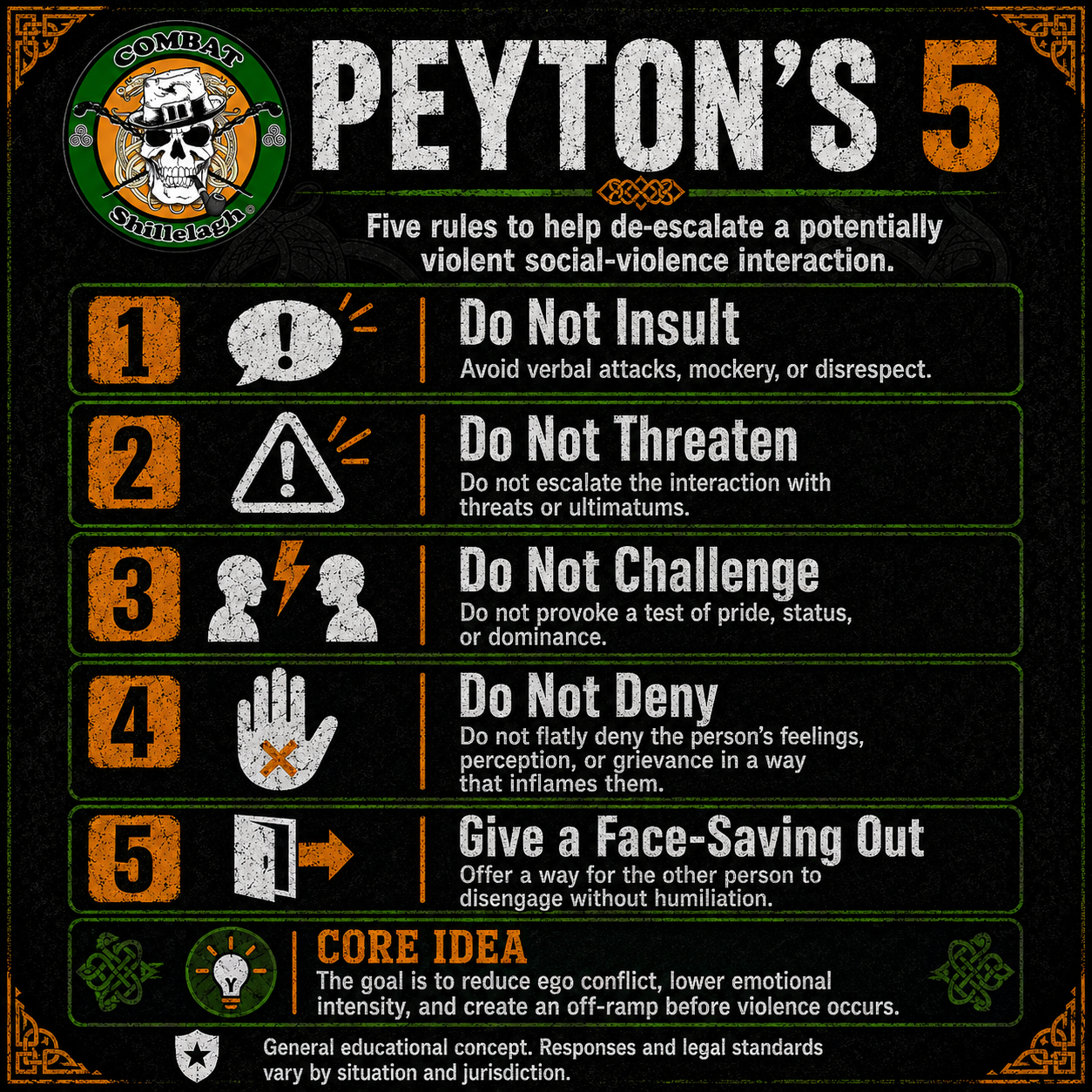
Peyton’s 5 is a simple framework for reducing the chance of escalation in a social-violence encounter. It is not about being weak. It is not about appeasing predators. It is about understanding how ego conflict works and creating an off-ramp before violence occurs.
The first rule is do not insult.
Mockery, name-calling, sarcasm, humiliation, and disrespect can turn a tense situation into a status contest. In social violence, people often fight because they feel disrespected, embarrassed, or challenged in front of others. If you insult someone, especially in front of an audience, you may be adding fuel to the exact fire you are trying to put out.
The second rule is do not threaten.
Threats and ultimatums can harden the other person’s position. If you say, “Take one more step and see what happens,” you may think you are setting a boundary, but you may also be daring them to prove something. A better approach is to use clear, simple boundary language without adding ego or challenge.
“I do not want trouble.”
“Stay back.”
“I am leaving.”
Those statements are clear without being performative.
The third rule is do not challenge.
Challenges are dangerous because they attack pride, status, and dominance. “What are you going to do about it?” “You think you’re tough?” “Go ahead, try it.” These phrases are invitations to violence. They turn the encounter into a test.
In many social-violence situations, especially where young men, groups, alcohol, or audiences are involved, a challenge can become a trap for both people. Now backing down feels like losing face. Once that happens, violence becomes more likely.
The fourth rule is do not deny.
This does not mean you agree with the other person. It means you avoid flatly dismissing their feelings or perception in a way that inflames them. Saying “You’re crazy,” “That didn’t happen,” or “You’re being stupid” may be true in your mind, but it can escalate the emotional temperature.
A better tactic is to acknowledge without surrendering.
“I hear you.”
“I can see you’re upset.”
“That wasn’t my intention.”
“I do not want this to turn into something bigger.”
You are not admitting guilt. You are lowering pressure.
The fifth rule is give a face-saving out.
This may be the most important piece. People often continue conflict because they do not know how to leave without feeling embarrassed. Give them a way to disengage that does not humiliate them.
“We’re good. I’m going to head out.”
“No problem. I’m leaving.”
“Let’s not make this worse.”
“You’ve got your night. I’ve got mine.”
The goal is to create an exit ramp.
In Combat Shillelagh training, we study self-defense through the use of the shillelagh. But real self-defense is not just about what happens when the stick comes out or when the hands come up. It is also about understanding human behavior, ego, escalation, and the ways violence can often be avoided before it becomes physical.
Peyton’s 5 gives you a practical way to lower the emotional intensity of a situation.
Do not insult.
Do not threaten.
Do not challenge.
Do not deny.
Give a face-saving out.
That does not mean you ignore danger. It does not mean you let someone violate your boundaries. It means you stay focused on the real goal: getting home safe.
Sometimes the strongest move is not proving you can fight.
Sometimes the strongest move is refusing to help the fight happen.