Yes, Irish Stick Fighting can be very good for self defense, especially when it is taught as a practical combative system rather than as choreography, historical reenactment, or sport-only training.
That is exactly where the Combat Shillelagh system stands apart. Combat Shillelagh is rooted in practical, reality-based training and effectiveness using the shillelagh as a serious defensive tool. The system is not focused on looking flashy or performing movements for show. It is focused on learning how to use the shillelagh with confidence, structure, power, control, and purpose in realistic self-defense situations.
Irish Stick Fighting is built around a simple idea: using a walking stick, shillelagh, cane, or similar everyday object to protect yourself with direct, powerful, and efficient movement. Unlike many martial arts that require years of athletic development before they become useful, shillelagh training can give students practical defensive skills early in their training journey.
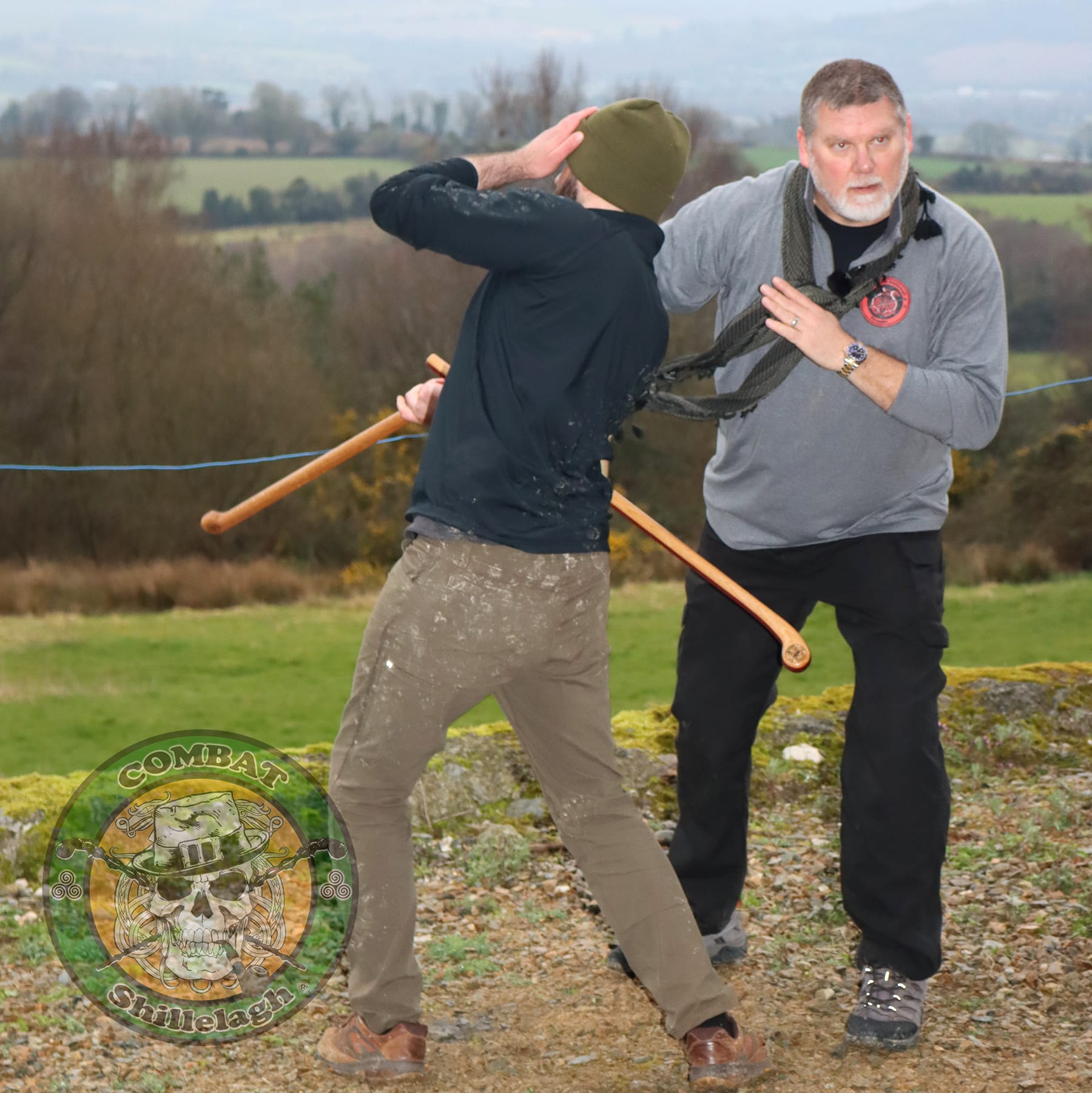
Combat Shillelagh also goes beyond simple striking. While powerful strikes are an important part of the system, the shillelagh can also be used at close range as a lever for body manipulation, joint control, balance disruption, and defensive control of an attacker’s structure. This gives the practitioner options at multiple distances, from long-range striking to in-close control.
That does not mean any martial art guarantees safety. It does not. But when taught correctly, Irish Stick Fighting offers several major advantages for real-world personal protection.
The Shillelagh Is a Practical Defensive Tool
One of the biggest advantages of Irish Stick Fighting is that it uses an object that naturally extends your reach.
In a self-defense situation, distance matters. A shillelagh allows you to create space between yourself and an attacker. That extra distance can be the difference between being grabbed, tackled, or struck, and being able to stop or disrupt the threat before it reaches you.
A properly used shillelagh can help a defender deal with someone who is larger, stronger, younger, or more aggressive. This is one reason stick-based fighting systems have existed in cultures all over the world. Human beings have used sticks as tools and weapons for thousands of years because they are simple, available, and effective.
The Irish shillelagh is especially connected to this kind of practical defense. Traditionally, it was not only a symbol of Irish identity. It was also a walking stick, a travel companion, and, when necessary, a means of protection.
The Combat Shillelagh system respects that history while focusing on modern application. Students are taught to see the shillelagh not as a costume prop or decorative object, but as a functional defensive tool.
Combat Shillelagh Focuses on Simple, Direct Movement
Good self-defense training should not depend on complicated techniques that fall apart under stress.
When fear, adrenaline, and chaos enter the picture, fine motor skills can decline. In a real confrontation, you are unlikely to perform a long sequence of perfect movements. That is why practical martial systems favor simple, repeatable actions that can be used under pressure.
The Combat Shillelagh system is built around this idea.
The training emphasizes direct striking, guarding, footwork, distance control, recovery, and practical defensive positioning. Students learn how to generate power, protect important targets, move off the line of attack, and use the shillelagh to maintain space.
A Combat Shillelagh practitioner does not need to be flashy. The goal is not to impress an audience. The goal is to survive, protect yourself, and escape the danger as quickly as possible.
The Shillelagh Is Also a Close-Range Lever
Many people think of stick fighting only as striking. While striking is important, it is only part of the picture.
One of the unique strengths of the Combat Shillelagh system is its in-close body manipulation work. At close range, the shillelagh can be used as a lever against the attacker’s body structure. This allows the defender to apply pressure, disrupt balance, control movement, and create openings to escape.
In practical terms, the shillelagh can be used to influence an attacker’s joints, spine, posture, shoulders, arms, and overall alignment. When used properly, it becomes more than an impact tool. It becomes a control tool.
This matters because real self-defense situations are messy. An attacker may rush in, grab, clinch, tackle, or crowd your space. If your entire strategy depends only on long-range striking, you may be in trouble once the distance collapses.
Combat Shillelagh addresses this by teaching students how the shillelagh can function in close quarters. The practitioner learns how to use structure, leverage, and positioning rather than relying only on strength. This can be especially valuable when dealing with a larger or stronger attacker.
Joint Manipulation and Spine Manipulation for Self Defense
The Combat Shillelagh system includes close-range methods that use the shillelagh as a lever for joint manipulation and spinal alignment disruption in a self-defense context.
This does not mean reckless force or unnecessary injury. It means understanding how the body moves, how joints are vulnerable to leverage, and how posture can be broken when pressure is applied correctly.
When the shillelagh is used as a lever, it can help the defender control an attacker’s arm, redirect pressure, compromise balance, or disrupt the attacker’s ability to continue advancing. The goal is not to wrestle strength against strength. The goal is to use the tool intelligently.
Spine manipulation in this context refers to using the shillelagh to affect the attacker’s posture, head position, shoulder line, and spinal alignment so their structure weakens. Once an attacker’s structure is broken, their power, balance, and forward pressure are reduced.
This is a critical part of practical self defense. A person who is balanced, aligned, and driving forward is dangerous. A person whose posture has been disrupted is easier to control, move, strike, disengage from, or escape.
It Gives Options at Multiple Ranges
A strong self-defense system should not work at only one distance.
Combat Shillelagh gives the practitioner tools for several ranges:
- Longer range, where the shillelagh can be used to maintain distance and strike
- Mid range, where the shillelagh can be used to guard, intercept, and redirect
- Close range, where the shillelagh can be used for body manipulation, joint control, and structural disruption
This range adaptability is one of the reasons the system is so practical. Real confrontations do not stay at one clean distance. The attacker may start far away, close the distance suddenly, grab, push, or crash into you.
The Combat Shillelagh system prepares the student to keep using the shillelagh even when the situation changes. It is not just a swinging tool. It is a striking tool, a shielding tool, a leverage tool, and a close-range control tool.
It Can Help Smaller or Older Practitioners
One of the strongest self-defense benefits of shillelagh training is that it can reduce the advantage of size and strength.
Empty-hand martial arts can be very valuable, but they often require close-range engagement. That can be dangerous if the attacker is significantly larger or stronger. Grappling, clinching, or trading strikes empty-handed with a stronger person may quickly become a serious problem.
A shillelagh changes the equation.
The defender now has reach, leverage, structure, and impact. The shillelagh can be used to create distance, strike vulnerable targets, disrupt forward pressure, manipulate joints, affect posture, and make it harder for an attacker to continue their assault.
This makes Irish Stick Fighting especially useful for adults who want realistic self-defense skills without needing to train like competitive fighters. It can appeal to older adults, beginners, people with limited athletic backgrounds, and martial artists who want to add a practical weapon-based system to their training.
Combat Shillelagh is designed with that practicality in mind. It is not about turning every student into a tournament fighter. It is about giving ordinary people useful skills with a traditional Irish weapon that can still make sense in the modern world.
It Builds Awareness, Confidence, and Readiness
Self defense is not only about physical technique. In many cases, the best self-defense outcome is avoiding the fight altogether.
A serious Irish Stick Fighting program should develop awareness, judgment, and confidence. Students should learn how to understand distance, notice body language, recognize danger, protect personal space, and identify ways to leave before violence happens.
Combat Shillelagh training supports this broader self-defense mindset. The shillelagh is the tool, but the real skill is learning how to manage distance, timing, movement, leverage, and intent.
Training also builds confidence. That confidence matters because people who appear distracted, uncertain, or intimidated may be more vulnerable. Real confidence is not arrogance. It is the quiet ability to stand your ground, move with purpose, and make decisions under pressure.
A Shillelagh Is Easier to Learn Than Many Traditional Weapons
Some weapons require years of technical study before they become useful. A stick is different.
That does not mean anyone can automatically use a shillelagh well. Proper instruction matters. But the basic mechanics of using a stick are natural for many people. Most people understand the basic idea of swinging, blocking, pointing, pushing, and creating space.
Combat Shillelagh takes those natural movements and refines them into a structured system.
Students learn how to hold the shillelagh, how to strike with power, how to recover after a strike, how to protect the body, how to move their feet, and how to use angles rather than standing directly in front of danger.
They also learn that the shillelagh is not limited to impact. It can be used to press, wedge, frame, lever, redirect, and control. These close-range applications make the system more complete and more adaptable.
The Skills Transfer to Everyday Objects
Another practical benefit of Irish Stick Fighting is that the principles can transfer to other objects.
A student trained in the Combat Shillelagh system may be able to apply similar ideas with a cane, umbrella, hiking stick, walking staff, training stick, or other sturdy object. The exact handling may change depending on the object’s length, weight, and shape, but the core principles remain useful.
This matters because real self defense is rarely convenient. You may not have the perfect tool. You may have whatever is nearby. A strong shillelagh system teaches principles that can adapt to different circumstances.
The same is true for leverage-based training. Once a student understands how to use a rigid object to create pressure, disrupt posture, and control space, those lessons can carry over to other practical tools.
It Preserves Irish Martial Culture While Teaching Practical Skills
Irish Stick Fighting is not only about self defense. It also carries history, identity, and tradition.
For many students, that is part of the appeal. Training with the shillelagh connects them to Irish martial heritage, old faction fighting methods, and the broader story of how ordinary people protected themselves with simple, effective tools.
Combat Shillelagh honors this cultural background while keeping the training focused on practical use. The goal is to preserve the spirit of the tradition without turning it into museum work.
Students are not just learning movements. They are participating in the continuation of an Irish fighting tradition that still has value today.
Training Quality Matters
Irish Stick Fighting is good for self defense only if the training is realistic.
A strong system should include:
- Practical striking mechanics
- Defensive guards and recovery
- Footwork and distance control
- Drills against pressure
- Close-range body manipulation
- Joint manipulation using the shillelagh as a lever
- Posture and spine disruption for defensive control
- Realistic self-defense concepts
- Responsible use-of-force discussion
- Progressive training from beginner to advanced material
The Combat Shillelagh system is built around practical, reality-based training. It is designed to help students understand how the shillelagh can actually be used, not just how it can be displayed.
A weak program may only teach patterns, historical demonstrations, or unrealistic movements that look interesting but do not hold up under stress. That is not enough for real self defense.
The better question is not simply, “Is Irish Stick Fighting good for self defense?” The better question is, “Are you learning a system that is actually designed for practical effectiveness?”
With Combat Shillelagh, the answer is yes.
The Legal and Ethical Reality of Using a Shillelagh
Any serious self-defense discussion must include responsibility.
A shillelagh can cause serious injury, whether used for striking, joint manipulation, or close-range control. That means it must be used only when legally and morally justified. Self-defense laws vary by location, and students should understand concepts such as reasonable force, proportional response, avoidance, and retreat requirements where applicable.
Training should not create reckless people. It should create disciplined people.
The purpose of Combat Shillelagh is not to start fights. It is to help students protect themselves or others when there is no safe alternative.
So, Is Irish Stick Fighting Good for Self Defense?
Yes. Irish Stick Fighting can be an excellent self-defense method because it is practical, direct, adaptable, and built around a tool that improves reach, leverage, striking power, and close-range control.
The Combat Shillelagh system takes those advantages and organizes them into a practical, reality-based approach to training. It teaches students how to use the shillelagh with purpose, how to move effectively, how to manage distance, how to generate power, and how to use the shillelagh as a lever for in-close body manipulation when the distance collapses.
This is what makes the system so useful. It is not limited to swinging from the outside. It includes the ability to strike, guard, frame, manipulate joints, disrupt posture, affect spinal alignment, and create opportunities to escape.
It is especially useful for people who want realistic self-defense skills without needing to become competitive athletes. It can benefit beginners, older adults, martial artists from other systems, people interested in Irish heritage, and anyone who wants to learn how to use a shillelagh, cane, or walking stick effectively.
Final Answer
Irish Stick Fighting is good for self defense because it gives the average person a practical way to protect themselves using reach, movement, leverage, impact, and simple combative principles.
The Combat Shillelagh system builds on that foundation by focusing on practical, reality-based training and effective use of the shillelagh as a defensive tool. It includes long-range striking, mid-range defense, and in-close body manipulation using the shillelagh as a lever for joint control and posture disruption.
It is not about fantasy fighting, performance, or complicated techniques. It is about learning how to use a traditional Irish weapon in a direct, disciplined, and functional way.
For anyone looking for a martial art that combines real-world practicality, personal protection, close-range control, and Irish martial heritage, Combat Shillelagh offers one of the most unique and valuable training paths available today.
When you are ready to start learning, you can check out all of our Training Programs here: https://www.combatshillelagh.com/product-category/distance-learning-courses/