
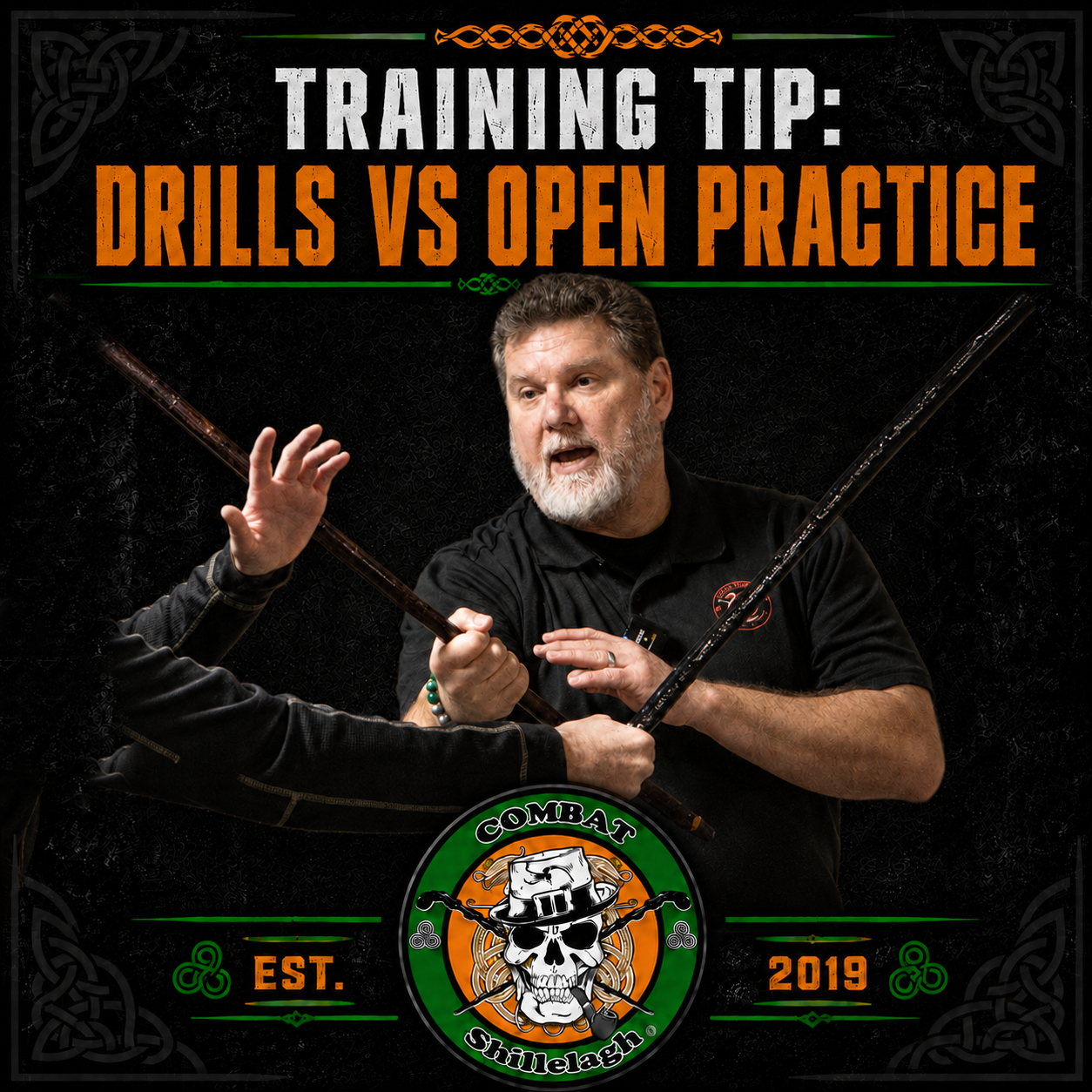
Proper practice makes perfect. More accurately, proper practice makes permanent. Whatever you repeatedly train, whether it is correct or incorrect, is what your body will eventually default to under pressure.
With that in mind, we have a few suggestions to help you get the most from your Irish Stick Fighting training.
People with limited exposure to our art occasionally comment on our social media videos with statements such as, “Now do it full speed!” They seem to expect every instructional demonstration to look like a scene from a John Wick movie. SMDH.
However, those comments bring up an important training point. There is a major difference between a drill, open practice, and sparring. Each has a different purpose, and each belongs at a different stage of the learning process.
Drills Are Designed to Teach
When we instruct at live seminars, weekly classes, or through our online training videos, the material is presented so that the practitioner can clearly see and understand what is happening.
That usually means demonstrating the movement slowly.
A defense or counterattack is not just a block followed by a strike. Foot placement, hand position, body angle, spinal alignment, distance, timing, balance, and recovery are all happening at once. If the technique were shown only at full speed, most students would miss the details that actually make it work.
Slow training allows us to isolate those details.
A drill provides a controlled situation in which both partners know what is supposed to happen. One person delivers a specific attack, and the other practices a specific response. The goal is not to surprise or defeat your partner. The goal is to develop correct movement, structure, timing, and understanding.
When learning a new movement, you should practice it slowly and with purpose. Speed is often an ego trap. Moving quickly can make a sloppy technique feel more effective than it really is.
If you cannot perform the movement correctly at one-quarter speed, you do not truly own it at full speed.
Start slowly. Pay attention to your feet, posture, hands, alignment, and balance. Once you can repeat the movement correctly, gradually increase the speed while preserving the same structure.
Speed Is Also a Safety Valve
Safety is another major reason we begin slowly. Protective equipment has an important place in martial arts training, especially during higher-intensity exercises. However, we also believe there is value in learning to move naturally without becoming completely dependent on heavy padding.
When training without protective equipment, speed becomes the primary safety valve.
Almost any technique can be explored safely when both partners move slowly, remain controlled, and respect the purpose of the drill. Slow practice allows you to examine strikes, thrusts, takedowns, balance disruptions, and close-range movements without turning every training session into a test of toughness.
Observe the movement slowly. Repeat it slowly. Correct the mistakes. Then increase the speed a little at a time.
Open Practice Introduces Choice
Once the basic movement becomes familiar, the next step is open practice. In a drill, the attack and response are usually predetermined. In open practice, one or both partners are given choices. The attacker may use several possible strikes. The defender must recognize the attack and select an appropriate response.
The intensity may still be moderate, but the mental demand is much greater.
Open practice develops recognition, decision-making, adaptability, and timing. It begins to close the gap between knowing a technique and being able to use it against an unpredictable person.
This stage may also include progressive resistance. Your partner gradually becomes less cooperative, changes the distance, adjusts the angle, interrupts your technique, or attempts to counter your response.
The purpose is not to make the technique fail. The purpose is to discover what must be adjusted when the situation is no longer perfect.
Sparring and Randori Put Everything Together
At the far end of the training spectrum is randori, or free training. This is where the tools in the toolbox have been practiced enough that you and your training partner can begin putting them together in real time. Neither person knows exactly what the other will do. You must manage distance, protect yourself, create openings, respond to pressure, and recover when your original plan does not work.
This is where the art comes alive.
However, sparring is not simply two people swinging sticks at each other as hard and fast as possible. Good sparring requires control, agreed-upon rules, appropriate equipment, and a clear training objective.
Different sparring rounds may emphasize different skills. One round may focus on footwork and distance. Another may allow only certain attacks. Another may explore close-range entries or counterattacks. Even free training should have enough structure to keep it productive.
Sparring reveals weaknesses that cooperative drills cannot. It shows whether your footwork holds up under pressure, whether you can recognize an attack, and whether you can maintain balance when the exchange becomes unpredictable.
But sparring does not replace drilling. Drills build the skill. Open practice tests and adapts the skill. Sparring teaches you to apply the skill under pressure.
You need all three. The ultimate goal is absolutely to move naturally, confidently, and at speed. But speed should be the result of correct training, not a substitute for it.
Walk before you run. Learn the movement, pressure-test it progressively, and then bring it into free practice. Your future training partners, and your future self, will thank you.
Then we can play.