
Self-defense is not just something you do. It is something you may have to explain later in a court of law.
That is an uncomfortable truth, but an important one. If you use force against another person, even for the right reasons, you may still have to articulate why your actions were necessary. A claim of self-defense is an affirmative claim. In plain language, that means you are saying, “Yes, I used force against this person, but I was legally and morally justified because I did it to protect myself.”
That requires more than saying, “I was scared.”
Fear matters, but fear alone is not enough. You need to be able to explain why the threat was real, why it was immediate, why you believed defensive action was necessary, and why your response made sense under the circumstances.
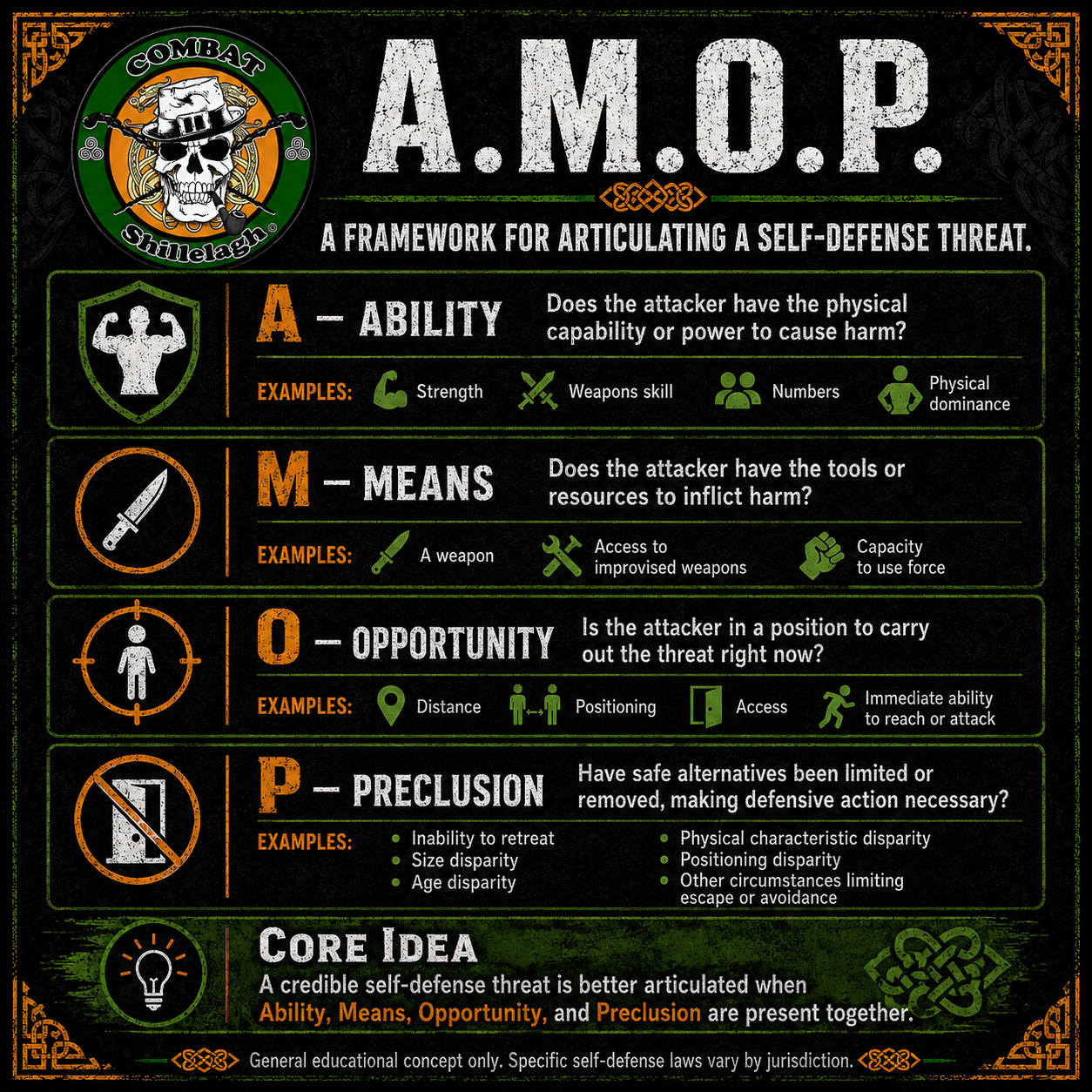
One useful framework for thinking through this is A.M.O.P.: Ability, Means, Opportunity, and Preclusion.
Ability asks whether the attacker had the physical capability or power to cause harm. Were they bigger, stronger, faster, or more physically dominant? Were there multiple attackers? Did they have training, weapons skill, or some other advantage? Ability is about whether this person could realistically hurt you.
Means asks whether the attacker had the tools or resources to inflict harm. A weapon is the obvious example, but means can also include improvised weapons, environmental hazards, or the ability to use force with hands, feet, or numbers. Someone does not need a formal weapon to be dangerous. A bottle, chair, curb, wall, or concrete floor can all become part of the threat.
Opportunity asks whether the attacker was in a position to carry out the threat right now. Distance matters. Position matters. Access matters. A person yelling from across the street may be threatening, but they may not have immediate opportunity. A person closing distance, cutting off your exit, reaching for a weapon, or getting within striking range is a very different problem.
Preclusion asks whether safe alternatives were limited or removed, making defensive action necessary. Could you leave? Could you create distance? Were you cornered, trapped, outnumbered, responsible for protecting someone else, or physically unable to retreat? Were there disparities in size, age, mobility, position, or circumstances that changed your options?
When Ability, Means, Opportunity, and Preclusion are present together, it becomes easier to explain why you believed you were facing a credible self-defense threat.
This matters because after a violent encounter, the police may arrive with limited information. They do not know who the “good guy” is. They do not know who started it. They may hear two completely different stories. The person who attacked you may claim to be the victim. Witnesses may be confused. Camera footage may exist, but it may not show everything.
The police are there to secure the scene, stop the disturbance, and preserve order. They are not necessarily going to decide your innocence on the sidewalk. Someone may be detained. Someone may be arrested. And that someone might be you.
That is why your conduct before, during, and after the encounter matters.
Did you try to leave? Did you avoid escalating? Did you set boundaries? Did you stop when the threat stopped? Did your response match the level of danger? Were you acting to protect yourself, or did it look like punishment, anger, or revenge?
In Combat Shillelagh training, we study self-defense through the use of the shillelagh. But carrying or using any defensive tool comes with responsibility. The tool is only part of the equation. Judgment, restraint, articulation, and understanding the boundaries of self-defense matter just as much.
A.M.O.P. gives you a way to organize your thinking.
Ability. Means. Opportunity. Preclusion.
Could they hurt me? Did they have the tools to hurt me? Were they in position to hurt me now? Were my safe alternatives gone?
Self-defense is not about winning an argument, proving toughness, or punishing someone for bad behavior. It is about stopping an immediate threat and getting home safely.
And if you ever have to explain why you acted, you need to be able to clearly describe the danger you faced and why your response was necessary.