
In a real self-defense situation, time is compressed.
You do not get the luxury of stopping, thinking through a perfect plan, and then executing one neat technique at a time. Violence is fast, chaotic, emotional, and ugly. If you are forced to act, every movement has to matter.
That is where the Iron Rule of 3 becomes such a useful framework.
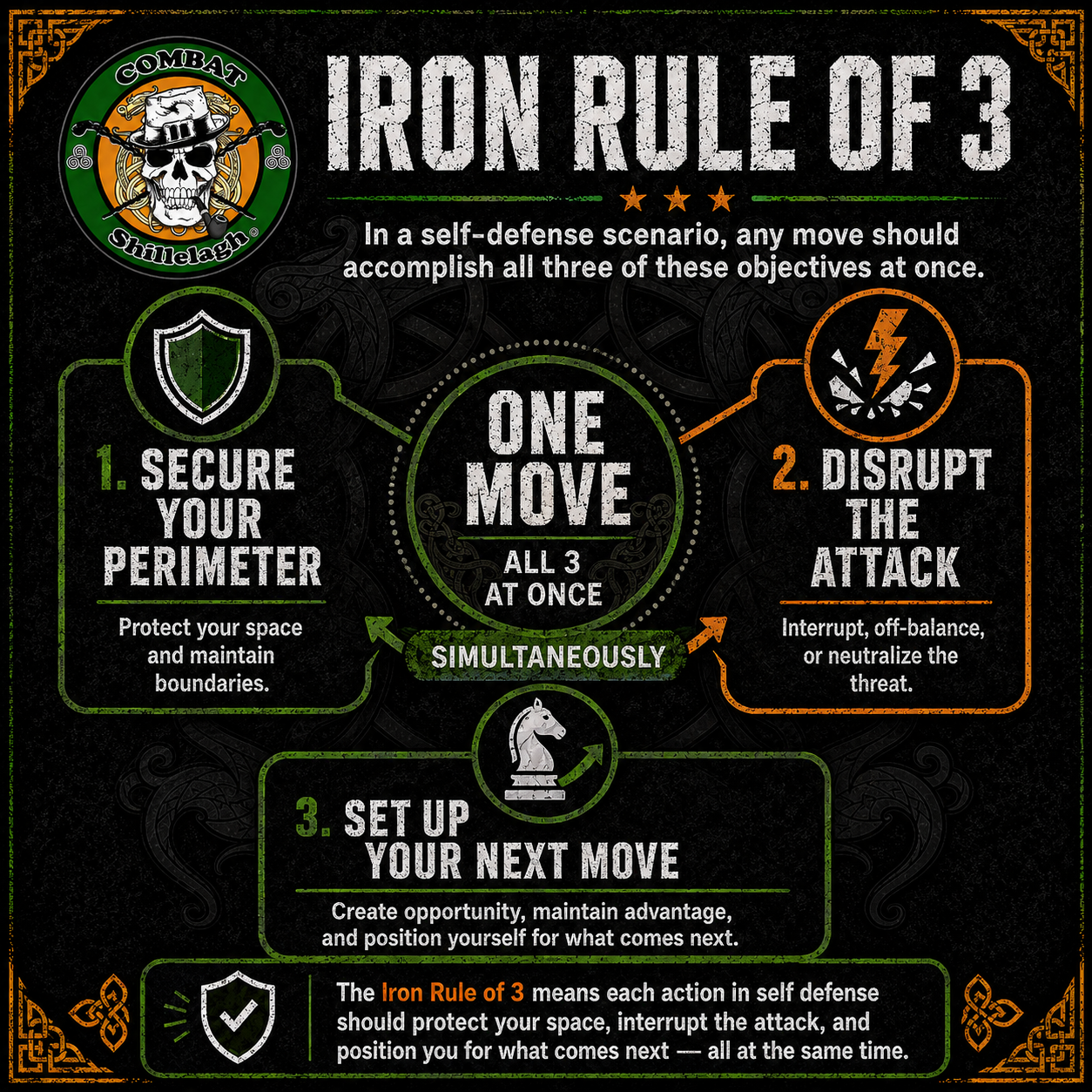
The idea is simple: in a self-defense scenario, every action you take should accomplish three things at the same time.
Secure your perimeter.
Disrupt the attack.
Set up your next move.
Not one of those things. All three.
The first objective is to secure your perimeter. This means protecting your space, your structure, and your boundaries. If someone is trying to crash into you, grab you, strike you, or overwhelm you, your movement should help protect the line between you and the threat.
This could mean moving your body off the line of attack, creating distance, putting your hands or shillelagh between you and the attacker, protecting your head, or preventing the attacker from getting to your back, your weapon, or someone you are responsible for protecting.
Your perimeter is not just personal space. It is your survival space.
The second objective is to disrupt the attack. It is not enough to simply cover up and hope the attack ends. You need to interrupt the attacker’s ability to continue harming you.
That disruption may come from striking, checking, blocking, angling, off-balancing, jamming their movement, controlling their weapon arm, creating pain, damaging their structure, or forcing them to reset mentally and physically.
This ties directly into the O.O.D.A. Loop. If the attacker is observing, orienting, deciding, and acting, your job is to interrupt that cycle. Make them deal with a new problem. Make them reorient. Make them lose timing, balance, confidence, or access.
In other words, do not just survive their action. Break their ability to keep acting.
The third objective is to set up your next move.
This is where many people get stuck. They think of self-defense as a single technique: block the punch, throw the strike, make the escape. But real encounters unfold in motion. One action leads to the next. Your first move should put you in a better position for whatever happens afterward.
Can you escape? Can you create distance? Can you move toward safety? Can you access your shillelagh? Can you protect a loved one? Can you control the attacker long enough to get away? Can you improve your angle while making their angle worse?
A good defensive action should not leave you standing still, squared up, and waiting to see what happens next. It should move you toward advantage.
In Combat Shillelagh training, this principle is especially important. The shillelagh gives us reach, leverage, structure, and impact, but the tool is only as useful as the movement and decision-making behind it. A strike should not just be a strike. It should protect your space, interrupt the threat, and position you for the next necessary action.
That is the power of the Iron Rule of 3.
It forces you to stop thinking in isolated techniques and start thinking in tactical movement. Every step, angle, strike, check, block, or escape should do more than one job.
Secure your perimeter.
Disrupt the attack.
Set up your next move.
When you train this way, your movements become more efficient. Your decisions become cleaner. Your actions become harder for the attacker to read and easier for you to build upon.
The goal is not to trade blows.
The goal is to protect yourself, break the attack, and create a path to safety.
One move. Three purposes. All at once.