The O.O.D.A. Loop is one of the most useful ways to understand how people process danger under pressure.
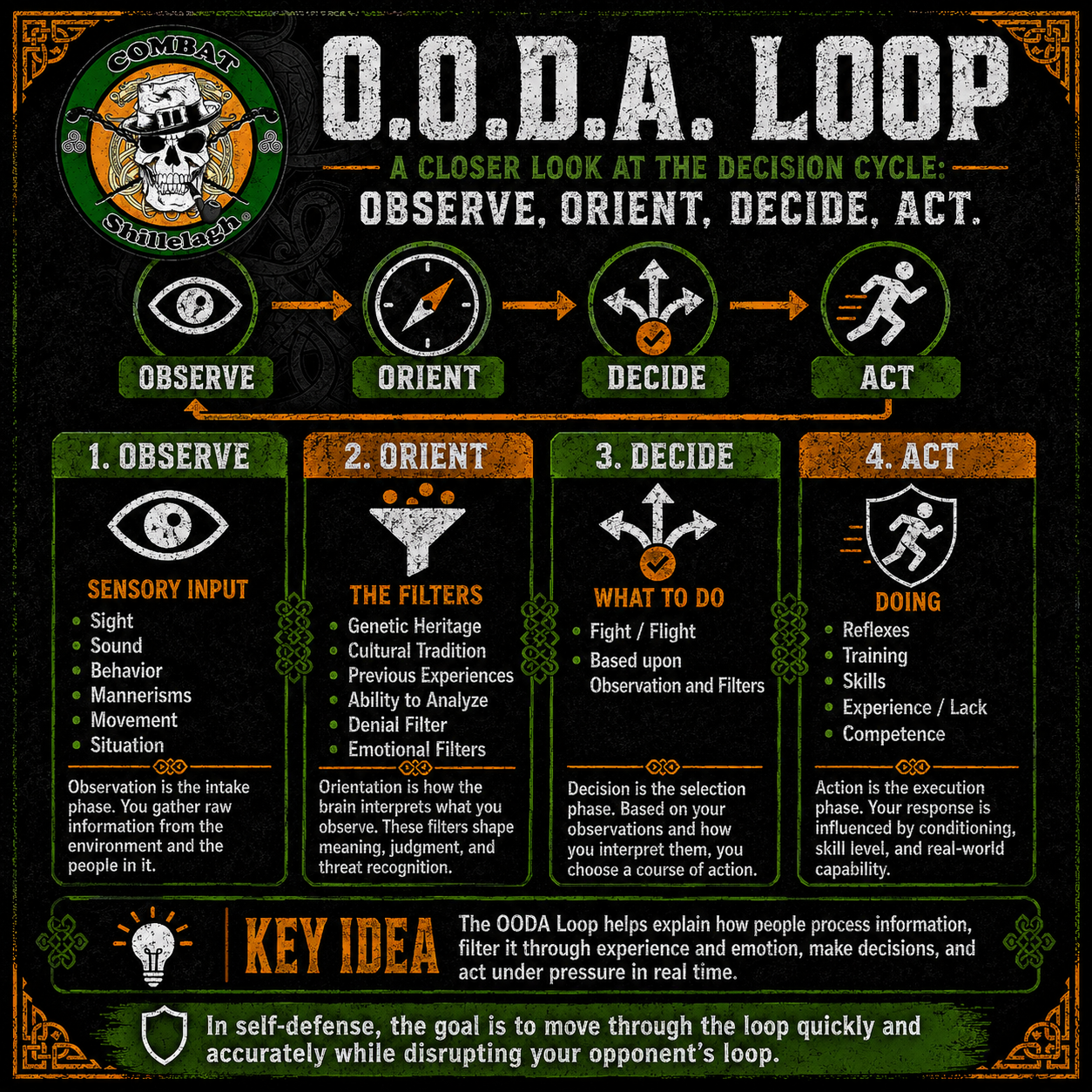
O.O.D.A. stands for Observe, Orient, Decide, and Act. In simple terms, it describes how your brain takes in information, filters it, chooses a response, and then executes that response. In self-defense, that process is happening constantly and often under stress, fear, confusion, and time pressure.
The first stage is Observe.
Observation is the intake phase. You are gathering information from the world around you. What do you see? What do you hear? How is the person moving? Where are their hands? Are they closing distance? Are they alone or with a group? Is the environment crowded, isolated, dark, loud, or chaotic?
Observation is not just “looking.” It is noticing movement, behavior, mannerisms, distance, tone, posture, and changes in the situation. The more clearly you observe, the more useful information you give your brain to work with.
The second stage is Orient.
This is where things get more complicated. Orientation is how your brain interprets what you observed. You do not process information in a vacuum. You filter it through your previous experiences, cultural expectations, training, emotional state, assumptions, and even denial.
That last one matters.
People often see danger and then explain it away. “He is probably just being friendly.” “I do not want to overreact.” “Maybe I am being rude.” “This probably is not a big deal.”
Those filters can slow your response. They can also distort the meaning of what you are seeing. In a self-defense context, learning to orient accurately is critical. You need to ask, “Does this behavior make sense in this context?” A stranger standing close at a concert is one thing. A stranger standing close in an empty parking garage is something else entirely.
The third stage is Decide.
Once you have observed and oriented, you choose what to do. That choice may be to leave, speak, set a boundary, move toward people, create distance, prepare to defend, or physically act. Sometimes the decision is to do nothing because the situation does not require action. But doing nothing is still a decision.
The quality of your decision depends on the quality of your observation and orientation. Bad information leads to bad decisions. Clear pattern recognition leads to better decisions.
The fourth stage is Act.
Action is the execution phase. This is where training, skill, reflexes, conditioning, experience, and competence matter. Under stress, people do not rise to fantasy. They tend to fall back on what they have practiced, internalized, and can actually perform.
This is why realistic training matters. If you have never practiced moving, speaking, creating distance, using your hands, using your shillelagh, or responding under pressure, your action phase may be slow, confused, or ineffective.
The key idea is that the O.O.D.A. Loop is continuous. You act, the situation changes, and then you observe again. Your opponent is doing the same thing. In self-defense, the goal is to move through your loop quickly and accurately while disrupting the other person’s loop.
That disruption might come from movement, distance, verbal commands, changing angles, escaping, presenting resistance, or forcing them to process something unexpected.
In Combat Shillelagh training, we study self-defense through the use of the shillelagh. The stick helps us understand distance, timing, structure, movement, and response. But the larger goal is not just physical technique. It is learning to recognize danger, process information clearly, make better decisions, and act decisively when necessary.
The O.O.D.A. Loop reminds us that self-defense is not just about action.
It is about seeing clearly, interpreting accurately, deciding wisely, and acting with purpose.