
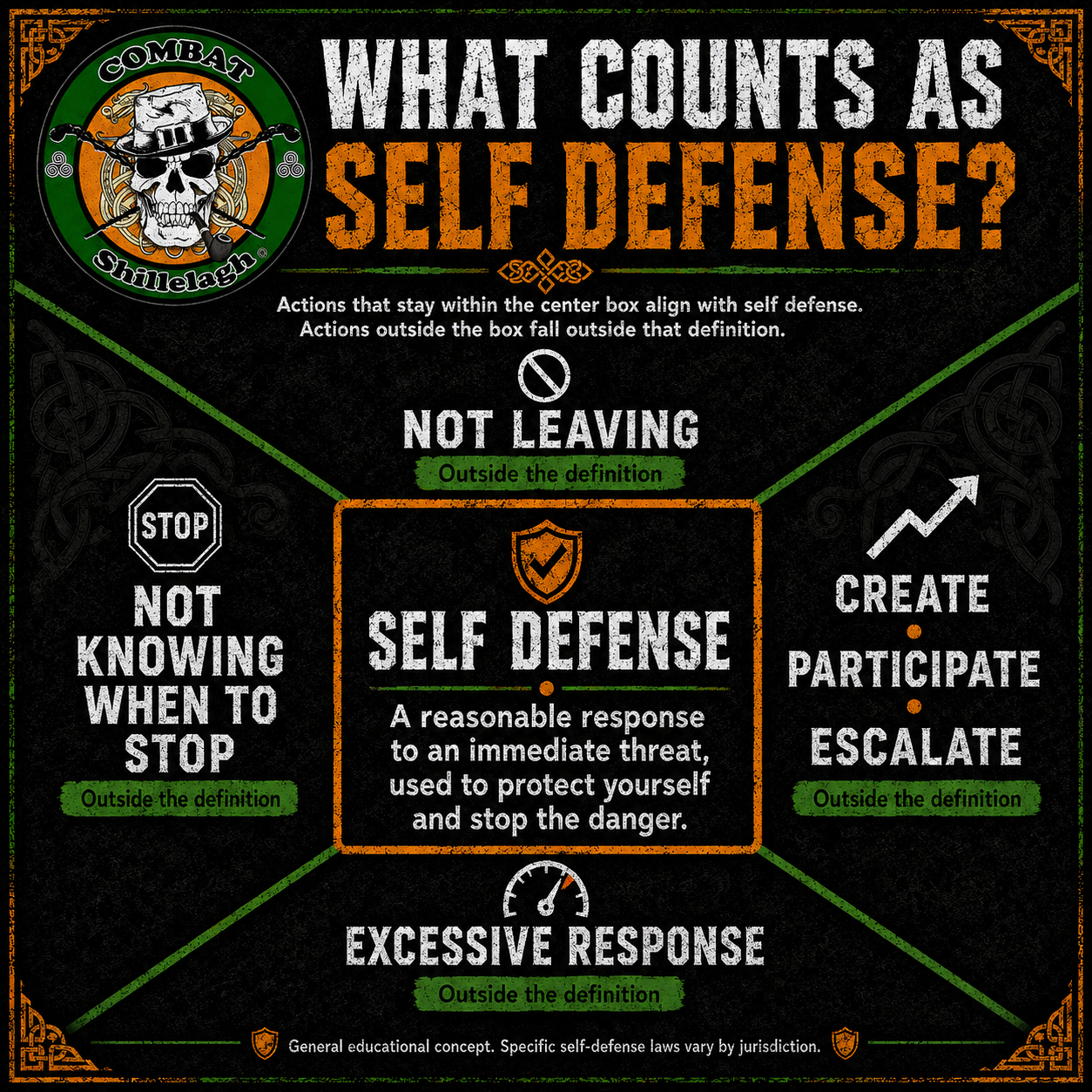
Self-defense is not just “fighting back.”
That is an important distinction. In real-world violence, and especially in the legal aftermath of violence, what matters is not simply that you were afraid, angry, insulted, challenged, or disrespected. What matters is whether your actions were a reasonable response to an immediate threat, used to protect yourself and stop the danger.
That is the center box.
Self-defense is about stopping a threat. Once the threat stops, your justification for using force changes.
This is where many people get into trouble. When adrenaline hits, emotions spike. Fear turns into anger. Anger turns into punishment. The person who started as the victim can cross a very thin line and become the aggressor in the eyes of witnesses, police, prosecutors, or a jury.
One of the biggest mistakes is not knowing when to stop.
If someone attacks you and you defend yourself long enough to create space, escape, or stop the immediate danger, that may fit within the concept of self-defense. But if the other person is down, retreating, disabled, no longer attacking, or no longer presenting an immediate threat, continuing to strike them may no longer be self-defense. At that point, it can become retaliation.
Another major issue is not leaving.
If you have a safe opportunity to exit before the situation becomes physical, take it. Leaving is not cowardice. Leaving is often the smartest self-defense decision available. If you stay to argue, prove a point, protect your ego, or “see what happens,” you may be moving from self-defense into participation.
That connects to the next point: creating, participating in, or escalating the situation.
If you help build the conflict, keep the argument alive, challenge the other person, follow them, insult them, dare them to act, or re-enter a situation you could have left, your self-defense claim becomes much weaker. Real self-defense is not about winning a dominance contest. It is about protecting yourself from danger you did not choose and could not reasonably avoid.
The final issue is excessive response.
Your response must make sense in relation to the threat. If someone shoves you and you respond with extreme force far beyond what is necessary to stop the danger, that may fall outside self-defense. Force must be tied to necessity, immediacy, and proportionality. The goal is to stop the threat, not punish the person.
This is why the mindset of “assess, plan, act” matters.
Even in a chaotic encounter, you must keep assessing. Is the person still a threat? Can I leave? Can I create distance? Can I de-escalate? Do I need to continue defending myself? Has the danger stopped? Is there a safer option now?
In Combat Shillelagh training, we study self-defense through the use of the shillelagh. But the stick is only one part of the larger picture. We also need to understand judgment, restraint, avoidance, and the legal and moral boundaries around force.
The goal is not to become violent.
The goal is to stay safe, protect yourself when necessary, and stop as soon as the danger has ended.
Self-defense is not revenge. It is not ego. It is not punishment.
It is a reasonable response to an immediate threat, used to protect yourself and stop the danger.