
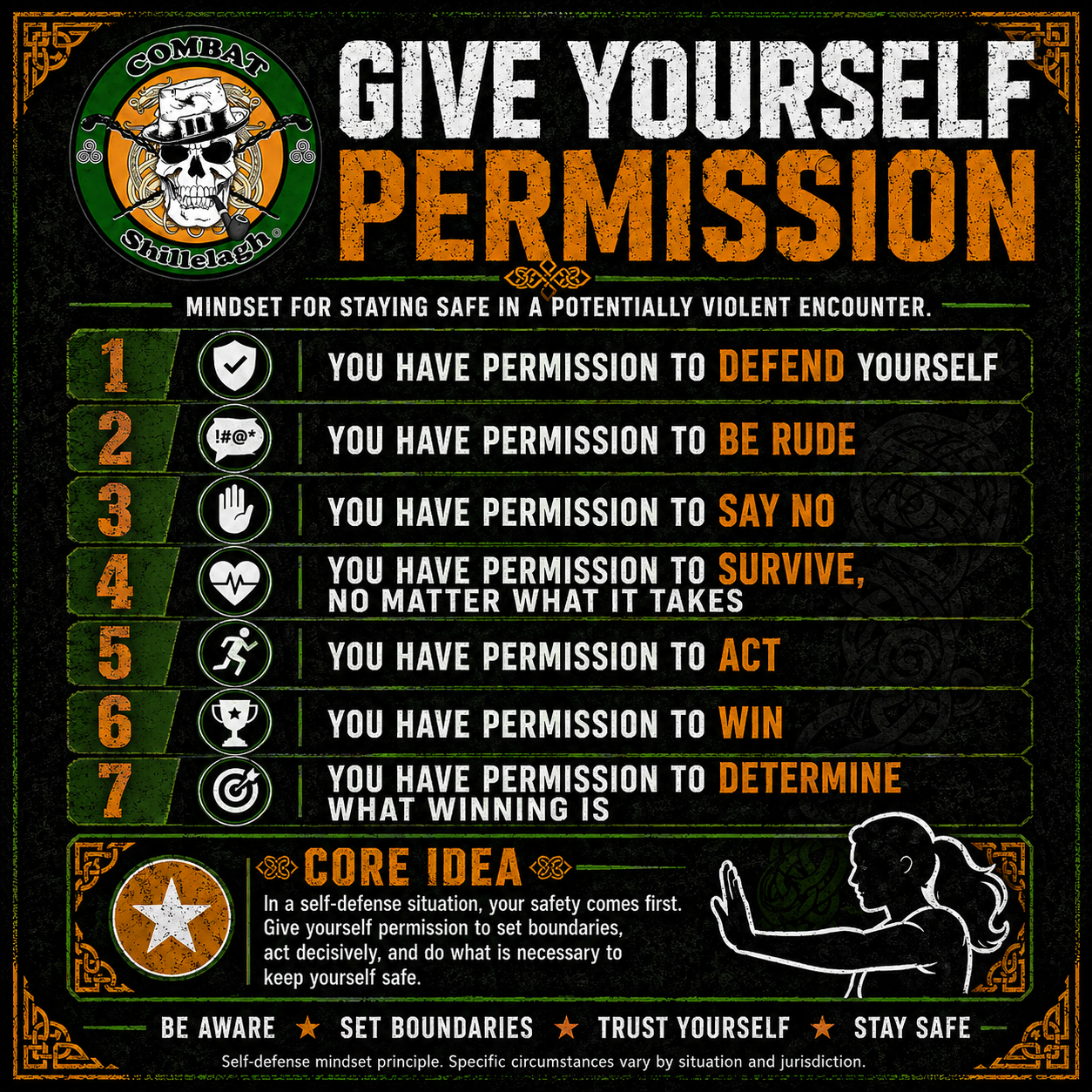
One of the hardest parts of self-defense is not learning how to strike, move, block, escape, or use a weapon.
One of the hardest parts is giving yourself permission to act.
Most of us are raised to be polite. We are taught to be patient, reasonable, respectful, and forgiving. In normal society, those qualities are useful. They help people cooperate. They keep everyday disagreements from turning into fights. They make civilized life possible.
But there is a point where normal social rules stop applying.
When someone is testing your boundaries, threatening your safety, isolating you, cornering you, or preparing to harm you, your first obligation is not to be polite. Your first obligation is to survive.
You have permission to defend yourself.
That does not mean you are looking for violence. It does not mean you want conflict. It does not mean you are eager to hurt someone. It simply means that if violence is coming to you, you are allowed to protect yourself.
You have permission to be rude.
This can be difficult for people to internalize. Predators and manipulators often use politeness as a weapon. They know many people do not want to make a scene, offend someone, or appear unreasonable. So they push. They ask again. They move closer. They ignore discomfort. They use guilt, charm, pressure, or intimidation to keep you engaged.
In that moment, being rude may be the safest thing you can do.
You have permission to say no.
No is a complete sentence. You do not owe a stranger an explanation. You do not need to justify your boundary. You do not need to apologize for not wanting to talk, not wanting help, not accepting a drink, not answering questions, not moving closer, or not going somewhere with someone.
A clear “no” sets a boundary. Holding that boundary tells the other person that you mean it.
You have permission to survive, no matter what it takes.
Real violence is not a game. It is not a movie. It may not be fair, clean, honorable, or symmetrical. If the situation becomes a true survival problem, your job is to get home. Get home to your family. Get home to your children. Get home to your spouse. Get home to the people who love you.
That may require decisive action. It may require fighting dirty. It may require doing things you would never consider in normal life. But self-defense is not about ego. It is about survival.
You also have permission to act.
You do not have to wait for someone else to approve your decision. You do not have to wait until the situation is so obvious that everyone around you agrees. If you recognize the pattern, if your boundaries are being violated, if distance is collapsing, if escape is closing, you are allowed to move, leave, shout, create space, seek help, or defend yourself.
And finally, you have permission to win.
But winning in self-defense does not always mean dominating the other person. Winning may mean leaving early. Winning may mean avoiding the argument. Winning may mean getting to your car safely. Winning may mean escaping with your children. Winning may mean using your voice before you ever need your hands.
You get to define what winning looks like.
In Combat Shillelagh training, we study self-defense through the use of the shillelagh. But the stick is only one part of the larger picture. Real self-defense also requires mindset, awareness, boundaries, and the willingness to act when action is necessary.
Your safety comes first.
Give yourself permission to set boundaries. Give yourself permission to be impolite when politeness becomes dangerous. Give yourself permission to survive.
Because when violence is coming your way, hesitation can cost you time.
And time may be exactly what you need to get home safe.