
Violence rarely comes out of nowhere.
It may feel sudden when it happens, but in many real-world encounters there are signs before the attack begins. These signs are called pre-attack indicators. They are the behavioral and positional cues that tell you a situation may be moving from words, tension, or intimidation into actual physical violence.
This is the last window before things go hands-on.
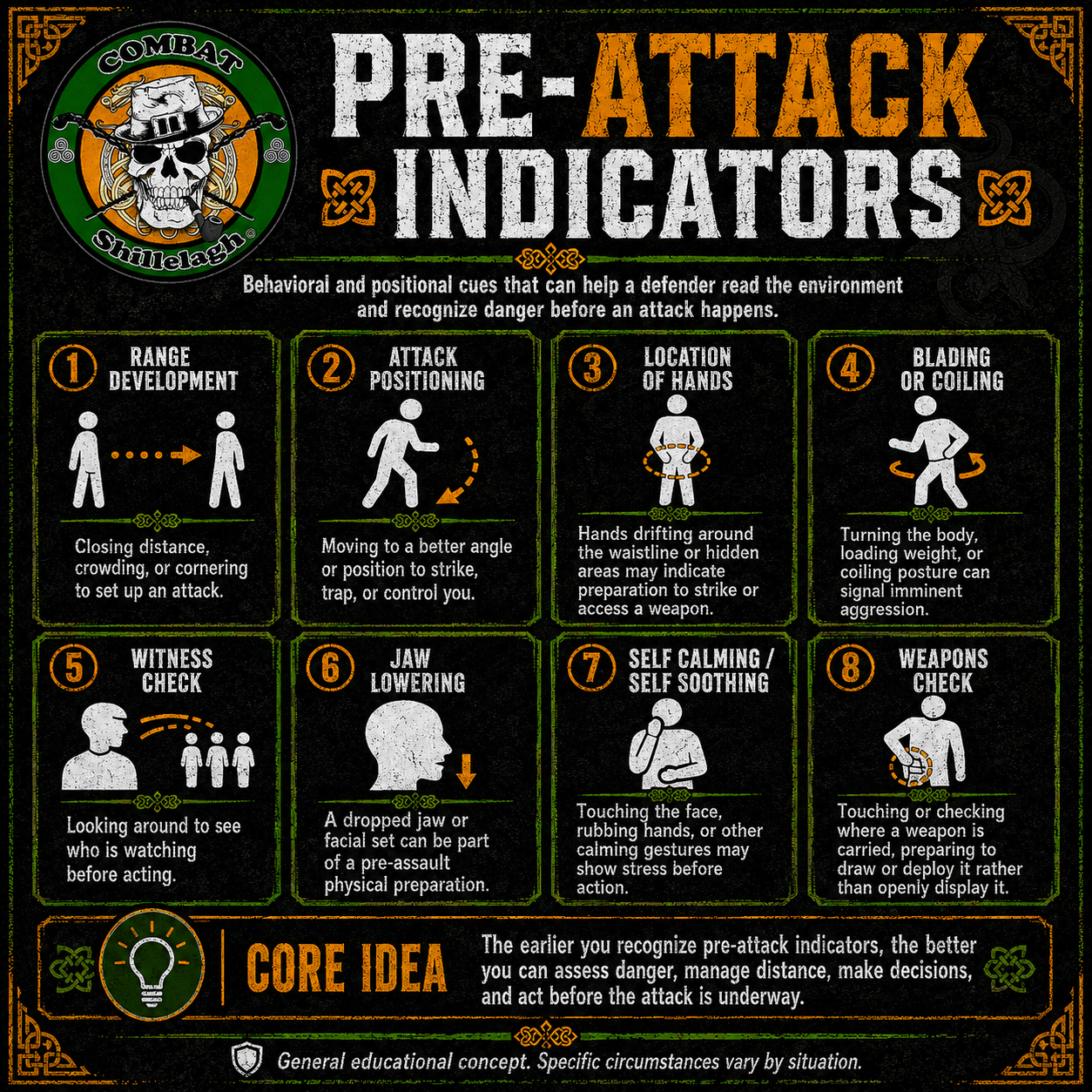
One of the biggest indicators is range development. If someone is closing distance, crowding you, cornering you, or separating you from other people, pay attention. Distance is safety. Distance gives you time to think, move, speak, escape, or prepare. When someone keeps moving into a range where they can grab you, strike you, or use a weapon effectively, that is not something to ignore.
Another major warning sign is attack positioning. People often adjust their body before they launch an attack. They may angle off, step to the side, square up, blade their body, or shift their weight. This is especially common in social violence, where a person may posture, turn partially away, or appear to disengage right before they strike.
That half-turn away can be deceptive. They may not be leaving. They may be coiling.
Coiling or blading the body can load the hips, shoulders, and hands for a punch, slash, tackle, or weapon draw. If their body position suddenly changes while their attention stays locked on you, treat that as useful information.
The hands matter most.
In law enforcement and military circles, you will often hear the phrase, “Watch the hands.” There is a reason for that. Hands can hurt you. Hands can grab, punch, stab, shoot, push, or control. If someone’s hands disappear into pockets, move toward the waistband, drift behind the back, or begin checking hidden areas of the body, you should take that seriously.
Hands near the waistline may indicate a weapon check. They may be touching, adjusting, or confirming the location of a concealed weapon. They may also be preparing to draw it without openly displaying it yet.
Other pre-attack indicators include the witness check. This is when someone looks around to see who is watching. They may be checking for cameras, witnesses, police, friends, or anyone who might interfere. That glance around can mean they are making a decision.
A lowered jaw or set face can also appear before violence. The person may be protecting their own vulnerable areas and preparing mentally and physically for impact. It is not always dramatic. Sometimes it is a subtle change in facial tension, posture, breathing, or focus.
You may also see self-calming or self-soothing behaviors. Touching the face, rubbing the hands, adjusting clothing, stroking the hair, fidgeting, pacing, or repeated gestures can indicate stress building in the body. That stress may be fear, anger, adrenaline, or the internal preparation to act.
None of these signs should be viewed in isolation. One cue does not automatically mean an attack is guaranteed. But several cues together, in the wrong context, at the wrong distance, with the wrong person, should raise your concern quickly.
In Combat Shillelagh training, we learn self-defense through the use of the shillelagh, but real self-defense is not only about the physical response. It is also about recognizing danger early enough to manage distance, create an exit, set a boundary, or prepare before the attack is underway.
Pre-attack indicators also matter after the fact. If you ever have to explain why you acted, you need to be able to describe what you saw: the closing distance, the angle change, the hand movement, the witness check, the weapon check, the body loading, and the failure to respect your boundaries.
The earlier you recognize the pattern, the more options you have.
Once the attack begins, your choices become fewer and faster. But before that moment, awareness gives you time. Time is a gift; time gives you a chance to make pre-emptive decisions. Decisions that give you a chance to avoid, interrupt, escape, or defend yourself when necessary.