
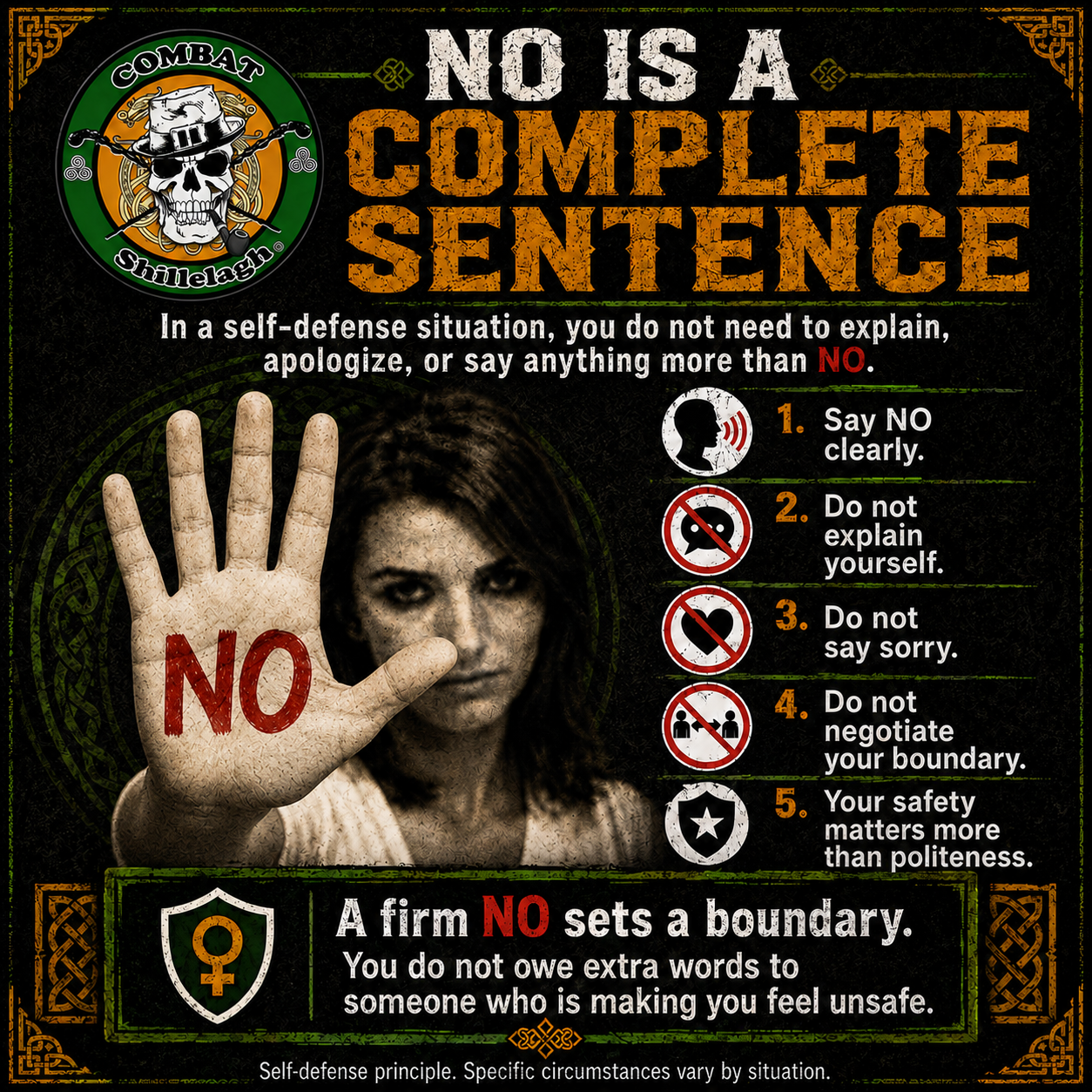
One of the most important self-defense skills is also one of the simplest:
Say no. Mean it. Hold it.
That sounds easy, but in real life, many people struggle with it. We are taught to be polite, agreeable, helpful, and reasonable. We are taught not to offend people. We are taught to explain ourselves when someone questions us. In normal social situations, that can be fine.
But in a potential self-defense situation, that social programming can become dangerous.
When someone is testing you, manipulating you, pressuring you, or making you feel unsafe, no is a complete sentence.
You do not need to explain it.
You do not need to apologize for it.
You do not need to soften it.
You do not need to negotiate it.
A firm “no” sets a boundary. What happens next tells you a lot about the other person.
A reasonable person may not like your boundary, but they will usually respect it. A predatory or controlling person may treat your “no” as the beginning of the test. They may push again. They may insult you. They may guilt you. They may step closer. They may act offended. They may try to make you feel rude, selfish, paranoid, or unreasonable.
That is the test.
They are trying to find out whether your boundary is real.
If you say no, but then stop to explain yourself, they learn they can keep you engaged. If you say no, but then apologize repeatedly, they learn you are uncomfortable enforcing your own boundary. If you say no, but then allow them to move closer, touch you, corner you, or control your movement, they learn your boundary does not hold.
In other words, they learn that your “no” can be negotiated.
That is why discounting the word no is such an important warning sign. A person who ignores a clear boundary is showing you that their desire matters more to them than your safety, comfort, or consent. That does not automatically mean violence is coming, but it does mean you should pay attention and take the situation seriously.
In self-defense, boundary setting is not just verbal. Your words, movement, posture, distance, and attention should all match.
Say no clearly. Keep moving. Create distance. Do not let them trap you in a conversation. Do not let politeness override your instincts. Do not give a stranger a debate when what you need is an exit.
This is especially important during the “interview” stage of violence, where someone may be testing whether you are a viable victim. They may want to know if you can be manipulated by guilt, controlled through social pressure, or pushed into compliance. A clear boundary, backed by action, can help communicate that you are not an easy target.
In Combat Shillelagh training, we study self-defense through the use of the shillelagh. But real-world self-defense is not only about swinging a stick after things become physical. It is also about recognizing danger early, setting boundaries, managing distance, and avoiding unnecessary violence whenever possible.
Your safety matters more than politeness. That can be hard to internalize, but it is critical. You are allowed to be rude to someone who is making you feel unsafe. You are allowed to walk away. You are allowed to refuse. You are allowed to stop explaining.
A firm “no” is not disrespectful. It is a boundary.
And in the right moment, that boundary may be what gives you the time, distance, and clarity you need to avoid violence before it begins.