
In real-world violence, words matter.
Not because words always prevent violence, but because the type of language being used can tell you a lot about where you are in the encounter. One of the most useful distinctions to understand is the difference between a threat and intimidation.
They may sound similar, but they are not the same thing.
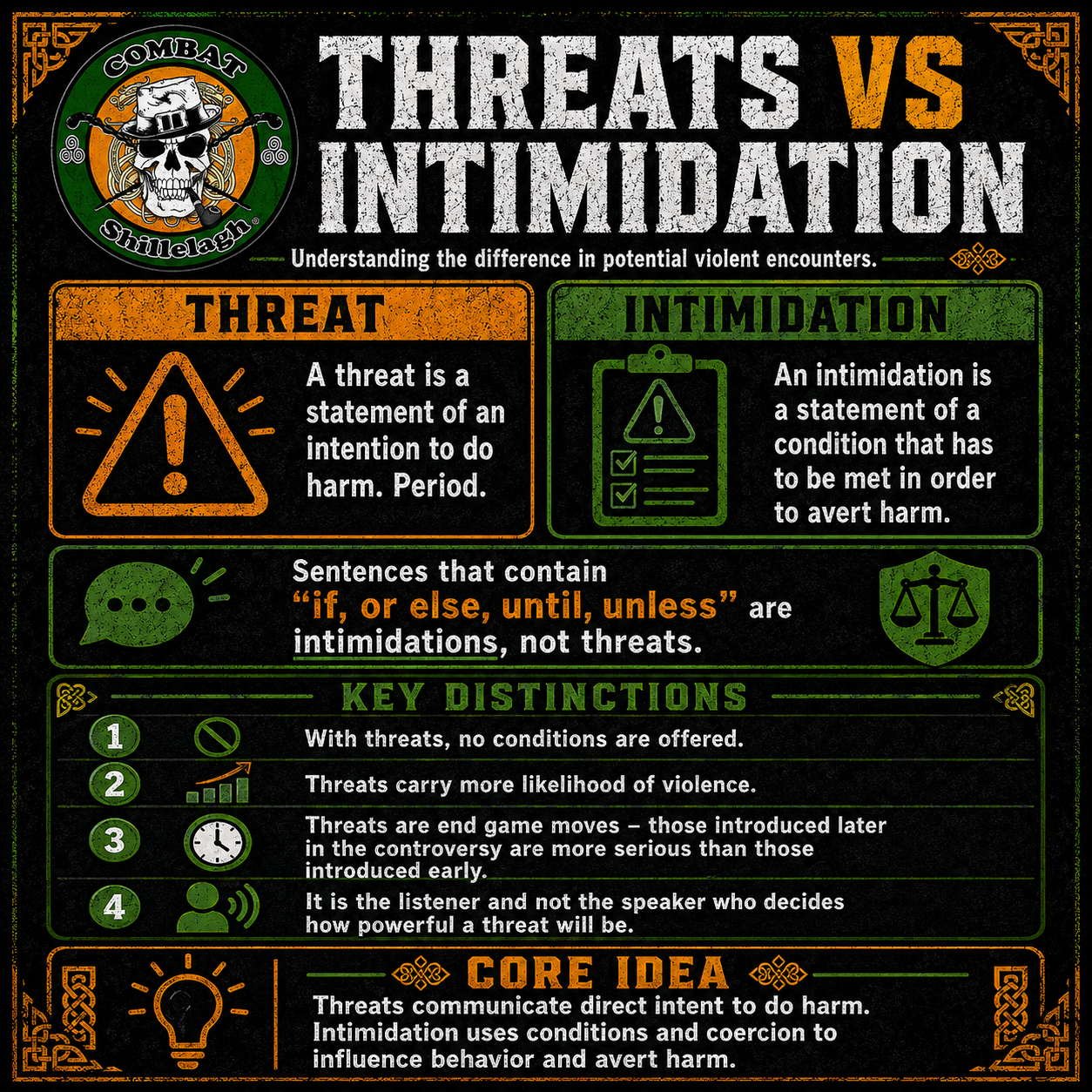
A threat is a statement of intent to do harm. Period.
“I’m going to hurt you.”
“I’m going to kill you.”
“I’m going to break your jaw.”
There are no conditions. There is no offer. There is no path being presented to avoid harm. The person is communicating direct intent. That does not mean every threat will turn into violence, but it does mean the language has moved into a more serious category.
An intimidation, on the other hand, is a statement of a condition that must be met in order to avoid harm.
“If you don’t give me your wallet, I’ll hurt you.”
“Back off, or else.”
“Unless you shut your mouth, you’re going to regret it.”
“Until you apologize, this isn’t over.”
Sentences that contain words like if, or else, until, or unless are usually intimidations, not threats. The person is trying to influence behavior through fear. They are using the possibility of harm as leverage to make you comply, retreat, submit, explain yourself, or change your conduct.
That distinction matters because it helps you understand what the other person may be trying to accomplish.
Intimidation is often about control. The person is attempting to create a behavioral outcome. They want you to do something, stop doing something, give them something, or accept their authority in the moment.
A threat is different. A threat is closer to an end-game move. It is more direct, more final, and often more dangerous, especially when it appears later in the encounter after emotions, positioning, and conflict have already escalated.
This is why timing matters.
A loud, vague intimidation early in a disagreement may be posturing. It may still be dangerous, but it is often part of the negotiation of dominance. A direct threat introduced later, after the person has closed distance, cut off your exit, or failed to control you through intimidation, should be taken much more seriously.
Threats tend to carry a higher likelihood of violence because they communicate intent without giving conditions. The person is no longer saying, “Do this so harm does not happen.” They are saying, “Harm is what I intend.”
But here is another key point: the listener, not the speaker, decides how powerful a threat is.
A person may think they are “just talking.” They may later claim they were only angry, only joking, or only trying to scare you. That does not matter in the moment. You are the one who has to evaluate the danger. You are the one who has to decide whether distance, escape, verbal boundary-setting, de-escalation, or physical defense is required.
In Combat Shillelagh training, we study self-defense through the use of the shillelagh, but the stick is only part of the larger picture. Real self-defense also requires understanding the behavior, language, and escalation patterns that happen before things go hands-on.
The goal is not to become paranoid. The goal is to become more accurate.
When you can recognize the difference between intimidation and a true threat, you gain better information. Better information leads to better decisions. Better decisions give you more time, more options, and a greater chance of avoiding violence before it starts.
Why This Matters in Combat Shillelagh Training
In the Combat Shillelagh system, we are learning self-defense through the use of the shillelagh. The stick gives us structure, range, leverage, and a practical training method for protecting ourselves. But the weapon is only one part of the larger self-defense picture.
Real self-defense is not just about what you do once things go hands-on. It is also about understanding how violence actually develops in the real world. If you can recognize predatory intent, identify the interview process, and disrupt dangerous positioning, you may be able to avoid the physical encounter entirely.
That matters because the best defensive outcome is not winning a fight. The best outcome is never having to fight in the first place.
So while we train the shillelagh seriously, we also want students to understand the behavior, timing, and warning signs that often come before violence. The more clearly you understand the pattern, the better prepared you are to mitigate risk, create distance, set boundaries, escape, and make better decisions before the situation ever becomes physical.