One of the biggest misunderstandings about Irish stick fighting is the idea that there was a single, unified, standardized style of Irish Stick Fighting, the traditional martial art practiced with the shillelagh. Many people imagine an old-school Irish “dojo” where every man in the village learned the exact same stances, grips, and techniques. But that couldn’t be further from the truth. The belief that there was only one style of shillelagh fighting is not only incorrect; it erases the rich diversity and local flavor that made Irish Stick Fighting such a fascinating, adaptable art.
Historically, Irish stick fighting was not taught in formal schools or systems. There were no uniforms, ranking belts, or centralized curriculums. Instead, the art was passed down informally within families and small communities. A father or uncle would teach the younger generation the techniques he learned in his youth, and those techniques often differed depending on region, clan, or personal experience. These private lineages created multiple micro-styles of Irish Stick Fighting. Each one legitimate, each one rooted in lived combat experience.
For example, some families favored holding the shillelagh with the short end forward, giving the user fast jabs, deceptive feints, and the ability to strike quickly with either end of the stick. Other families preferred the long-end-forward grip, emphasizing extended reach, powerful downward strikes, and a rhythm closer to staff fighting. Some lineages were heavy on “binding,” the practice of sliding, locking, or trapping the opponent’s stick through pressure. Others focused more on footwork, evasive angling, and counterstriking. Some families favored single handed grips or double handed grips. And there were lineages that utilized single stick or double stick, etc. There were also strong undercurrents of “collar and elbow” skills. In essence, Irish stick fighting developed like language dialects, local, adaptive, and deeply tied to family identity and the unique needs of applying it.
These variations were not contradictions, they were expressions of the same martial foundation, shaped by generations of unique encounters and environments. A community that faced frequent inter-faction skirmishes might emphasize one set of tactics. A family that traveled regularly might prefer defensive techniques for self-preservation on the road. A region with thicker, knotty blackthorn might use guards and strikes adapted to the natural weight distribution of their local sticks. The diversity was not a flaw; it was a strength.
So where did the myth of “one style” come from? It largely stems from modern expectations of martial arts. Today, people are used to systems like karate, taekwondo, or judo. Arts with global standardization, codified movements, and universally recognized ranking structures. Irish Stick Fighting never developed that way. It wasn’t meant to. Instead, it grew organically from real-life use, which means multiple styles coexisted side by side. Additionally, because so much of the art was practiced privately, the general public lacked visibility into these variations, leading many to assume the art was singular.
The modern revival of Irish stick fighting has helped debunk this myth, and modern-day combative programs like Combat Shillelagh embrace the historical truth: there was no single “correct” style.
Today there are several schools of Shillelagh Irish Stick Fighting, each with it’s own unique properties and value.
Combat Shillelagh draws from verified historical sources, personal experience, 37+ years of martial expertise in staff and blade arts, and practical combative principles to create a modern Irish Stick Fighting system that honors tradition while remaining functional for today’s needs. Our system contains a vast treasure trove of concepts and applications utilizing the shillelagh, cudgel, blade and empty hand techniques you simply will not find anywhere else.
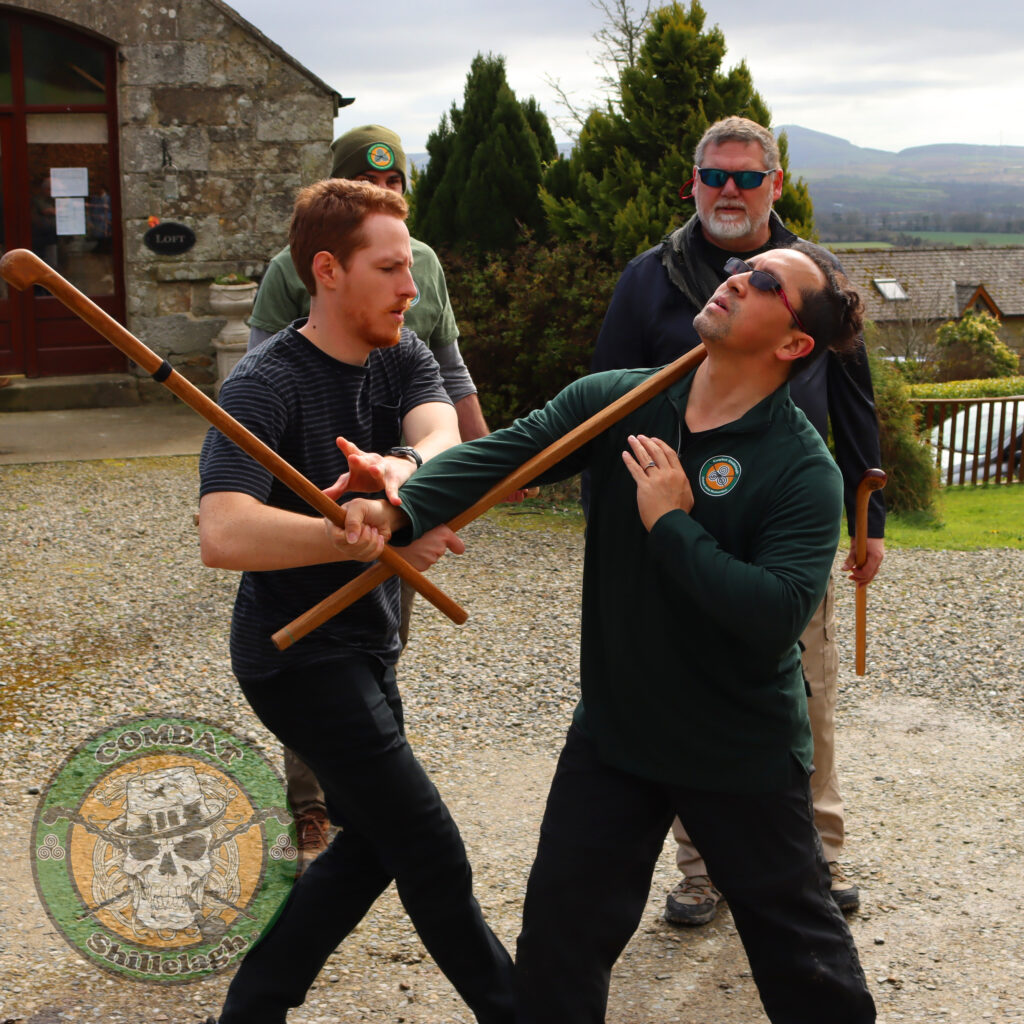
Students learn grips, guards, footwork patterns, body manipulations and striking & blocking mechanics that reflect the essence of Irish Stick Fighting rather than a rigid reconstruction of a single lineage. This allows the system to stay authentic to core self-defense principles without being restricted. By acknowledging and preserving the diversity of Irish stick fighting, the Combat Shillelagh program helps practitioners appreciate the real history, not a simplified myth. The beauty of Irish Stick Fighting is that it evolved through lived experience, not through rigid codification. Recognizing that history enriches the art and ensures it remains a dynamic martial tradition today.