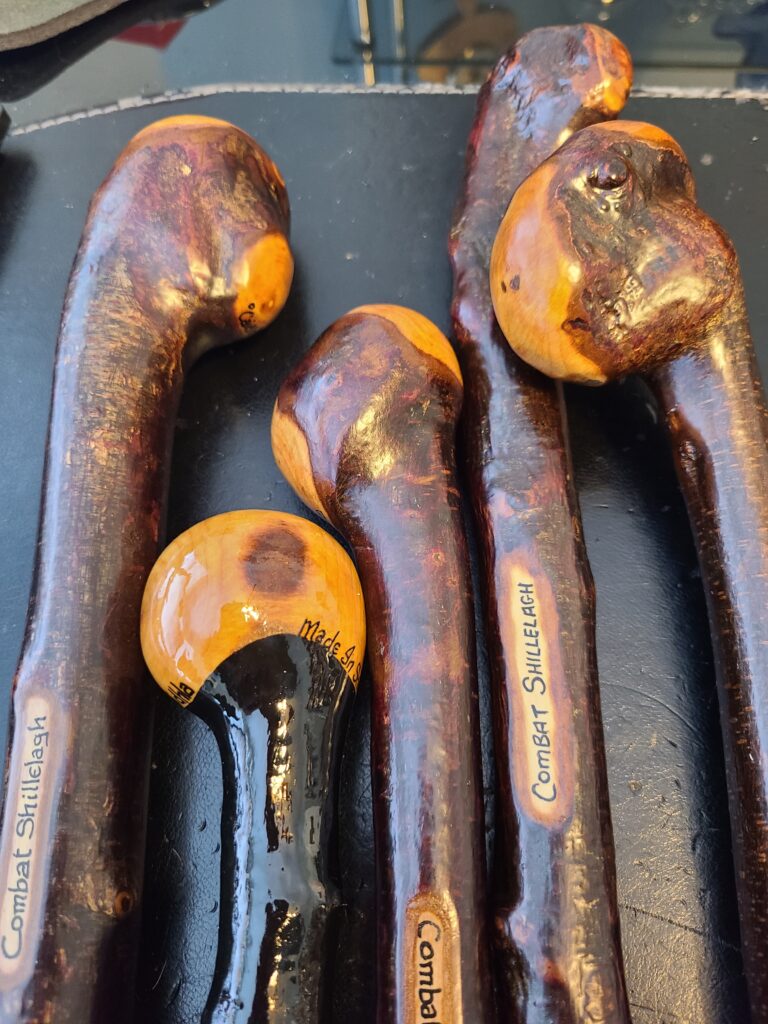
When most people imagine a shillelagh, they picture the same thing: a glossy black stick made from Irish blackthorn. The word itself conjures images of thorny hedgerows, rugged Irish countryside, and the famous dark-barked cudgel that has become almost synonymous with the weapon. And while blackthorn absolutely deserves its legendary status, the notion that shillelaghs were always made from blackthorn is one of the most widespread misunderstandings about the weapon.
In reality, blackthorn was only one of several woods historically used to make shillelaghs. It became dominant because of a perfect combination of availability, density, durability, and ease of crafting, but it was far from the only option. Plenty of Irish fighters, travelers, and families crafted sticks from whatever hardwoods grew naturally in their region. The idea that blackthorn was the universal material simply doesn’t reflect the true diversity of historical shillelaghs.
To understand this myth, it helps to consider the geography and ecology of Ireland. Blackthorn grows abundantly in many parts of the countryside, forming dense hedgerows that were ideal for both agriculture and natural fencing. Because it was everywhere, people could easily find suitable branches with minimal travel. But even then, not every region had equally dense or mature blackthorn growth. In areas where blackthorn was scarce or where people preferred a different feel, oak, holly, ash, and hazel were commonly used alternatives. Each of these woods offered unique properties that shaped the style and feel of the shillelagh.
Oak, for example, is one of the hardest and strongest woods available in Ireland. An oak shillelagh tends to feel solid, slightly heavier, and built like a battering ram. It was ideal for fighters with a powerful striking style or for those who wanted a stick that could double as a robust walking staff. Ash, on the other hand, was prized for its natural springiness and shock absorption. It made lighter, faster sticks that were excellent for rapid striking and precise defensive motions, qualities that paired well with certain family lineages of Irish Stick Fighting.
Holly provided an entirely different aesthetic. Its pale wood, fine grain, and surprising hardness made it a favorite for those who wanted something both functional and visually striking. Holly shillelaghs were often prized objects “Sunday sticks” but they could absolutely be used in combat. Hazel, meanwhile, was extremely common and widely accessible, producing lightweight sticks perfect for everyday carry. While not as dense as blackthorn or oak, hazel was convenient, easy to shape, and strong enough for daily use.
Beyond these familiar woods, some shillelaghs were even crafted from root-knob clubs, sticks harvested with the entire root ball intact. These heavy knobs created a natural, powerful striking end, allowing the stick to be used almost like a mace when necessary. This variation is one reason we see so many styles of shillelaghs in historical illustrations. Not all of them had the sleek, straight lines of blackthorn. Some were thicker, some shorter, some almost club-like. The weapon evolved based on what was available and what the user needed.
So why did blackthorn become the iconic symbol? The answer lies in its perfect combination of features. Blackthorn is naturally dense, shock-resistant, and extremely strong for its size. The wood has an almost fibrous quality to it that makes it uniquely flexible while maintaining strength and rigidity. It grows in twisted shapes that make for visually fascinating sticks, and its bark, dark, glossy, and covered in thorn scars, looks distinctive even from a distance. When cured and smoke-treated, blackthorn becomes exceptionally durable, often lasting generations. These qualities made it the “gold standard,” and over time, tourist markets further cemented blackthorn as the stereotypical shillelagh wood.
Yet limiting the history of the shillelagh to just blackthorn erases the ingenuity and adaptability of the Irish people who used whatever hardwood was available to craft a reliable tool. In the Combat Shillelagh training program, students learn that the weapon’s effectiveness doesn’t depend on one specific species of wood. It depends on density, balance, seasoning, and proper technique. We prefer fighting “versions” of blackthorn sticks (matte natural color with an oil rubbed finish) for several of the reasons stated above. However, many students train successfully with sticks made from oak, ash, or even modern hardwood dowels. What matters most is understanding how the shillelagh functions as a martial tool, not obsessing over a single material.
The myth persists mainly because blackthorn dominated later commercial production and became a marketing icon. But the reality is far richer and more diverse. The shillelagh was a weapon of practicality, shaped by availability, environment, and craftsmanship, not by strict adherence to one type of wood.
In truth, the Irish made shillelaghs from whatever strong hardwood they could find, and they made them well.