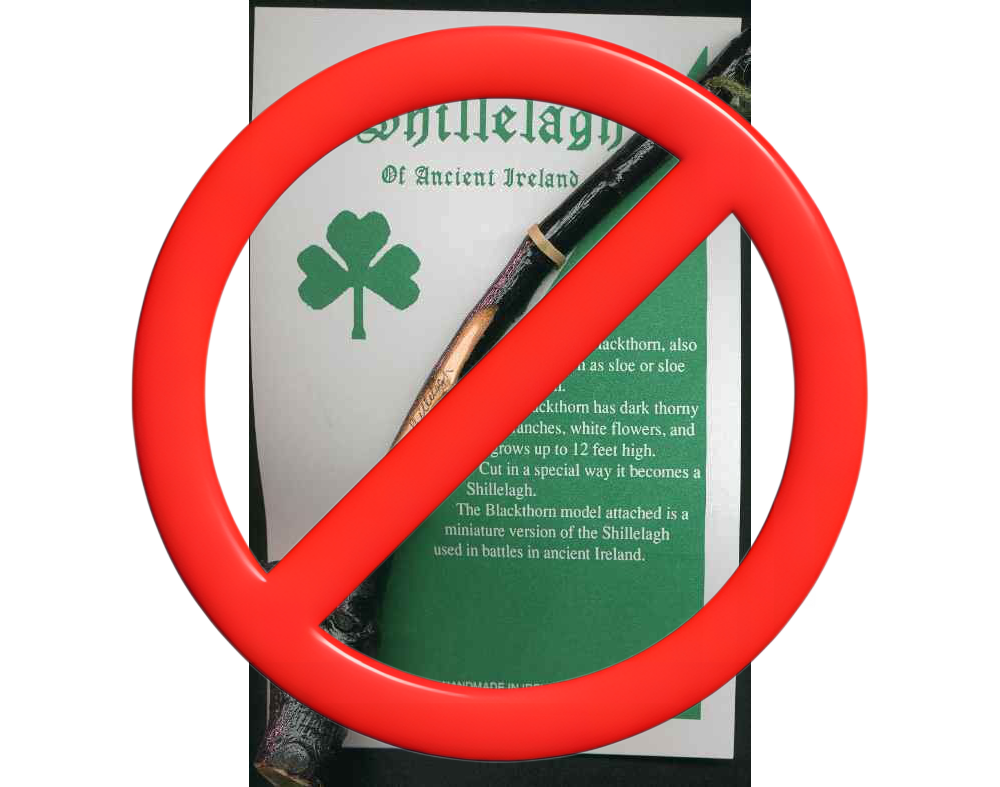
If you walk into most Irish gift shops, you’ll probably find a bundle of glossy, lightweight sticks labeled “shillelaghs.” They’re often dipped in black lacquer, decorated with stickers of shamrocks or leprechauns, and set up as fun souvenirs for tourists. And unfortunately, that’s where one of the biggest myths about the shillelagh comes from: the idea that it’s nothing more than a quirky Irish novelty item. But in reality, the shillelagh has a deep history as a functional fighting stick, and its roots go far beyond airport trinkets and souvenir shelves.
Historically, the shillelagh was a tool for both everyday life and personal protection. Irish men carried them while walking, working, traveling, and navigating rough terrain, but they also relied on them in times of danger. This wasn’t just cultural flair, it was a practical necessity in a time before modern policing, especially in rural Ireland. A solid hardwood stick was legal to carry, easy to justify, and extremely effective when used properly. While a modern souvenir shillelagh might snap the moment it hits a solid object, a genuine traditional shillelagh, crafted from seasoned blackthorn, holly, ash, or oak, was built to withstand real impact.
The myth that shillelaghs are just souvenirs often blinds people to the craftsmanship that goes into a real one. Traditional shillelagh makers spent months, and sometimes years, selecting, drying, smoking, and curing the wood. The result was a weapon that could deliver sharp jabs, powerful downward strikes, and quick, whip-like attacks using either end of the stick. It was more than a walking stick; it was a personal companion that accompanied its owner everywhere. It was as much a part of a man’s identity as his hat or coat.
This leads to another truth hidden beneath the myth: the shillelagh was not a crude or improvised stick. It was deliberately crafted through generations of knowledge, often using techniques that ensured durability and strength. The bark might be left on for protection, the wood smoked to harden it, the root ball shaped into a natural striking surface. There is an artistry behind a true shillelagh, one that souvenir versions simply don’t capture.
Another part of the myth comes from the commercialization of Irish culture. As tourism grew, lightweight softwood sticks painted black and marketed as “authentic shillelaghs” spread across the world. They were cheap, easy to produce, and visually appealing, but they lacked the structural integrity, balance, and history of the real thing. Over time, this distorted public perception. For many people, the only shillelagh they’ve ever seen is a decorative trinket, not a true combat-capable tool.
Thankfully, there’s a growing revival of interest in traditional Irish martial arts, and systems like Combat Shillelagh are bringing the real history and functionality of the shillelagh back into the spotlight. When students first hold a properly made hardwood shillelagh during training, they immediately notice the difference. The weight, the balance, the feel of seasoned wood, it all reinforces how far-removed modern souvenirs are from the weapon’s true origins.
Combat Shillelagh teaches students how to identify real hardwood sticks, how to train responsibly, and how to appreciate the weapon the way it was meant to be understood: as a long-standing part of Irish survival, culture, and martial tradition. Instead of treating the shillelagh as a novelty, the system treats it as a legitimate martial art tool, because that’s exactly what it is.
So no, the shillelagh is not “just a souvenir” at all. It’s a living piece of Irish history, a combat-tested tool, and a symbol of resilience. The myth crumbles as soon as you understand the tradition behind the stick and even more so when you learn to wield it properly.