When people first encounter Irish stick fighting, traditionally known as bataireacht, they often wonder if it is actually effective. Many modern martial arts have reputations shaped through organized sport, military programs, or fitness culture, but Irish stick fighting was born from something far more grounded: the realities of daily life, personal defense, and cultural survival. Understanding its historical roots, its real-world uses, and the unique capabilities of the blackthorn shillelagh makes the answer overwhelmingly clear. Irish stick fighting is, without question, an effective martial art both historically and today.
To appreciate its effectiveness, one must begin with Ireland’s historical landscape. From the 17th through 19th centuries, Ireland was a rugged place marked by long distances between towns, limited law enforcement, and frequent interpersonal and factional violence. People carried shillelaghs not as fashion accessories, but because life demanded it. A shillelagh served multiple roles: it was a walking companion on uneven terrain, a defensive tool when traveling, a symbol of status or adulthood, and a readily available weapon in times of danger. Irish Stick Fighting was not a sport, it evolved because people genuinely fought with these sticks, testing and refining techniques through real use. Ineffective methods simply did not survive. What was passed down through families endured precisely because it worked.
The effectiveness of Irish stick fighting carries naturally into modern self-defense. A shillelagh, or any similarly sized stick, is one of the most practical personal defense tools someone can carry today. In many places, a walking stick is perfectly legal in public, whereas other weapons may not be. Because a shillelagh extends your reach, it allows you to keep an attacker at a safe distance, which is a major advantage over empty-hand defense. It functions effectively at multiple ranges. At long range it can whip, snap, and hook; at mid-range it delivers powerful angular shots and deflections; and at close range it becomes a tool for body manipulation, joint locks, throws, jabs, wraps, and lever-based strikes. The blackthorn shillelagh in particular acts as an equalizer, giving smaller individuals a means to deter or disable stronger aggressors through timing, mechanics, and leverage rather than brute force.
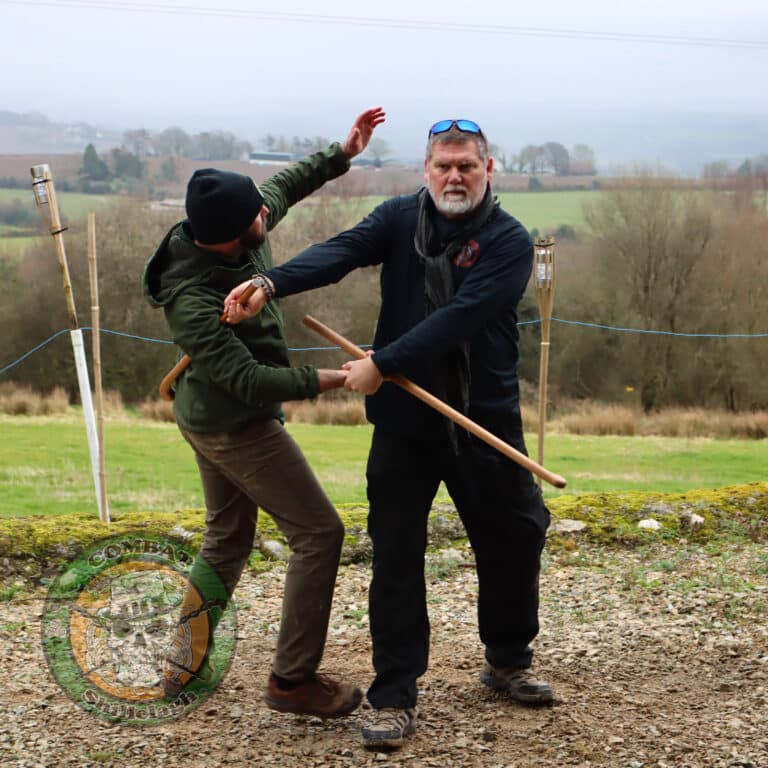
The core mechanics of Irish Stick Fighting further reinforce its practicality. Irish stick fighting uses footwork designed to create angles and avoid danger; deceptive hand positioning, including grips with the short end forward; defensive structures built around deflection and redirection; and the unique practice of binding, where sticks slide or lock against each other in controlled engagements. None of these skills rely on raw strength. They rely on timing, body alignment, and efficiency. This is one of the reasons the shillelagh has remained effective across centuries: it empowers the average person rather than requiring exceptional athleticism.
Much of the shillelagh’s effectiveness comes from the properties of blackthorn, the wood most famously associated with the weapon. Blackthorn is exceptionally dense for its size, allowing even slender sticks to deliver significant stopping power while remaining quick and maneuverable. Its thorn-scarred bark is naturally tough and moisture-resistant, which, when cured properly, becomes incredibly durable. A well-shaped root knob, although not mandatory, provides a natural striking surface for close-quarter techniques while also contributing to grip security and overall balance. Beyond its physical qualities, the blackthorn shillelagh carries a unique psychological presence. People instinctively recognize it as a serious tool with deep cultural roots, and that alone can serve as a deterrent in many encounters.
Modern training programs like Combat Shillelagh carry this tradition forward by blending historical principles with contemporary self-defense methodology. Students train footwork, guard mechanics, defensive redirection, binding, “V” trapping, striking with both ends of the weapon, and applied real-world scenarios. Training also includes conditioning and mobility work that builds coordination and functional movement patterns. What makes this system particularly effective is that anyone, regardless of age, size, or physical condition, can learn to wield the shillelagh effectively because the art relies on mechanics rather than strength. The weapon becomes an extension of the practitioner through repetition and structured progression.
So, is Irish stick fighting effective? Absolutely. It was forged through centuries of real conflict, preserved through family lineages, and now revived and enhanced in modern training systems. The combination of practical mechanics, historical necessity, and the natural advantages of the blackthorn shillelagh make it one of the most accessible and effective martial arts available today. With proper training and understanding, it becomes not only a self-defense tool but a meaningful connection to a living cultural tradition.