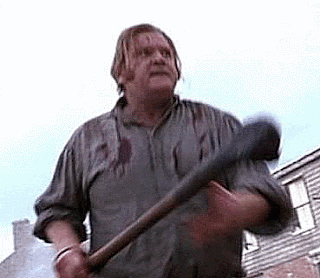
One of the most persistent myths, reinforced by cartoons, pub stories, and Hollywood stereotypes, is the idea that shillelaghs were carried only by big, burly, giant Irishmen with arms like tree trunks and tempers to match. It’s the classic image: a towering man with a barrel chest, and a heavy blackthorn stick in hand. But while this image is certainly colorful, it doesn’t line up with historical reality. The truth is much more interesting and far more inclusive: shillelaghs were used by people of all sizes, ages, and physical builds.
To understand why this myth is inaccurate, you have to look at what the shillelagh really was, a practical, everyday tool. For centuries, it served as a walking aid, traveler’s companion, defensive tool, and even a symbol of status or adulthood. You didn’t need to be a giant to carry one. Farmers, shepherds, laborers, merchants, travelers, and even older men used shillelaghs because they were simple, functional, and legal to carry at a time when other weapons might have been restricted. They were as common as pocketknives in some regions. A young man might receive his first shillelagh as a rite of passage, while a grandfather might lean on his for support during long walks.
The idea that you needed great physical strength to use a shillelagh also misunderstands the weapon’s design. Unlike heavy war clubs or oversized staffs, shillelaghs were often chosen precisely because they allowed someone of average size or strength to defend themselves effectively. The dense hardwood provided natural striking power without requiring a bodybuilder’s physique. Proper technique, not brute force, was the key to using a shillelagh effectively. A skilled practitioner could generate surprising power through hip rotation, leverage, footwork, and timing. The stick amplified the user’s ability, allowing even a smaller person to end a confrontation decisively.
Historical accounts back this up. Travelers’ journals, court records, and newspaper descriptions from the 18th and 19th centuries describe fighters of all sorts: tall, short, heavy, lean, young, old. In many cases, it was a person’s skill, rather than size that made them dangerous with a shillelagh. A well-trained fighter could break a wrist, intercept a strike, or counterattack fluidly regardless of their build. Irish stick fighting wasn’t about raw strength. It was about cleverness, timing, and adaptability.
The myth also stems from romanticized depictions of Irish fighting culture. Stories of the “big Irish bruiser” are fun, exaggerated tales that have survived through pub culture, jokes, and fictional literature. But they aren’t historically accurate representations of who actually carried or used shillelaghs. Much like any martial art, the shillelagh was a tool for ordinary people first, not caricatures.
Today, this myth can discourage potential students who believe they’re not “big enough” or “strong enough” to learn Irish stick fighting. In the Combat Shillelagh system, this misconception is one of the very first things we dispel. Students of all ages, sizes, and abilities train effectively with the weapon because the techniques favor speed, control, precision, and leverage rather than raw power. Women, older adults, and people of diverse physical backgrounds all excel in the program because the system is based on universal movement principles, not brute strength. In fact, many smaller practitioners become incredibly fast and accurate due to the lighter weight of their weapon and their ability to move fluidly.
The shillelagh was, and still is, an equalizer. It empowers average people to protect themselves, improve their coordination, and connect with a martial tradition that doesn’t require towering height or superhuman strength. Anyone can learn to use a shillelagh effectively, and that’s exactly what makes the weapon such a powerful symbol of Irish resilience and everyday practicality. So no, shillelaghs weren’t reserved for giant men. They were carried by people of all sizes because the weapon was never about stature. It was about survival, identity, and skill. And in modern training systems like Combat Shillelagh, that same truth remains: the weapon belongs to everyone, not just the mythical Irish giants of legend.