
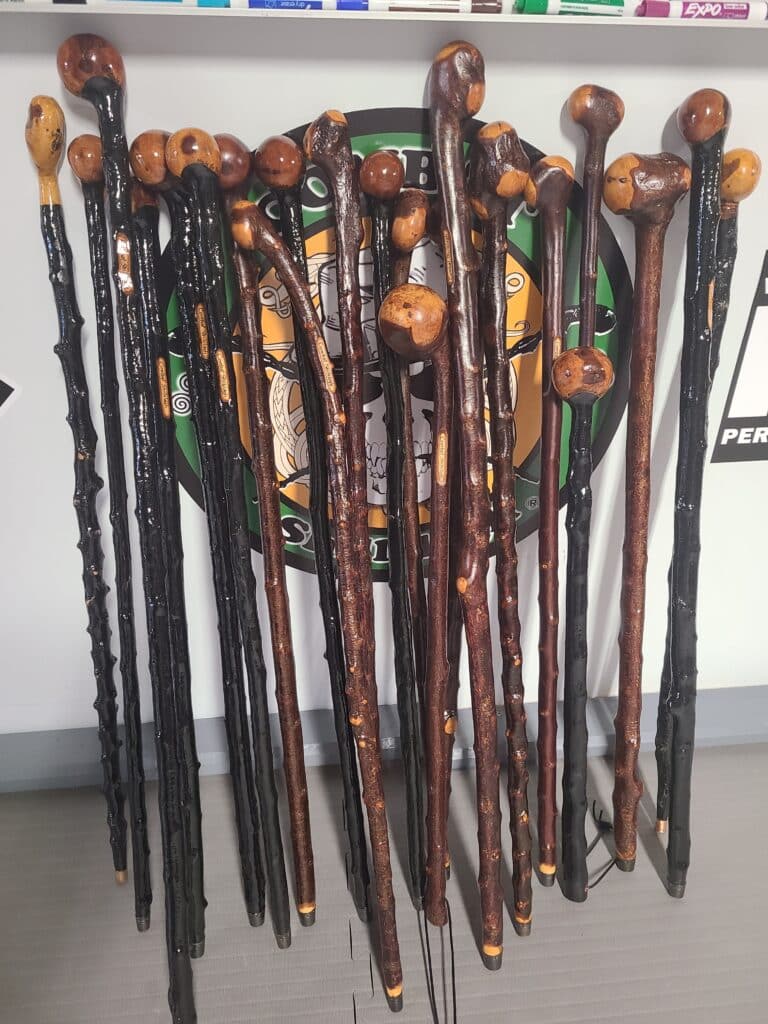
If you Google “shillelagh,” you’ll notice that almost every image shows the same thing: a walking-stick-length weapon with a large, rounded knob at the top. This image is so widespread that many people assume all shillelaghs historically looked exactly like this. But this is one of the most persistent and inaccurate myths about the weapon. The truth is that shillelaghs came in many shapes, lengths, and configurations, and not all of them had a knob at all.
The knobbed shillelagh became popular in the public imagination largely due to souvenirs and caricatures. Tourist shops love the iconic “big-knob” design because it looks dramatic and immediately recognizable. The exaggerated version, sometimes comically oversized, only reinforced the stereotype. But historically, shillelaghs had far more variation.
Yes, many traditional shillelaghs did include the root ball of the blackthorn bush (or the large portion of intersecting branches), which created a natural knob. This knob offered several practical advantages: it provided a secure grip, could serve as a powerful striking surface, and helped balance the stick. But root-ball shillelaghs were not the only type, nor necessarily the most common. Many fighters preferred sticks that were straight and uniform in thickness along their length. Others used shorter cudgel-like sticks without pronounced knobs. Some shillelaghs had only a subtle flare at the top, barely noticeable unless you examined the wood closely.
Regional vegetation also influenced variation. Not all areas had abundant blackthorn, especially outside Ireland. Families in regions rich in holly, ash, or oak often produced sticks without root knobs simply because those species didn’t grow in a way that created them naturally. The lack of a knob didn’t compromise the weapon’s functionality. In fact, for certain grips, guards, and fighting techniques, a non-knobbed shillelagh could actually be preferable. It allowed for cleaner sliding motions, smoother two-ended striking, and easier handling for fighters who preferred mid-shaft grips.
The notion that “all real shillelaghs have big knobs” also ignores the diverse uses of the weapon. A shorter shillelagh used in close-quarter fighting might only be 18 to 24 inches long, with little or no knob. These shorter sticks were often carried inside jackets or belts. Meanwhile, longer sticks, similar to walking staffs, might include more pronounced knobs simply due to the nature of how the wood was harvested. But again, there was no universal template.
In modern times, the popularity of knobbed shillelaghs grew because of their dramatic appearance and easy marketability. Souvenir makers leaned heavily into the stereotype, creating mass-produced versions with identical knobs, often painted or resin-coated rather than seasoned through traditional methods. These decorative versions misled people into thinking the knob was the defining feature of the shillelagh.
Combat Shillelagh works to correct this misunderstanding by teaching students the full spectrum of applications of Irish Stick Fighting techniques with the shillelagh. What matters most is durability, balance, density, and practicality for the intended techniques. Many Combat Shillelagh students train with sticks that have only small flares or small knobs, and they perform exceptionally well. The program emphasizes function over aesthetics, helping practitioners understand how to choose a shillelagh suited to their personal grip, style, and training needs.
So, while the knobbed shillelagh is certainly one legitimate form, and a beautiful one, the idea that every shillelagh had a big knob is a myth rooted in marketing, not history. The truth is far more diverse, and once you understand that you gain a deeper appreciation for the weapon’s practicality and cultural evolution.